Is the AI Industry Really Ready to Slow Down? The Gap Between Executive Rhetoric and Reality

AI leaders talk about slowing down, but the gap between their words and actions tells a more complicated story.
Prompted by a discussion on the tech podcast Equity, this article unpacks the real logic behind the AI industry's "slowdown" narrative. The term itself is strategically vague — covering everything from reduced model iteration to regulatory buffer time — giving companies room to appear cautious without actually decelerating. Given the intense competition for capital, compute, and talent, unilateral slowdowns amount to surrendering market share, making genuine coordinated restraint nearly impossible. More tellingly, public calls for caution often serve strategic ends: leaders with market advantages push for slowdowns to entrench them, while challengers quietly accelerate. The article concludes that R&D spending, product cadence, and openness to binding regulation are far more reliable signals than executive statements alone.
What AI Executives Actually Mean by "Slowing Down"
In a recent episode of the tech podcast Equity, the hosts tackled a genuinely contentious question: do AI industry leaders actually mean it when they talk about slowing down the pace of development? On the surface, a growing number of industry figures have begun speaking publicly about safety, regulation, and "responsible AI" — but when you examine these statements against the backdrop of fierce market competition, things get considerably more complicated.
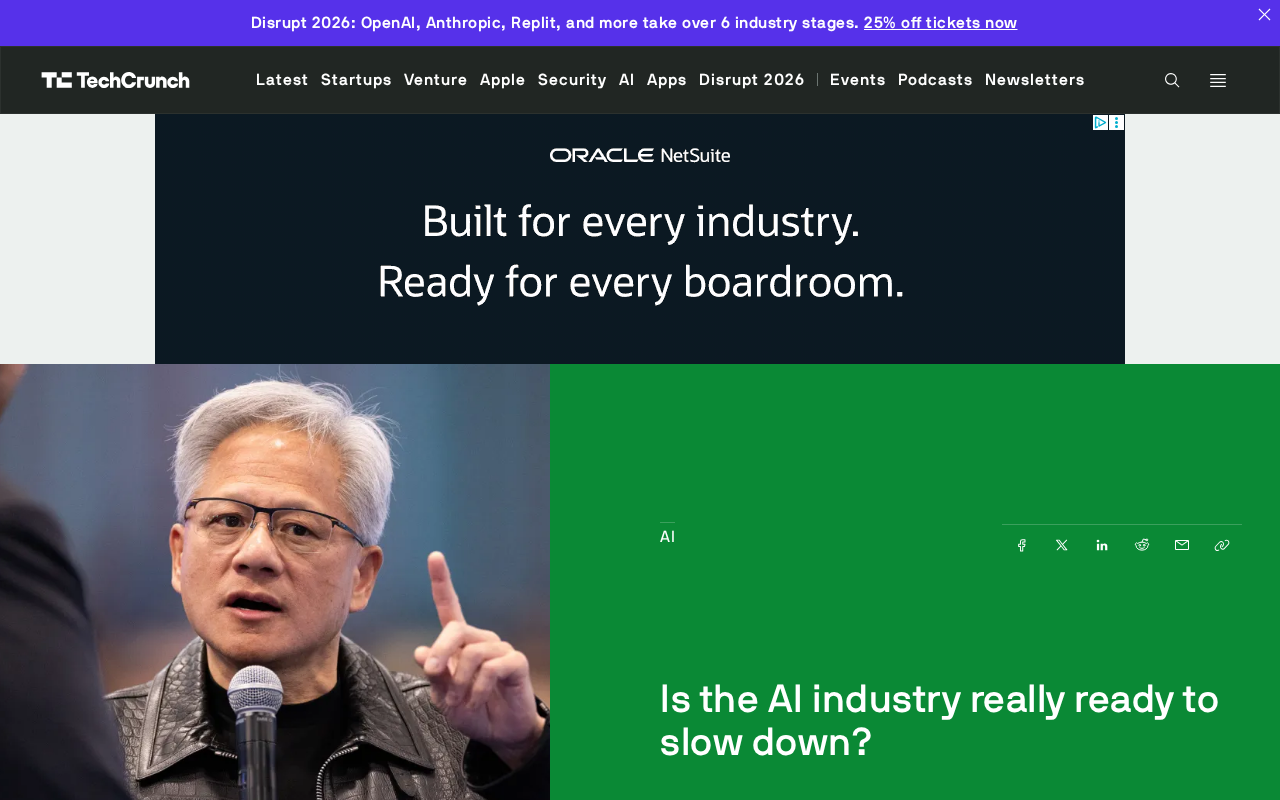
The term "slowing down" means different things depending on who's saying it. Some use it to mean reducing the pace of model capability improvements; others mean delaying commercial product launches; still others simply want more breathing room before regulatory frameworks are established. This semantic ambiguity gives the industry enormous room to maneuver — projecting a posture of caution without actually taking the foot off the gas.
The Gap Between Words and Actions
The more probing question is this: if a company genuinely wanted to slow down, would it be willing to cede ground while its competitors are sprinting forward? In practice, capital investment, the compute arms race, and the talent war in AI are all intensifying. In that environment, unilateral deceleration effectively means surrendering market share — something that cuts directly against basic business instincts.
This is the core tension the podcast discussion circles around. When executives call for the industry to collectively dial back, they're essentially asking for a "synchronized brake" — one where no individual player pays a penalty for being cautious, because everyone slows down together. But voluntary industry self-regulation without binding enforcement mechanisms rarely achieves that kind of coordination. Across multiple technology sectors throughout history, pure "self-restraint" driven by corporate goodwill has proven difficult to sustain.
This "synchronized brake" dilemma maps directly onto classic game theory models — the prisoner's dilemma and the tragedy of the commons. Even if all participants agree that collective deceleration is good for the industry's long-term health, each individual actor still has a rational incentive to defect: if a rival doesn't slow down simultaneously, the first mover loses market share; and if the rival does slow down, the first mover has already paid the price. This structural trap means that without an external enforcement mechanism — such as government regulation or a binding industry agreement — spontaneous coordination is nearly impossible. The AI field currently lacks any multilateral framework comparable to the Basel Accords in finance or ICAO standards in aviation, making the prospect of a "collective brake" all the more remote.
Who's Pushing for Deceleration — and Who's Quietly Accelerating
Public calls for slowing down can sometimes carry a distinctly strategic flavor. Companies that have already established a leading position may have more to gain from an industry-wide slowdown that locks in their advantage, while challengers have every incentive to keep pushing full speed ahead. So when a given executive talks about "AI needing to slow down," understanding their company's market position and underlying interests is often more informative than taking the statement at face value.
Regulatory pressure adds another variable. At a stage when the regulatory landscape is still taking shape, some companies choose to proactively raise the slowdown narrative — both to cultivate a "responsible" public image and to gain influence over how future rules get written. This "strategic retreat" maneuver makes the entire slowdown discussion considerably more complex.
This phenomenon — using regulatory advocacy to construct competitive moats — is what scholars sometimes call a variant of "regulatory capture," or more precisely, "strategic regulatory advocacy." When dominant firms champion stricter regulation, it can appear to be an act of social responsibility while in practice converting compliance costs into a barrier to entry. Large incumbents have the resources to absorb steep compliance expenditures; startups and new entrants may simply be priced out. Historical parallels exist: after the 2008 financial crisis, certain large banks supported tougher capital requirements; after the EU's General Data Protection Regulation (GDPR) took effect, major tech platforms actually consolidated their market positions. Understanding this dynamic is essential for reading AI leaders' public stances on regulation with appropriate skepticism.
What This Means for Industry Observers
For practitioners and investors tracking AI developments, the most practical yardstick isn't what executives say — it's what companies actually do. Is R&D spending contracting? Is the product release cadence slowing? Are companies willing to accept binding external oversight? "Slowing down" only carries real meaning when words and actions align.
For now, the industry's overall momentum remains powerful, and a slowdown in any meaningful sense has yet to materialize. The debate over whether AI should — or even can — slow down won't find a clear resolution in the near term. But it reflects a deep underlying tension between rapid expansion and genuine accountability. That debate itself may be worth watching more closely than any conclusion it might eventually reach.
Related articles

WorkBuddy Full Tutorial: Build an AI Office Automation Agent from Scratch
A complete WorkBuddy tutorial: installation, three working modes, multimodal picture book video practice, expert team agent building, and workflow configuration for low-cost AI office automation.

WorkBuddy Agent Complete Guide: From Beginner to Automation in 7 Days
Based on Bilibili's 256-episode WorkBuddy masterclass, this systematically breaks down Tencent's AI office workbench core capabilities: Agent principles, Skill encapsulation, cross-platform connectors, scheduled automation, knowledge bases, and zero-code development, with learning path recommendations.

8 AI Accounts, 7 Failed: An Honest Review of Using AI to Get Work Done
Only 1 of 8 AI-run Bilibili accounts succeeded. We break down the real difference between "performing AI" and "using AI to get work done."