Is the Global Workspace Just for Show? New Causal Test Reveals the Internal Computation Mechanisms of Language Models

A causal message transplantation test reveals whether workspace models compute or merely relay information.
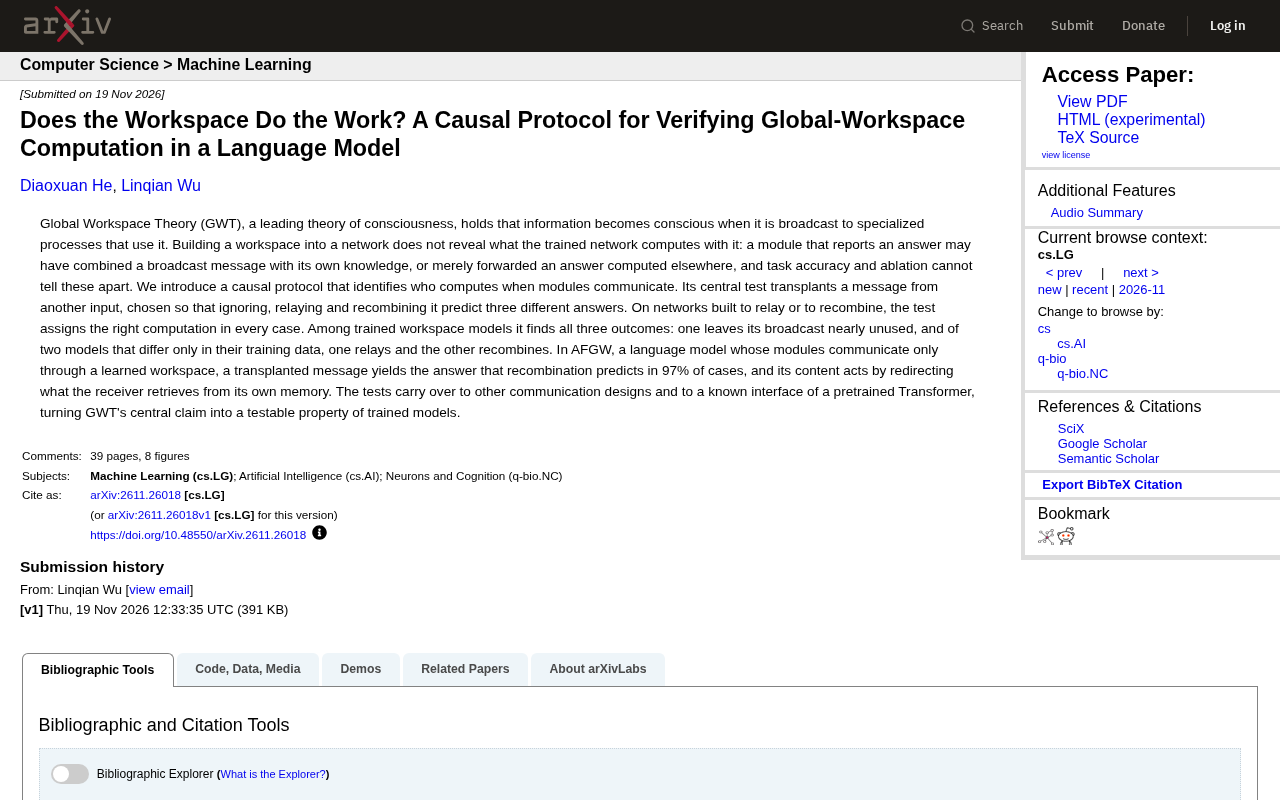
The article introduces a causal protocol for testing whether neural networks with an embedded global workspace (GWT) truly use broadcast information for computation. By transplanting a message from another input and designing the setup so that ignoring, relaying, and recombination produce different answers, the protocol infers the model's actual computation type. Validated on purpose-built relay and recombination networks, it was then applied to trained workspace models, revealing all three behaviors, with training data alone sufficient to shift a model from relaying to recombination. The AFGW language model recombined in 97% of cases, with broadcast messages acting by redirecting the receiver's memory retrieval. The test generalizes to other communication designs and pretrained Transformer interfaces, turning GWT's core claim into a testable property.
Introduction: Is the Workspace Actually Working?
When building neural networks with a Global Workspace Theory (GWT) architecture, a fundamental question is often overlooked: is this modular communication channel actually performing computation, or is it merely acting as an information relay station? GWT holds that information only enters the "conscious" level once it is broadcast to specialized sub-processors and used by them. But embedding a workspace into a network does not guarantee that the trained model actually uses it for computation—a module that reports answers might integrate broadcast information with its own knowledge, or it might simply forward a result computed elsewhere. And traditional task accuracy or ablation experiments simply cannot distinguish between these cases.
A recent paper proposes a causal protocol aimed at solving this verification problem. Through carefully designed intervention tests, it can clearly determine who is computing when modules communicate.
Global Workspace Theory (GWT) was originally proposed by cognitive scientist Bernard Baars in the 1980s to explain the "theater" metaphor of human consciousness: large numbers of unconscious processors work in parallel, and only information that is selected and broadcast to the global workspace enters consciousness and is shared among specialized subsystems. In machine learning, this concept has been reworked into a modular architecture—multiple expert networks exchange information through a shared bottleneck of limited capacity (the workspace), with typical representatives such as Global Workspace Networks and Perceiver-style models. The key claim of GWT is not merely that "a broadcast channel exists," but that broadcast information is actually used and integrated by downstream processors. Therefore, verifying this claim in artificial systems requires proving that the computation of receiving modules depends on the broadcast content, rather than merely forwarding or ignoring it.
Core Method: A Causal Test via Message Transplantation
The core test of this protocol is ingenious: transplant a message from another input into the message channel of the current input. This transplanted message is carefully chosen so that three possible processing modes—ignoring it, relaying it, or recombining it—predict three different answers. In this way, simply by observing the model's final output answer, one can infer which computation it actually performed.
The researchers first validated the test on purpose-built "relay networks" and "recombination networks": in all cases, the test correctly identified the network's computation type. This laid a reliable foundation for the subsequent analysis of trained models.
Three Behavioral Modes: Ignoring, Relaying, and Recombining
When the test was applied to trained workspace models, the researchers observed all three outcomes:
- One model made almost no use of its broadcast messages (ignoring mode);
- Two models that differed only in their training data: one exhibited relaying, the other exhibited recombination.
This finding directly challenges the intuitive assumption that "as long as the architecture contains a workspace, the model will use it for integrative computation." Whether and how a model actually uses the workspace depends heavily on the specific details of the training data and training process.
Causal intervention differs from traditional correlational observation: it actively modifies an internal variable of the system and observes how the output changes accordingly, thereby determining whether that variable lies on the causal path. In neural network interpretability, common techniques include activation patching, causal tracing, and ablation. The message transplantation test is a variant of activation patching—injecting an intermediate representation "patch" from another input into the current forward pass, and designing input pairs that make different hypotheses produce distinguishable outputs. Its validity relies on a premise: the transplanted message must be semantically recognizable and processable by the receiving module, and the predicted answers of the three hypotheses (ignore/relay/recombine) must be mutually distinct; otherwise the test cannot yield a unique conclusion.
The AFGW Model: Recombination Dominates, with Accuracy as High as 97%
The paper focuses on a language model called AFGW, whose modules communicate only through a learned workspace. On this model, the message transplantation test produced highly convincing results:
In 97% of cases, the answer given by the model after message transplantation was consistent with the recombination prediction.
This means that AFGW does not simply forward broadcast messages, but recombines them with information that the receiving module itself retrieves from memory. More interestingly, the study further reveals that the content of broadcast messages works by redirecting what the receiver retrieves from its own memory. In other words, what the workspace transmits is not the answer itself, but retrieval cues, guiding the receiving module to extract and integrate relevant information.
This mechanism aligns closely with the core claim of GWT—information, once broadcast, is used and integrated by specialized processors. But the key point is that this integration is verifiable, not assumed.
AFGW belongs to a class of "global workspace" language models: multiple modules (such as a memory retrieval module and a language generation module) are not directly interconnected, and all cross-module information must pass through a learned shared workspace tensor. This bottleneck design forces information compression and, in theory, promotes integration. The statement in the paper that "broadcast messages redirect the receiver's memory retrieval" means that what the workspace carries is not the final answer, but a cue akin to a query key, which the receiving module uses to pull relevant content from its own parametric memory and then combine it. This is related to the idea in retrieval-augmented generation (RAG) that "retrieval cues drive memory access," but the difference is that here retrieval occurs within the model's internal parametric memory rather than an external document store.
Beyond a Single Model: The Generality of the Protocol
This causal test is not limited to AFGW or a specific workspace architecture. The researchers point out that these tests can be transferred to other communication designs and are also applicable to a known interface of pretrained Transformers. This means the protocol provides a general tool capable of turning GWT's core claim into a testable property of trained models.
For AI interpretability research, this offers a path from "architectural assumption" to "computational empirical evidence." We no longer need to guess whether the workspace is being used; instead, we can directly measure its computational role through causal intervention.
Significance and Outlook: From Theory to Testable Science
The importance of this work lies in turning a core concept from consciousness theory—global broadcast—into an engineering problem that can be causally verified in artificial systems. Traditional ablation experiments can only tell us that "performance drops when a certain module is removed," but cannot distinguish whether that module is the core of computation or a conduit for information. The message transplantation test, by contrast, can precisely locate where and how computation occurs.
For building more interpretable and more controllable AI systems, this causal protocol provides a new evaluation dimension. In the future, similar methods may be used to audit the actual division of labor among different modules in large language models, ensuring that the "workspace" we understand is consistent with the "workspace" the model actually uses.
Implications for AI Researchers
- Do not assume architecture equals function: A model with a workspace architecture may not actually use it for computation.
- Causal tests are better than correlational observation: Accuracy and ablation experiments are insufficient to reveal internal computation mechanisms; intervention experiments designed to distinguish different computational hypotheses are needed.
- Training data shapes computation patterns: Differences in training data alone can cause a model to shift from "relaying" to "recombination," reminding us that data curation has a profound impact on a model's internal mechanisms.
One-line Summary
A causal message transplantation test reveals whether a workspace model is actually computing or merely relaying information.
Paragraph Summary
The article introduces a causal protocol for testing whether a neural network with an embedded global workspace (GWT) truly uses broadcast information for computation. The protocol transplants a message from another input into the current message channel and is designed so that three processing modes—ignoring, relaying, and recombination—produce different answers, thereby inferring the model's actual computation type. After validating its effectiveness on purpose-built relay and recombination networks, the authors applied it to trained workspace models and observed all three behaviors, with differences in training data alone sufficient to produce a shift between relaying and recombination. The AFGW language model analyzed in focus exhibited recombination in 97% of cases, with broadcast messages acting by redirecting the receiver's memory retrieval. The test can also be transferred to other communication designs and pretrained Transformer interfaces, turning GWT's core claim into a testable property.
Related articles

VP ≠ VNP: A Major Breakthrough in Computational Complexity Theory
A study claiming to prove VP ≠ VNP over every field sparks heated discussion on Hacker News. This article analyzes the algebraic complexity background of VP and VNP, the proof approach, community controversy, and its potential impact on computational complexity theory.

Developer Naming Woes: The Technical Names That Drive Us Crazy
Why is technical naming so maddening? From Nginx and Vite to Qt and Sudo, a YouTube creator rants about the chaos of developer naming and pronunciation, revealing the tug-of-war between creators' intentions and community habits, and the cultural roots behind spelling traps like PyPI and GNOME.

Figma Workplace Scandal: Employee Sues CEO for Forcing Confrontation with Harasser
Figma and its CEO are sued by a current employee alleging sexual harassment and discrimination, and forcing the victim to confront her harasser. This article outlines the background, potential impact, and industry reflection.