Is There a Glass Ceiling in AI R&D Without a Ph.D.?

A Ph.D. matters for top research labs, but industry rewards results over credentials for most AI roles.
This article examines whether a glass ceiling exists for AI engineers without a Ph.D. While top research labs like DeepMind and FAIR effectively require doctorates, most industry roles value problem-solving ability over credentials. Master's-level engineers can thrive on the IC (Individual Contributor) track and build credibility through open-source contributions, patents, and production impact. The decision to pursue a Ph.D. should be goal-driven, with a pragmatic strategy of exploring career growth in industry first.
A 27-Year-Old Engineer's Career Anxiety
In an era of rapid advancement in AI and computer vision (CV), more and more young engineers are grappling with a practical question: without a Ph.D., can you go all the way on a technical R&D career track?
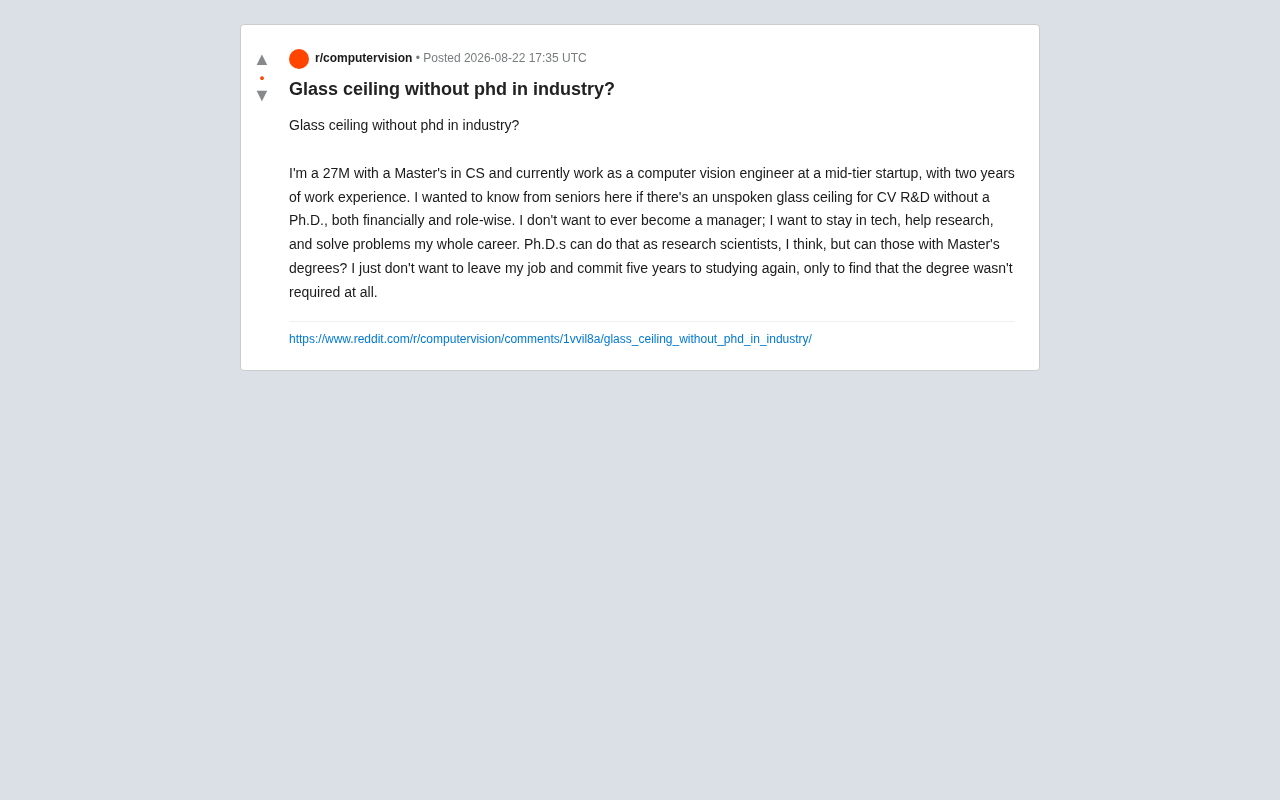
Recently, a 27-year-old computer vision engineer on Reddit — holding a CS master's degree and two years of experience at a mid-sized startup — posed a question that resonated widely. His goal was crystal clear: he doesn't want to go into management; he wants to stay on the technical frontlines for his entire career, doing research and solving problems.
His core question was this: in industry, does the lack of a Ph.D. create a "glass ceiling" — whether in compensation or seniority? Ph.D. holders can become Research Scientists, but can master's-level engineers? He didn't want to rashly quit his job and spend five years on a doctorate, only to discover that the degree was never actually necessary.
While this question seems personal, it actually touches on a core tension in the AI industry's talent structure.
The Ceiling Does Exist — But Its Height Depends on Where You Work
Top Research Labs: A Ph.D. Is Nearly a Hard Requirement
Let's be honest — in certain contexts, the "invisible barrier" of a Ph.D. is very real.
If your goal is to join Google DeepMind, Meta FAIR, OpenAI, or Microsoft Research as a formal "Research Scientist," then a Ph.D. is, in practice, close to a prerequisite. The core evaluation criteria for these roles are a track record of publications at top conferences (NeurIPS, CVPR, ICML, etc.) and the ability to independently define research directions — and doctoral training is precisely the systematic path for developing these capabilities.
It's worth understanding why these top conferences carry so much weight in AI. NeurIPS (Conference on Neural Information Processing Systems), CVPR (Conference on Computer Vision and Pattern Recognition), and ICML (International Conference on Machine Learning) are widely regarded as the three premier academic venues in AI, with acceptance rates typically hovering between 20%-25% — making them fiercely competitive. Publishing at these conferences means not only that your work has survived rigorous peer review, but also that you possess the complete research skill set: from problem formulation and method design to experimental validation. A Ph.D. typically takes 4-6 years, and its core training revolves around "how to identify a good problem and systematically solve it" — a capability that's difficult to fully develop through engineering practice alone. This is why top research labs view a Ph.D. as a signal of capability, rather than mere credential screening.
More practically, the compensation structure and promotion tracks at these institutions are often tightly coupled with the "Research Scientist" title. Without the corresponding background, even engineers with outstanding technical skills may find themselves stuck in the "engineer" track, unable to cross into the "scientist" track — leading to divergence in long-term compensation growth.
The Vast Majority of Industry Roles Don't Require a Ph.D.
However, when you broaden your view to the entire AI/CV industry, the picture is far more optimistic.
The vast majority of companies — including startups, mid-sized tech firms, and even product teams at major tech companies — value the ability to solve real problems over credentials. In these environments, a master's-level engineer who can deploy models to production, optimize inference performance, and tackle data engineering challenges is worth far more than a Ph.D. holder who can write papers but can't ship anything.
It's important to understand the actual tech stack and industry value of a CV engineer working in industry. Computer vision is one of the most deeply industrialized subfields of AI. A CV engineer's daily work extends far beyond model training — they need to master the entire pipeline from data collection and annotation, model architecture selection and training, to inference optimization (e.g., model quantization and acceleration using TensorRT or ONNX Runtime), and edge device deployment (e.g., running real-time detection on NVIDIA Jetson or Qualcomm chips). In recent years, with the explosive growth of autonomous driving, industrial quality inspection, medical imaging, and AR/VR, engineers who can turn cutting-edge CV algorithms into stable products have become extremely scarce. This "last mile" engineering capability — including handling long-tail data distributions, solving model robustness issues in production environments, and building scalable ML pipelines — is precisely where master's-level engineers hold their strongest competitive advantage.
In fact, industry offers a well-established Individual Contributor (IC) technical expert track that carries no management responsibilities. From Senior Engineer, Staff Engineer, to Principal Engineer and Distinguished Engineer, this pathway allows engineers to stay on the technical frontlines for their entire career, with compensation that can match or even exceed management roles.
The IC track is a talent incentive system that Silicon Valley tech companies have refined over the past decade-plus, designed to solve a classic organizational problem — the "Peter Principle," where outstanding technical talent gets promoted into management roles they're ill-suited for, thereby losing their value. Google pioneered a comprehensive IC level system, ranging from L3 (Junior Engineer) to L11 (Senior Fellow), where compensation at L7 (Staff Engineer) and above typically matches or exceeds that of same-level managers. Meta, Apple, Amazon, and others have built similar systems. Staff Engineers typically need cross-team technical influence, Principal Engineers need to define technical direction at the company level, and Distinguished Engineers are industry-level technical leaders. On this track, credentials matter far less than technical judgment and systemic impact.
How Master's-Level Engineers Can Break Through
Replace Credential Backing with Real-World Results
For the engineer who posed this question, rather than agonizing over whether to pursue a Ph.D., the better approach is to think about how to build technical credibility through visible results.
In industry, the "hard currency" that substitutes for a Ph.D. includes:
- Open-source contributions: Maintaining influential CV-related projects on GitHub, or contributing core code to major frameworks (such as PyTorch, OpenCV, Detectron2);
- Patents and production impact: Translating research into actual products with quantifiable business impact;
- A small number of high-quality papers: Even without a Ph.D., industry engineers can collaborate with research teams to publish papers and participate in cutting-edge research.
These achievements are often more persuasive than a diploma when it comes to hiring and promotions.
"Research" Is Not the Same as the "Research Scientist" Title
One potential misconception the questioner may hold is equating "participating in research" with "holding a Research Scientist position."
In reality, many Research Engineer roles in industry are tailor-made for master's-level technical talent. These roles involve deep participation in research projects — responsible for experiment implementation, model training, and system building — and are an indispensable part of any research team. Many breakthrough results owe their successful deployment precisely to these engineering-strong Research Engineers.
The Research Engineer role has seen a significant elevation in status over the past five years. In earlier AI research, Research Scientists proposed ideas and designed experiments while engineers were seen as mere "executors." But as modern AI research has become critically dependent on computational infrastructure — training a large vision model might require hundreds of GPUs working in concert for weeks, and the efficiency of data preprocessing pipelines directly affects research iteration speed — Research Engineers have become irreplaceable. Take Google Brain (now Google DeepMind) as an example: many landmark papers (such as the early engineering implementation of the Transformer architecture) involved deep contributions from Research Engineers. At OpenAI, Research Engineers can even become core authors on papers. This trend has blurred the traditional boundary between "research" and "engineering," opening the door for non-Ph.D. technical talent to participate in frontier research.
In other words, the career aspiration of "contributing to research and solving problems" absolutely does not require a Ph.D. as a prerequisite.
Whether to Pursue a Ph.D.: A Cost-Benefit Analysis
The Opportunity Cost Must Be Calculated Clearly
What does a five-year Ph.D. journey mean? It means forgoing five years of industry salary growth, equity accumulation, and career seniority. For an engineer who has already established a foothold in the CV field, this is a massive opportunity cost.
Therefore, the decision should come down to a goal-driven assessment:
- If your ultimate career goal is to enter a top research lab, independently lead frontier research directions, and publish foundational papers — then a Ph.D. is worth the investment;
- If your goal is simply to stay on the technical frontlines long-term, participate in meaningful R&D, and earn competitive compensation — then a Ph.D. is likely an unnecessary detour.
A Smarter Strategy: Explore First, Decide Later
For engineers still on the fence, a safer strategy is: push upward in industry first, and deal with the ceiling when — and if — you hit it.
Start by trying to transfer internally to a Research Engineer role, proactively join your company's research collaboration projects, and produce open-source contributions or papers in your spare time. If you find your career progressing smoothly through this process, it means a Ph.D. isn't a necessity for you. If you genuinely find yourself repeatedly blocked by credential barriers, then considering a Ph.D. at that point — perhaps even a part-time or industry-sponsored program — is by no means too late.
It's worth noting that for engineers who've already accumulated several years of industry experience, a traditional full-time Ph.D. isn't the only option. In recent years, multiple flexible doctoral training models have matured: many universities in Europe and the US offer Part-time Ph.D. programs that allow students to complete doctoral research while maintaining employment, typically taking 6-8 years; Google, Microsoft, DeepMind, and others have established joint doctoral programs with universities (such as the Google Ph.D. Fellowship), where researchers can complete most of their research within the company while earning an academic degree; France's CIFRE program is an exemplary model of industry-funded industrial doctorates. The core advantage of these pathways is that research topics derive directly from real industry needs, graduates don't need to endure the painful transition from academia to industry, and career development and income accumulation are never fully interrupted.
Conclusion: The Ceiling Is Relative
Returning to the original question — does a glass ceiling exist in industry for those without a Ph.D.?
The answer is: it does exist for a small number of top research positions, but for the vast majority of technical R&D career paths, the ceiling is determined by your capabilities and results, not your credentials.
For this 27-year-old engineer, the most important thing may not be rushing to decide whether to pursue a Ph.D., but rather clarifying what kind of "research" he truly wants to do — and then proving he deserves that position through the means industry can verify: code, products, and impact. The tech world is, ultimately, a place where results speak loudest.
Related articles
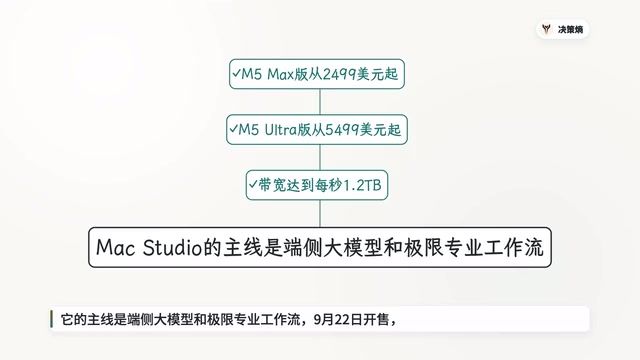
Apple's Four New Macs Decoded: From Desktop Agents to Local LLM Workstations
Apple launches four new Macs from $899 to $5,499+, building a full local AI price ladder. We break down memory budgets, performance bottlenecks, and which Mac runs which model size.

DeepSeek V4's First Multimodal Model Goes Open Source: 305B Weights Fully Released Under MIT License
DeepSeek open-sources V4-Flash-Vision-Exp, a 305B multimodal vision model under MIT license. Built on V4-Flash, it surpasses Opus 4.8 on three benchmarks including Agent's Last Exam.
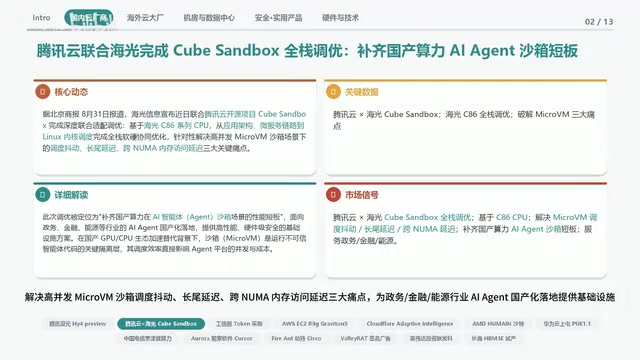
DeepSeek Open-Sources V4 Multimodal Vision Model as China's AI Ecosystem Accelerates Across the Board
DeepSeek open-sources V4-Flash-Vision-Exp multimodal model with 305B MoE params (13B active) under MIT license. Domestic compute, policy procurement, and AI security threats all accelerate.