Is Vibe Coding Real or Hype? Human Oversight Is Key

Vibe Coding is a real productivity tool, but humans must stay in the loop for oversight.
The article discusses "Vibe Coding," a programming approach that uses natural language to drive AI code generation, and offers a pragmatic verdict: it's real, but only if a human always stays in the loop. It explains the core workflow and suitable scenarios (rapid prototyping, personal tools, learning), warns about high-risk areas (security, payments, large codebases), and proposes three rules: review code, test before release, and never paste passwords or keys.
Core idea: You describe what you want in natural language, AI generates the code, and you test it and give feedback for changes—a programming approach known as "Vibe Coding" that is sparking heated debate. Is it a genuine productivity revolution or a passing fad? The original video from YouTube offers a pragmatic verdict: it's real, but only if a human stays in the loop.
What Exactly Is Vibe Coding?
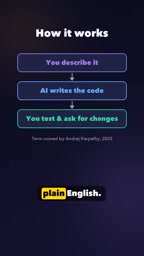
The core workflow of Vibe Coding is extremely simple: you describe the functionality you want in everyday language, AI writes the code, you run the tests, and then you request changes in natural language. You don't need to type a single line of code by hand—everything happens through conversation.
What makes this approach appealing is that it dramatically lowers the barrier to programming. In the past you had to learn syntax, frameworks, and debugging techniques; now you just need to express your intent clearly. For non-professional developers, this undoubtedly opens a new door.
Vibe Coding is a term coined by AI researcher Andrej Karpathy in early 2025, describing a way of programming where you're "fully immersed in the vibe": developers no longer write code line by line but instead describe their intent to a large language model (LLM) in natural language, the model generates the code, and the developer is responsible only for running it, observing the results, and continuing to iterate in natural language. It is fundamentally different from traditional "AI-assisted programming" (such as code completion or Copilot-style suggestions): the latter still centers on humans writing code with AI as a helper, whereas Vibe Coding hands the primary role of code generation to the model, shifting the human's role to requirement expression, result verification, and direction control. The reason this concept has sparked widespread discussion is that it touches on two core issues—"the barrier to programming" and "responsibility for code quality"—because when code is no longer written character by character by humans, the boundaries of understanding, review, and accountability need to be redefined.
Suitable Scenarios: Prototypes, Personal Tools, and Rapid Learning
The video clearly states that Vibe Coding excels in several specific scenarios.
Rapid prototyping is the most typical application. When you have an idea that needs validation, having AI generate a runnable version from natural language is far faster than traditional development. You can see a preliminary result within minutes and then decide whether it's worth further investment.
Personal tools and small projects are equally well suited. For example, writing a script to automatically organize files, or building a simple data visualization page—Vibe Coding lets you skip the tedious configuration process and get directly to a usable result.
Learning to program is also an underappreciated use case. By observing AI-generated code, beginners can quickly grasp common patterns and experience how code structure changes as they revise requirements.
Risk Warnings: Security, Payments, and Large Codebases
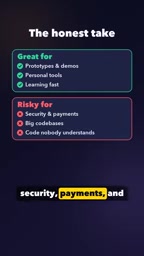
Vibe Coding is not a cure-all. The video specifically highlights three high-risk areas.
Security-sensitive scenarios require extra caution. AI-generated code may contain subtle vulnerabilities, such as insufficient input validation or incorrect permission checks. If you deploy such code directly to a production environment, the consequences could be serious.
Payment-related functionality is equally dangerous. Once logic involving monetary transactions goes wrong, the losses are direct. AI may generate payment flow code that looks reasonable but is actually flawed, and these issues may not surface in simple testing.
Large codebases are another difficulty. When a project grows in size and its dependencies become complex, it's hard for AI to fully understand the context, and the generated code may conflict with other modules or introduce bugs that are hard to trace.
The reason large codebases are such a challenge is closely tied to the context window limitations of LLMs. The amount of code a model can "see" in a single conversation is limited; when a project contains dozens of modules, complex dependencies, and implicit conventions, the model often can only generate code based on local fragments, making it hard to perceive global interface contracts, naming conventions, and data flow. This leads to generated code that looks reasonable in isolation but conflicts with existing modules when placed into the project, or breaks the original level of abstraction. In addition, the model may "hallucinate" non-existent APIs, outdated library versions, or incorrect configuration items—issues that are easy to spot in small scripts but can hide very deep in large systems. Therefore, using Vibe Coding in large codebases usually requires good module partitioning, clear interface documentation, and engineering habits such as small incremental commits and continuous integration, to keep AI output confined to a controllable local scope.
Three Practical Rules
Faced with these risks, the video offers clear operational advice.
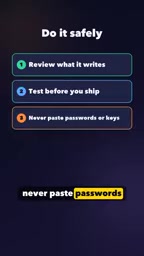
Review the code. Even if you don't write code, have AI explain the key parts, or ask an experienced developer to take a look. Don't skip review just because the code "runs."
Test before releasing. Automated tests and manual verification are both essential, especially for features involving user input and data processing.
Never paste passwords or keys. This is the most easily overlooked rule. Handing sensitive information to an AI service means exposing it to potential risk.
The rule "never paste passwords or keys" reflects the reality of data handling by AI services: what you input may be used by the provider for logging, abuse monitoring, or even model training under some product terms. Once an API Key, database password, or private token enters a conversation, it has left your controlled environment and may appear in logs, caches, or third-party systems. A safer approach is to use environment variables or secret management tools, replace real credentials with placeholders in the code you give to AI, and inject them at local runtime. In addition, watch for whether generated code hardcodes example keys or writes sensitive configuration into locations visible on the front end—these are common security oversights in AI-generated code.
Final Verdict: Real, but Dependent on Human Oversight
The video's conclusion is crisp: Vibe Coding is real, provided that a human always stays in the loop.
This judgment deserves serious consideration. Vibe Coding does change the way programming works, enabling more people to turn ideas into runnable products. But it doesn't eliminate the need for technical judgment—in fact, it amplifies risk in certain areas.
In other words, Vibe Coding isn't about "not needing to understand technology"; it's about "applying technical judgment where it matters most." You need to know what to delegate to AI, what you must oversee yourself, and how to verify whether the results are reliable.
For individual developers and small teams, this is a tool worth embracing. For scenarios involving security, payments, and complex systems, caution and review remain indispensable steps.
One-line Summary
Vibe Coding is a real productivity tool, but humans must stay in the loop to provide oversight.
Paragraph Summary
The article discusses "Vibe Coding," a programming approach that uses natural language to drive AI code generation, and offers a pragmatic verdict: it's real, but only if a human always stays in the loop. It first explains the core workflow—describing requirements in everyday language, AI writing the code, and the user testing and providing feedback in natural language—and notes that it dramatically lowers the barrier to programming. It then explains the suitable scenarios: rapid prototyping, personal tools and small projects, and learning to program. It goes on to warn about three high-risk areas: security-sensitive scenarios, payment-related functionality, and large codebases, involving hidden vulnerabilities, direct monetary losses, and conflicts and bugs caused by insufficient context understanding, respectively. Finally, the article proposes three rules: review the code, test before releasing, and never paste passwords or keys, emphasizing that Vibe Coding is not about "not needing to understand technology" but about applying technical judgment where it matters most.
Related articles
The Binding of Isaac Developer Removes AI Music, Steam Review Bombing Subsides
The Binding of Isaac: Repentance+ faced Steam review bombing over AI music, and the developer has removed the tracks. This article reviews the incident, analyzes player anxiety about AI replacing human creation, and explores transparency and trust costs around AI content in the game industry.

Why Data Centers Have Become the Center of Big Tech's Backlash
Tech journalist Paris Marx's book Hyperscale reveals how data centers became the flashpoint for Big Tech backlash—from resource costs and environmental impacts to policy battles.

Astra 6.2 and Sol 6.2 Unexpectedly Flop on Simple Bench
Astra 6.2 and Sol 6.2 underperformed on the Simple Bench benchmark, sparking heated discussion on Hacker News. This article analyzes the background, Simple Bench's testing logic, and implications for evaluating model capabilities.