iWAM: Efficient Action Prediction with World Models Without Generating Future Frames
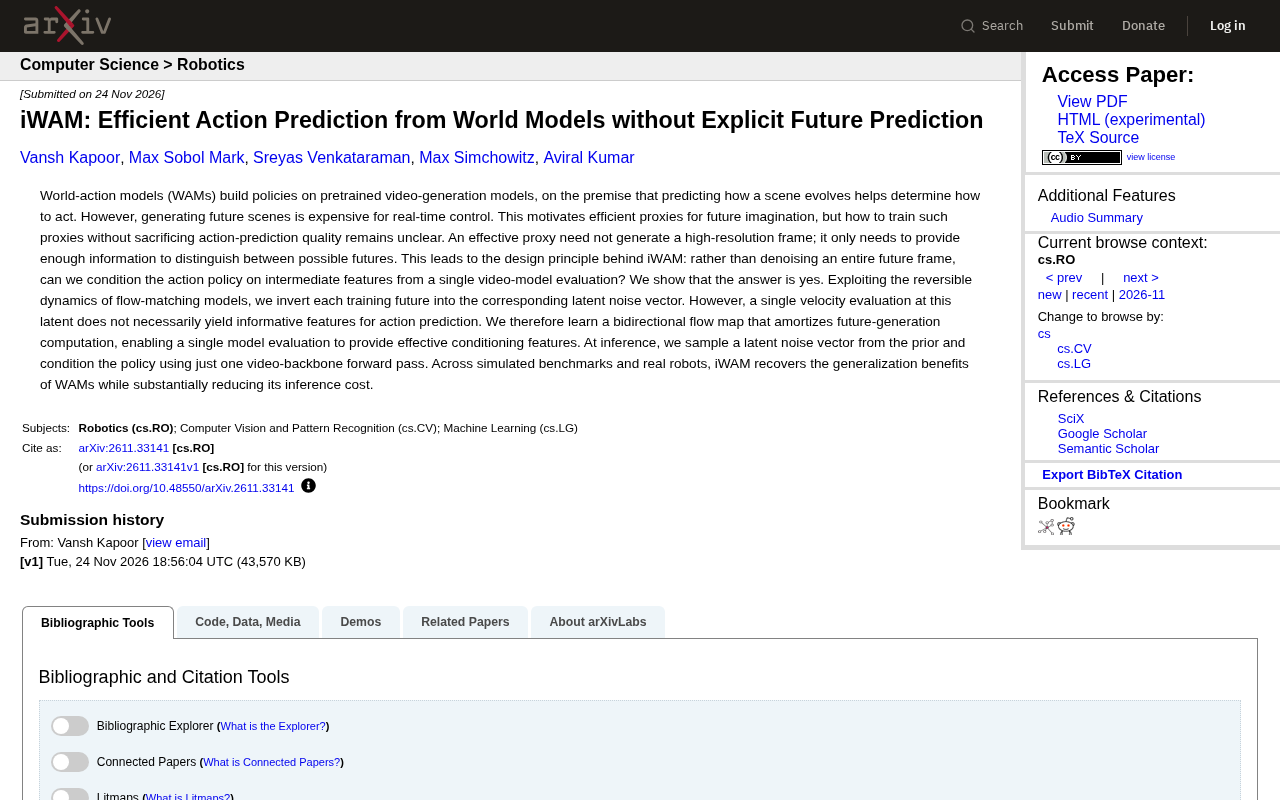
iWAM replaces future frame generation with intermediate features from a single video model forward pass for efficient world action models.
iWAM tackles the high inference cost of World Action Models (WAM), which repeatedly denoise to generate future frames. Instead of generating full future frames, it uses a single forward evaluation of the video generation model to condition the action policy on intermediate features. The key technique exploits the invertible dynamics of flow matching models to invert training future frames into latent noise vectors, and learns a bidirectional flow map to amortize future generation computation so that features from a single evaluation are sufficiently informative. During inference, latent noise is sampled from the prior and only one forward pass of the video backbone is needed to condition the policy. Validation on multiple simulated benchmarks and real robots shows that iWAM recovers WAM's generalization benefits while significantly reducing inference cost, offering a pragmatic path for deploying world models in real-time control.
The core idea of World Action Models (WAM) is to first have a video generation model "imagine" how the future scene will evolve, and then decide actions based on that. This logic is intuitively sound—if the model knows what the next frame will look like, decisions have a basis. But the problem is that the computational cost of generating future frames is too expensive for real-time control. iWAM proposes a path that bypasses explicit future prediction: instead of generating full frames, it uses a single forward evaluation of the video model to directly condition the action policy on intermediate features.
The Efficiency Dilemma of World Action Models
WAM's assumption is that "predicting the future helps decide actions," so the policy is built on a pretrained video generation model. During inference, it repeatedly denoises and generates future frames, then extracts decision information from them. For robot control scenarios requiring real-time response, the time cost of this pipeline is hard to accept.
A natural alternative is to train some kind of "cheap proxy for future imagination"—one that doesn't need to generate high-resolution frames, but only needs to provide enough information to distinguish different possible futures. However, how to train such a proxy without sacrificing action prediction quality was previously unclear. iWAM's design principle starts exactly here: instead of denoising an entire future frame, can the action policy directly condition on intermediate features from a single evaluation of the video model?
Flow Matching is a class of generative modeling methods that learns a velocity field to continuously transform a simple prior distribution (such as Gaussian noise) into a target data distribution. During training, the model is asked to predict the instantaneous velocity along the path from noise to data points; during inference, a noise sample is drawn from the prior and evolved step by step along the velocity field via numerical integration (e.g., Euler method) to obtain a generated sample. Compared with diffusion models, flow matching has a more direct training objective and more flexible path design, often achieving fewer sampling steps. In WAM, the video generation model is based on the flow matching framework; its "denoising" process corresponds to integrating the velocity field, and each evaluation of the velocity field is one network forward pass. The "single evaluation" used by iWAM means calling the velocity field network only once, rather than a full multi-step integration.
Invertible dynamics here refers to the reversibility of the velocity field defined by the flow matching model: given a data point (such as the latent representation of a future frame), one can integrate backward along the velocity field to uniquely map it back to a latent noise vector in the prior space. This property allows the research team to "invert" future frames in the training set into corresponding latent noises, so that when a single velocity evaluation is performed in latent space, the evaluation point maintains an exact correspondence with the real future frame, providing supervision signals for learning a bidirectional flow map.
Key Obstacles to Single Evaluation and Bidirectional Flow Mapping
Directly taking features from a single velocity evaluation is not necessarily effective. The research team exploited the invertible dynamics of the flow matching model to invert each training future frame into a corresponding latent noise vector. However, performing a single velocity evaluation on this latent variable may not yield features with sufficient information for action prediction.
To this end, iWAM learns a bidirectional flow map to amortize the computational cost of future generation. After such training, a single model evaluation can provide effective conditioning features. During inference, the system samples a latent noise vector from the prior and performs only one forward pass of the video backbone network to condition the policy.
The cleverness of this design lies in shifting the cost of "generating the future" to one-time learning during training, while compressing inference to a single forward pass. It retains WAM's structural advantage of relying on future information for decision-making while greatly reducing inference overhead.
Bidirectional Flow Map is the core component of iWAM; its role is to learn a mapping from latent noise to "effective conditioning features" to amortize the computation of full future generation. Specifically, directly performing a single velocity evaluation on the inverted latent noise may produce features lacking enough information to distinguish different futures. Through training, the bidirectional flow map learns to map latent noise to an intermediate representation such that the features after a single velocity evaluation sufficiently encode future information to guide actions. It is called "bidirectional" because the mapping works in concert with the invertible dynamics of the flow matching model: it can invert from future frames to latent noise, and also forward-evaluate from latent noise to effective features, forming a bidirectional information pathway. During training, the mapping network is optimized end-to-end with action prediction loss as supervision; during inference, one only needs to sample latent noise from the prior, pass it through the mapping and one forward pass of the video backbone, and condition the policy is provided—avoiding the high cost of repeatedly denoising to generate full frames.
Generalization Performance in Simulation and on Real Robots
According to the paper, iWAM was validated on multiple simulated benchmarks and real robots. Results show that it recovers WAM's generalization benefits while significantly reducing inference cost. This means that the two goals of "using world models to improve policy generalization" and "real-time controllability" do not necessarily require trade-offs against expensive generative computation.
From a broader perspective, iWAM represents a shift in thinking: the value of a world model may not lie in how realistically it generates, but in whether its internal representations carry enough information for decision-making. For robot learning and real-time control, this "good enough" feature proxy may be more pragmatic than pursuing high-fidelity future frames.
World Action Model (WAM) is a class of frameworks that use video generation models as world models and learn action policies conditioned on the future information they predict. Its core assumption is: if the model can predict the evolution of future scenes, action decisions have richer basis, thereby improving generalization. A typical WAM, during inference, needs to repeatedly denoise and generate future frame sequences based on current observations using a video generation model, then extract features from the generation process for action prediction. This paradigm of "imagine the future first, then decide" is intuitively reasonable, but the computational cost of generating future frames poses a severe challenge for real-time robot control. iWAM targets exactly this bottleneck by proposing not to explicitly generate future frames, but instead to use intermediate features from a single forward pass of the video model as conditioning for the action policy, thereby greatly reducing inference cost while retaining WAM's generalization advantages. Understanding WAM's original pipeline helps grasp exactly where iWAM's efficiency improvement occurs.
Implications for Deploying World Models
iWAM's conclusions offer two reference points for future research. First, the intermediate-layer features of video generation models may themselves be usable decision signals; one need not wait until full generation is complete. Second, the invertibility of flow matching models provides an operable mathematical tool for training such proxies, making features from a single evaluation informative.
Of course, the information currently public about the paper focuses on method design and benchmark validation. The stability of the bidirectional flow map under different task distributions, and the impact of latent noise sampling strategies on policy robustness, remain to be tested in broader scenarios. But for the goal of "using world models for efficient action prediction," iWAM offers a feasible solution with a clear direction.
One-line Summary
iWAM replaces future frame generation with intermediate features from a single forward pass of a video model, enabling efficient world action models.
Paragraph Summary
iWAM addresses the problem that World Action Models (WAM) require repeated denoising to generate future frames during inference, incurring excessive computational cost. It proposes not generating complete future frames, but instead using only a single forward evaluation of the video generation model to directly condition the action policy on intermediate features. Its key technique leverages the invertible dynamics of flow matching models to invert training future frames into latent noise vectors, and learns a bidirectional flow map to amortize the computation of future generation, making features from a single evaluation sufficiently informative. During inference, latent noise is sampled from the prior, and only one forward pass of the video backbone is needed to condition the policy. Validation on multiple simulated benchmarks and real robots shows that iWAM recovers WAM's generalization benefits while significantly reducing inference cost, providing a pragmatic path for deploying world models in real-time control.
Related articles

The Gemini 4 Trio and 3.8 Flash: A Full Comparison of Positioning, Pricing, and Benchmarks
A comparison of Gemini 4 Neon, Carbon, Argon, and Gemini 3.8 Flash: positioning, context, API pricing, Artificial Analysis and Arena benchmark scores, and available entry points.

AI Coding Model Leaderboard: Opus 5.5 Crowned, Gemini Neon Stages a Comeback
Tech blogger Matthew Berman releases an AI coding model tier list: Claude Opus 5.5 holds S-tier, Gemini Neon surprises with A-tier, OpenAI Astra lands B-tier. How do open-source models like DeepSeek fare? We break down the scoring logic and practical takeaways.

New Jersey Joe Sandwich: Meat and Coleslaw on Triple-Decker Rye
New Jersey Sloppy Joe isn't a ground beef burger—it's triple-decker rye bread with meat, Swiss cheese, and coleslaw, plus Russian dressing. Learn the authentic Essex County method and family recipe.