Java Developers Transitioning to AI Large Models: A LangChain4j Practical Guide

Java developers can no longer rely solely on microservices—large model skills are becoming the new hiring standard.
The article notes that while Spring Boot, Spring Cloud, and microservices were once enough, enterprise JDs now frequently list large model requirements, making these capabilities a must-have. Interviews commonly test vector databases, long-text summarization, and prompt engineering, and companies want to add an AI enablement layer on top of microservices. LangChain4j covers tool calling, RAG, and agent orchestration, letting Java developers transition smoothly without switching to Python. The course targets Java developers with zero prior experience, delivering a hands-on enterprise-grade AI assistant project to strengthen resumes and job prospects.
The Current State of Java Developers: Microservices Are No Longer Enough
Over the past three to five years, Java developers who mastered Spring Boot, Spring Cloud, and microservices architecture—plus a bit of Docker, Redis, and containerized deployment—had little trouble finding jobs. But today, enterprise hiring requirements have clearly escalated: knowing only traditional microservices is no longer enough to stand out in the competition.
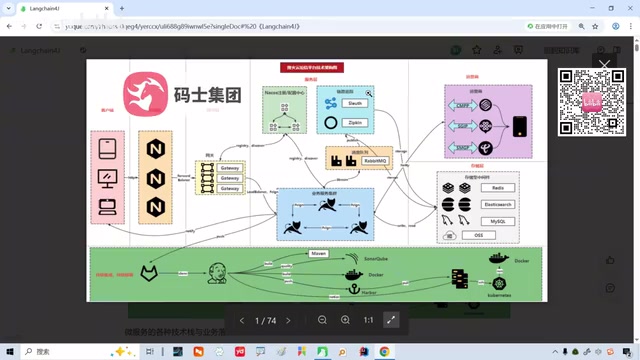
The course instructor points out that in today's enterprise architecture, the microservices stack (Nexus, gateways, caching, cloud deployment) is still the foundation, but job descriptions (JDs) now frequently list "large model-related skills" as requirements. For example, pick any backend developer position on BOSS Zhipin, and beyond traditional Java skills, it explicitly asks for familiarity with large model technology. This means large model capabilities are shifting from a bonus to a must-have.
"There's no such thing as a bad technology—only insufficient skills." The instructor emphasizes that Java itself isn't the problem; the key is whether developers have stocked up on new skills. When ten people interview and only two can speak to large model concepts, interviewers naturally use those two as the benchmark.
New Signals in Enterprise Job Descriptions
Open any job-hunting app and you'll notice that many backend JDs now add requirements for large model application development alongside Java fundamentals, microservices, and middleware. For instance, interviewers may ask: What is a vector database? What is long-text summarization? What is prompt engineering? They may even require you to add a model invocation layer on top of traditional microservices to bring AI capabilities to existing systems.
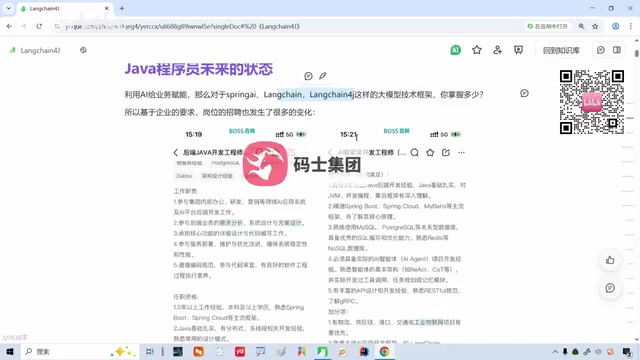
Behind this is business demand—many companies want to empower their operations with large models, so they add an "AI enablement layer" or "model layer" to their architecture. If you can't work with frameworks like Spring AI or LangChain4j, it's hard to land a suitable offer.
Vector databases are databases purpose-built for storing and retrieving high-dimensional vectors (i.e., numerical representations of text, images, etc., produced by embedding models). They use approximate nearest neighbor algorithms (such as HNSW) to achieve millisecond-level similarity search and are a key component in RAG architectures for recalling relevant knowledge snippets. Qdrant is an open-source vector database supporting filtering and hybrid retrieval; PGVector is a vector extension for PostgreSQL that lets teams perform vector search directly on their existing relational database, reducing operational overhead.
Prompt engineering refers to the practice of designing and optimizing the instructions given to large models (including role setting, task description, examples, output format constraints, etc.) to reliably obtain high-quality outputs. Common techniques include few-shot examples, chain-of-thought guidance, and structured output constraints. In engineering practice, prompts often require version management and effectiveness evaluation, making them an indispensable part of AI application development.
Why LangChain4j?
LangChain4j is a framework in the Java ecosystem specifically for building large model applications, lowering the barrier for Java developers to integrate large models. The course covers core capabilities such as tool calling, RAG (Retrieval-Augmented Generation), and agent orchestration, with the goal of guiding you step by step to build an enterprise-grade AI assistant project.
For Java developers, learning LangChain4j comes with natural advantages: your existing engineering mindset and Spring ecosystem experience can transfer smoothly to AI application development. You don't need to learn Python from scratch—you can build agents, integrate vector databases, and implement RAG workflows directly in Java.

The instructor notes that vector databases like Qdrant and PGVector, along with concepts like long-text summarization and prompts, are high-frequency interview topics. Master these, and your resume gains large model highlights, significantly increasing your opportunities whether you're job-hopping or a fresh graduate.
RAG (Retrieval-Augmented Generation) is a technical pattern that combines external knowledge bases with large models. Its core workflow: first split documents and vectorize them into a vector database; when a user asks a question, retrieve the most relevant snippets, then concatenate them as context into the prompt and hand it to the large model to generate an answer. Compared to letting the large model answer directly, RAG significantly reduces hallucinations, supports private knowledge, and requires no model retraining—making it one of the most common ways enterprises implement AI applications.
Agent orchestration refers to letting large models autonomously decide which tools to call, in what order, and how to adjust the next action based on intermediate results. An agent typically consists of a model, a set of tools, memory, and a planning strategy. The orchestration layer manages multi-turn decisions, tool calls, and state passing, enabling the system to complete multi-step tasks like "query the database—call an API—summarize and generate" rather than just single-turn Q&A.
What Can the Course Bring You?
This course is designed for Java developers with zero prior experience, starting with tool calling and gradually advancing to RAG and agent orchestration. You don't need to understand large model theory beforehand—as long as you know Java, you can follow the hands-on project through the entire workflow. The final output is a runnable enterprise-grade AI assistant that you can put directly on your resume and showcase in interviews.

The instructor repeatedly emphasizes that learning large model technology is no longer an elective—it's a required exam. Layering AI capabilities on top of microservices is the core competitiveness for Java developers in the coming years. Rather than worrying that "Java is doomed," it's better to proactively upgrade your skill stack and turn large model knowledge into part of your repertoire.
Final Thoughts
Technology never waits. In the microservices era, Spring Boot and Spring Cloud were standard; in the AI era, LangChain4j and vector databases are becoming the new standard. For Java developers, mastering large model application development early gives you more initiative in the job market. The value of this course lies in using a approach familiar to Java developers to turn concepts like agent development, RAG, and tool calling into actionable code—so you can truly get hands-on rather than staying at the theoretical level.
One-line Summary
Java developers can no longer rely solely on microservices—large model skills are becoming the new hiring standard.
Paragraph Summary
The article notes that while Spring Boot, Spring Cloud, and microservices were once enough to secure a job, enterprise JDs now frequently list large model requirements, making these capabilities a must-have rather than a bonus. Interviews commonly test concepts like vector databases, long-text summarization, and prompt engineering, and companies want to add an AI enablement layer on top of traditional microservices architecture. LangChain4j, as a large model application framework in the Java ecosystem, covers tool calling, RAG, and agent orchestration, enabling Java developers to transition smoothly without switching to Python. The course targets Java developers with zero prior experience, delivering a hands-on enterprise-grade AI assistant project to add large model highlights to resumes and boost job competitiveness.
Related articles

A 19-Year-Old's Rental Horror Story: Ceiling Collapse, Bug Infestation, and the Lessons It Taught Me
At 19, my first off-campus rental brought bug infestations, no heat, a collapsed ceiling, and a ruined laptop with no renter's insurance. Here are the hard-won lessons for first-time student renters.

Veda Nurse's Cranial Nerve Exam: Why ASMR Role-Play Is Going Viral
Bilibili creator Veda's cranial nerve exam ASMR video goes viral, blending humor and sensory triggers through nurse role-play. This article analyzes its unique appeal and the audience psychology behind ASMR role-play.

LG Cinebeam AI Review: 120-Inch Giant Screen + 3000 Lumens, a New Choice for the Living Room Theater
LG Cinebeam AI projector review: 3000 ANSI lumens, 4K, 100 inches from about 8 cm and 120 inches from about 18 cm. Built-in webOS, AI Concierge voice recommendations, AI Sound Pro 11.1.2 virtual surround, and Game Optimizer—positioned for fixed living room installation, complementing the portable Cinebeam S.