Java4Shell Vulnerability Reported: OpenJDK PR Sparks Security Debate

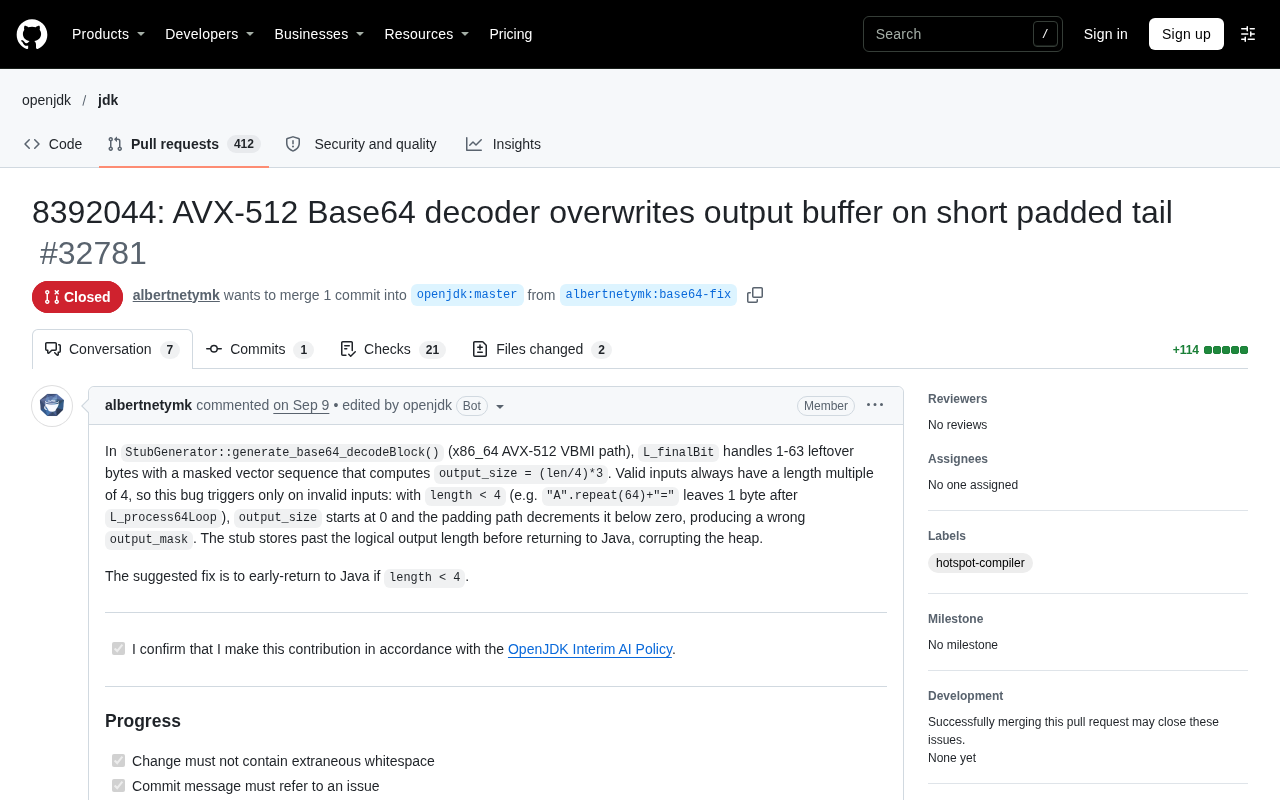
Hacker News is debating the "java4shell" report, which points to OpenJDK PR #32781, but vulnerability details remain undisclosed.
A vulnerability report named "java4shell" has drawn attention on Hacker News, with discussion pointing to PR #32781 in the OpenJDK repository; the post received 307 points and 82 comments. The name borrows the Log4Shell format and suggests potentially broad impact, but the source material only provides the PR link and does not include technical details, a CVSS score, or a CVE ID. The article reviews OpenJDK's PR process and security response mechanisms, analyzes the likely focus of community discussion—the authenticity of the vulnerability, its scope of impact, and the fix cycle—and notes that developers should follow official security announcements, avoid overreacting based on limited information, and emphasize dependency management and timely updates.
Event Overview
A report about a "java4shell" vulnerability has drawn attention in the tech community. According to a discussion on Hacker News, the report points to a Pull Request in the OpenJDK repository (PR #32781). The post received 307 points and 82 comments, showing how sensitive developers are to security in the Java ecosystem.
The "java4shell" name clearly borrows the format of "Log4Shell," suggesting this could be a widely impactful Java vulnerability. However, the publicly available information is currently limited to a single PR link, and the specific vulnerability details have not been elaborated in the source material.
What Is OpenJDK PR #32781?
The source material only provides the PR link and does not include the specific content of the PR. Judging from the title of the community discussion, the PR is related to a defect reported as a security issue. As the open-source implementation of the Java platform, OpenJDK's PR process typically involves code review, testing, and community discussion.
A security-related PR being submitted may mean the vulnerability has been identified and is being fixed, or at least that someone has proposed a fix. But the use of the word "reported" suggests this may be an issue submitted by an external security researcher rather than an officially pre-planned security update.
OpenJDK uses a public collaborative development model, and its code repository and issue tracking system (JDK Bug System) are open to the community, but the handling of security vulnerabilities follows a special process. According to OpenJDK conventions, fixes for genuine security vulnerabilities are usually not discussed directly in the form of public PRs. Instead, they go through a restricted "security silence" channel and are made public only after the fix is ready. Therefore, a public PR labeled as a security issue may mean several things: the reporter misjudged the security nature of the issue, the issue has not yet been confirmed as a security vulnerability, or the OpenJDK security response team has assessed it and decided that confidentiality is unnecessary. Issues in the JDK Bug System usually have two visibility levels, "Confidential" and "Public," and security-related issues are not public by default. This means the public status of PR #32781 is itself noteworthy—it could be an ordinary defect fix that has not yet been marked as a security issue, or it could be a public discussion that has already been sanitized.
Community Reaction and Discussion Focus
The 82 comments on Hacker News indicate that the community has had substantive discussion on this topic. Although the source material does not provide the comment content, based on common patterns in similar security incidents, the discussion may revolve around the following points:
- The authenticity and scope of impact of the vulnerability: whether it is truly exploitable and which Java versions are affected.
- OpenJDK's security response process: whether the cycle from report to fix is reasonable.
- The chain reaction across the ecosystem: whether enterprise applications, middleware, and frameworks that depend on Java need urgent assessment.
The name "java4shell" itself has also sparked discussion—whether it is an exaggerated analogy or whether there really is a problem as serious as Log4Shell.
Log4Shell became a landmark event because the Log4j library is widely depended on indirectly, and the exploitation threshold for the vulnerability was extremely low (a single JNDI lookup string could trigger remote code execution). When people use the "X4shell" naming pattern for a new vulnerability, the implicit reference frame is: remotely exploitable, no authentication required, and broad impact. But the Java platform itself has a different exposure surface from third-party libraries like Log4j—as the runtime foundation, JDK vulnerabilities usually require specific configurations or application scenarios to be triggered, and they do not exist in every logging call path the way Log4j does. Therefore, the community's sensitivity to the "java4shell" name essentially reflects memory of the cascade effects of Log4Shell, rather than a precise judgment of the severity of the current vulnerability.
Security Implications: The Fragility of the Java Ecosystem and Response Mechanisms
Regardless of the final rating of this vulnerability, the incident once again reminds us that Java, as the cornerstone of enterprise applications, has security that directly affects a large number of systems. The open-source community discusses security issues publicly through PRs, which increases transparency on the one hand but may also trigger unnecessary panic before a fix is complete on the other.
For developers, it is necessary to follow official security announcements and PR progress, but it is inadvisable to overreact based on limited information. At the same time, this also highlights the importance of dependency management—updating dependency libraries in a timely manner and paying attention to security advisories are basic practices for reducing risk.
Open Questions and Follow-up Observation
Because the source material contains limited information, the following questions remain unanswered:
- The specific technical details of the vulnerability and its CVSS score.
- Whether there is already an official CVE ID.
- Whether the fix has been merged, and the expected release version.
It is recommended to follow OpenJDK's official channels and subsequent updates to the original Hacker News post for more accurate information.
One-line Summary
Hacker News is hotly discussing the "java4shell" report, which points to OpenJDK PR #32781, but vulnerability details have not yet been made public.
Paragraph Summary
A vulnerability report named "java4shell" has attracted attention on Hacker News, with discussion pointing to PR #32781 in the OpenJDK repository; the post received 307 points and 82 comments. The name borrows the format of Log4Shell and suggests potentially broad impact, but the source material only provides the PR link and does not include technical vulnerability details, a CVSS score, or a CVE ID. The article reviews OpenJDK's PR process and security response mechanisms, analyzes the likely focus of community discussion—the authenticity of the vulnerability, its scope of impact, and the fix cycle—and points out that developers should follow official security announcements and avoid overreacting based on limited information, while also emphasizing the basic practices of dependency management and timely updates.
Related articles

ChatGPT Plus Subscription Pitfall Guide: Go/Plus/Pro Tier Comparison and Quick Activation
A complete ChatGPT Plus subscription guide based on a Bilibili tutorial: from registering an account, comparing Go/Plus/Pro tiers, to the practical steps for quickly completing your subscription.

GPT-6.2 Sol/Astra Released! A Step-by-Step ChatGPT Plus Subscription Guide and Tier Comparison
GPT-6.2 Sol/Astra is out—here's a ChatGPT Plus subscription guide: register an account, compare Go/Plus/Pro tiers, and subscribe in a minute.

Comparing Three Channels for Subscribing to GPT Plus in China: Is Website Top-Up the Easiest?
How to subscribe to GPT Plus in China? This article compares website top-up, credit card, and mobile top-up channels—process, cost, and risk—with steps and tips to help you choose wisely.