Jeff Bezos Deeply Involved in New James Bond Casting: How Is Amazon Reshaping the Bond IP?
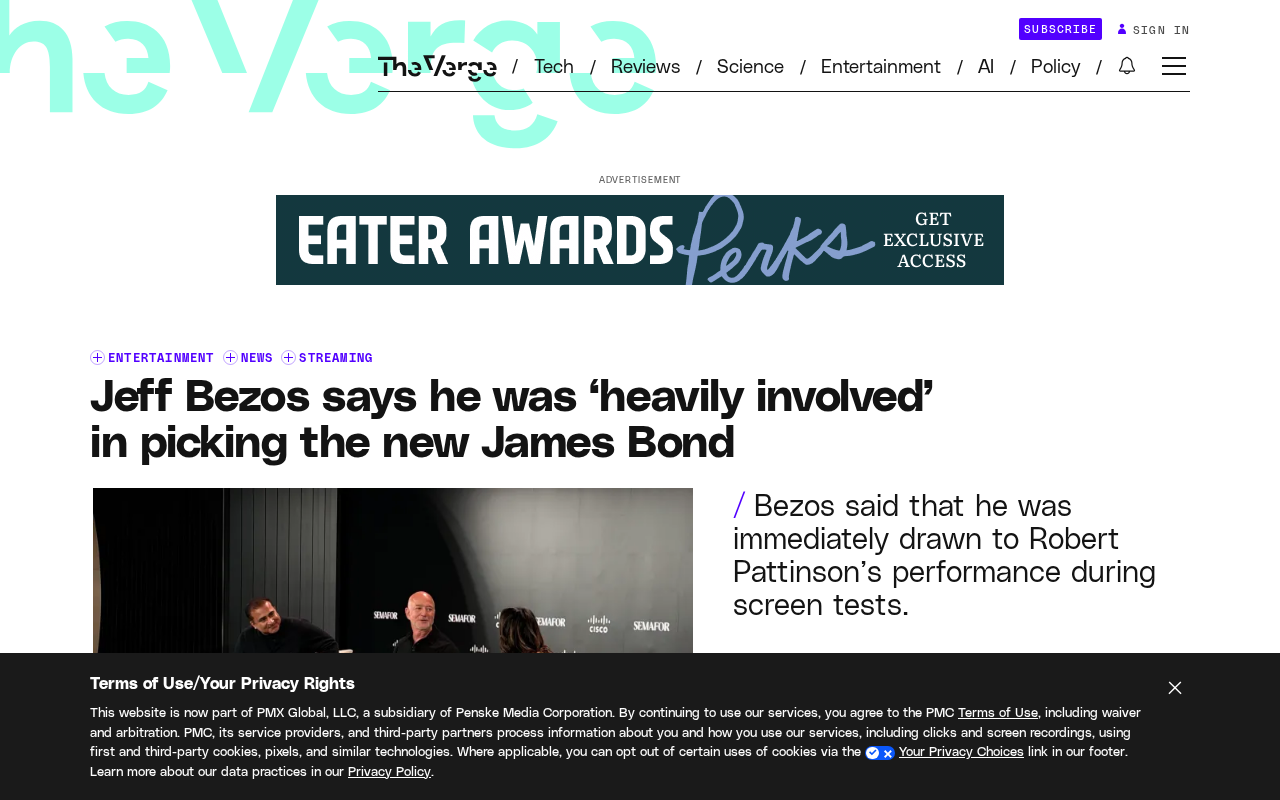
Bezos reveals he was heavily involved in casting the new Bond, signaling Amazon's control over the 007 IP has extended from capital to the creative core.
Amazon founder Jeff Bezos publicly acknowledged at the Semafor conference that he was "heavily involved" in selecting Robert Pattinson as the new James Bond. This statement breaks the convention of tech companies merely acting as "financiers" and shows that Amazon's control over the top-tier 007 IP after acquiring MGM has extended from the capital level to creative decision-making. Pattinson's prior working relationship with director Villeneuve provided artistic legitimacy for the casting, while Bezos signed off at key junctures, forming a compromise model where "director-centric auteurism and executive will coexist." The article further discusses the tension between efficiency and auteurism triggered by tech companies' involvement in film creation, arguing that 007 is undergoing its most "tech-company-ized" transformation since its birth.
From Tech Titan to Film Producer: Behind the Scenes of Bezos's Bond Casting
When Robert Pattinson was announced as the next James Bond, many fans found the choice "made sense"—after all, he had just worked with director Denis Villeneuve, who is directing the new installment of the franchise for Amazon. But according to the latest reports, one of the people who had the final say was also Amazon founder Jeff Bezos.
At Semafor's "Silicon Valley and the World" event, Bezos publicly stated that he was "heavily involved" in selecting the new Bond. This statement itself is a more significant signal than the casting result: Amazon's involvement in the top-tier Bond IP has extended from the capital level to the core of creative decision-making.
Amazon's IP Logic: From Acquiring MGM to Stepping In Directly
After Amazon acquired MGM, the distribution rights and part of the creative rights to the 007 franchise fell into its hands. Traditionally, casting is the domain of producers and directors, and tech companies usually play the role of "financier." But Bezos's remarks break this convention—he was not only informed but "heavily involved."
Behind this is Amazon's consistent strategy for content IP: using data and platform resources to feed back into creation, while having senior executives directly intervene in key decisions. From The Lord of the Rings: The Rings of Power to the Bond franchise, Amazon is testing a "platform-led IP operation" model. For Bezos personally, Bond is one of the few cultural symbols he has publicly expressed interest in, so his personal involvement in casting is not surprising.
The Copyright Structure of MGM and 007
To understand Amazon's involvement, one must first clarify the complex copyright landscape of the 007 franchise. The film rights to 007 have long been jointly held by Eon Productions (controlled by the Broccoli family) and MGM, with Eon holding creative control and MGM responsible for financing and distribution. In 2022, Amazon acquired MGM for approximately $8.5 billion, thereby obtaining a 50% stake in the 007 franchise and distribution channels, but Eon's creative veto power still exists. This means Amazon's "deep involvement" is not without boundaries; its influence still needs to be negotiated with Eon within the existing copyright framework. The fact that Bezos can publicly discuss casting involvement itself reflects a subtle shift in the balance of power between the two sides.
The Pattinson + Villeneuve Combination: Balancing Art and Commerce
Pattinson's selection is not purely "executive will." His working relationship with Villeneuve provides creative legitimacy for the decision: the director is familiar with the actor's performance rhythm, and the actor understands the director's visual language. This combination has become increasingly common in recent blockbuster productions—director-centric auteurism and the star system are converging.
From a commercial perspective, Pattinson combines arthouse credibility with blockbuster experience (The Twilight Saga series, The Batman), making him a risk-controllable, highly newsworthy choice for Amazon. Bezos's involvement may be more reflected in the "final sign-off" stage rather than overturning the director's creative judgment.
The Convergence of Director-Centric Auteurism and the Star System
Casting power in Hollywood has historically gone through roughly two phases: during the studio era, executives and producers dominated; after New Hollywood, the professional judgment of directors and casting directors gradually gained the upper hand. In recent years, with the rise of streaming platforms, stars' global appeal and social media buzz have been re-quantified, and casting has shown a trend of swinging back toward "commercial metrics." The Pattinson-Villeneuve combination is seen as a compromise precisely because it finds common ground between the auteur director's artistic judgment and the platform's commercial demands: the director's creative instincts provide artistic legitimacy for the casting, while the actor's fan base and newsworthiness satisfy the platform's growth needs. This "director nominates, platform signs off" process may become the new normal for casting major IPs in the streaming era.
Tech Companies Making Movies: The Tension Between Efficiency and Auteurism
Bezos's high-profile statement also raises a deeper question: when tech company founders go from "investors" to "casting committee members," how will the traditional power structure of film creation change?
Supporters argue that platforms possess user data and market insights that can reduce blind spots in the casting process; critics worry that executive will may squeeze the professional space of directors and producers. Currently, Amazon has chosen a middle path—retaining auteur directors like Villeneuve while having Bezos maintain a "strong presence" at key junctures.
Whether this model can produce good Bond films will ultimately be tested by audiences. But what is certain is that 007, an IP with decades of history, is undergoing its most "tech-company-ized" transformation since its birth.
The Conflict Between Auteurism and Platform Logic
"Auteurism" originates from the "auteur theory" proposed by the French New Wave, emphasizing that the director is the author of the film and should retain personal style and final say in creation. The core of platform logic is data-driven, scaled production, and risk control. The two have an inherent tension in their decision-making basis: the former relies on artistic intuition and personal vision, while the latter relies on user profiles and market forecasts. Amazon's current approach is to preserve creative space for auteur directors while exerting platform will at key junctures such as casting, budgeting, and distribution. Whether this "limited intervention" can be sustained in the long term depends on the platform's tolerance for creative autonomy and whether the commercial returns of individual works can support its patience.
Conclusion: The Next Era of Bond
Bezos's "deep involvement" is not just a casting gossip item. It marks that Amazon's control over the Bond IP is moving from behind the scenes to the forefront, and it also foreshadows a deeper integration between tech giants and the traditional film industry. Whether the Pattinson version of Bond will succeed remains to be seen, but the casting process itself is enough to show: the future of 007 will be written by the platform logic of the streaming era.
Related articles

Win a Car for Getting Close to 50 Pounds? The Whatnot Marketing Behind a YouTube Challenge
An analysis of the YouTube challenge "Get Close to 50 Pounds and Win a Car," exploring how it drives traffic to livestream platform Whatnot and why weight-guessing content attracts viewers and converts commercially.
The Binding of Isaac Developer Removes AI Music, Steam Review Bombing Subsides
The Binding of Isaac: Repentance+ faced Steam review bombing over AI music, and the developer has removed the tracks. This article reviews the incident, analyzes player anxiety about AI replacing human creation, and explores transparency and trust costs around AI content in the game industry.

Why Data Centers Have Become the Center of Big Tech's Backlash
Tech journalist Paris Marx's book Hyperscale reveals how data centers became the flashpoint for Big Tech backlash—from resource costs and environmental impacts to policy battles.