JellyDisc Rebrands as DYSC: A Self-Hosted Music Client Built Around the Physical Album Experience

DYSC (formerly JellyDisc) expands to support three self-hosted media servers with a physical album collecting experience on iOS.
DYSC (formerly JellyDisc) is an iOS music client that has expanded from Jellyfin-only to support Navidrome and Plex as well. Its standout feature is a physical record-collecting-inspired interface with interactive vinyl/cassette players, DJ mode, and custom Mixtapes. It also covers daily album notifications, always-on radio, offline mode, CarPlay, iPad layout, and home screen widgets. Built by a designer using Claude and ChatGPT to write Swift code, the app is currently in public TestFlight beta, with Plex users especially encouraged to test.
From JellyDisc to DYSC, this iOS music client has undergone a significant upgrade — moving beyond Jellyfin to support three major self-hosted media servers: Jellyfin, Navidrome, and Plex. For users who prefer managing their own music collections and want nothing to do with the cookie-cutter interfaces of mainstream streaming services, this is a project worth watching.
From Jellyfin-Only to Three Media Servers
DYSC's predecessor, JellyDisc, started out as an early-stage Jellyfin-only music client. After receiving a flood of community requests for broader media server support, the developer expanded compatibility to include Jellyfin, Navidrome, and Plex during the app's development and polish phase leading up to its official release.
It's worth noting that Plex's library structure differs significantly from the other two, so the developer has acknowledged that Plex support is still being refined — and is actively seeking more testers to help validate compatibility. This makes clear that multi-server support isn't just a superficial port; it requires adapting to each backend's unique data organization model.
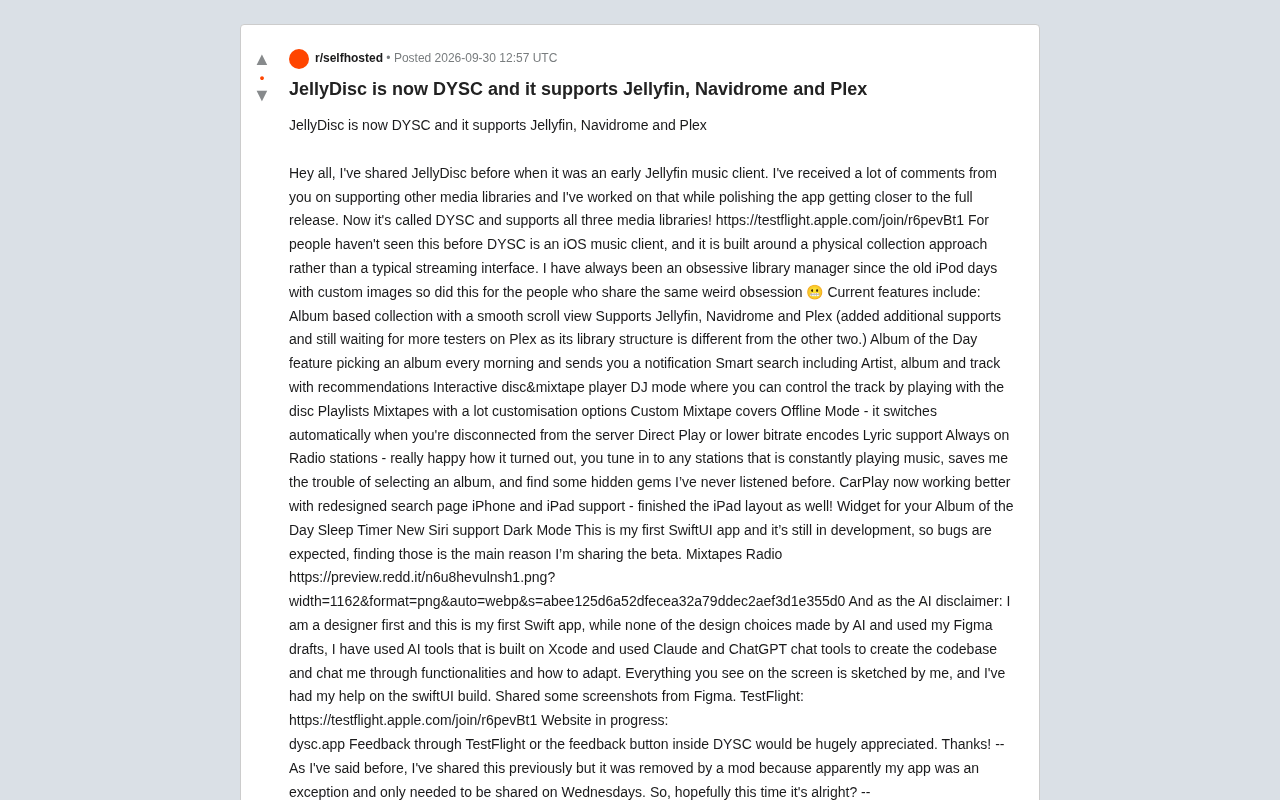
While Jellyfin, Navidrome, and Plex are all self-hosted media server solutions, they differ in design philosophy and architecture. Jellyfin is fully open-source and subscription-free, community-driven, and supports multiple media types including audio and video. Navidrome focuses exclusively on music and is built on the Subsonic API, with an extensive client ecosystem — nearly any Subsonic-compatible app can connect to it directly. Plex is the most commercially oriented of the three, offering both free and paid (Plex Pass) tiers, with metadata management and library structures that differ substantially from the other two — which is precisely why the DYSC developer noted that Plex integration requires extra work. For those considering setting up a self-hosted music library, Navidrome is the lightest to deploy, Jellyfin offers the most comprehensive features, and Plex has an edge in cross-device sync and family sharing.
An Interaction Philosophy Built Around Physical Collecting
DYSC's most distinctive characteristic is that it doesn't use the typical feed-style interface found in mainstream streaming apps. Instead, it's built around the concept of a physical record collection. The developer describes himself as someone who has had a "collection management obsession" since the old iPod days — the kind of person who custom-labels album artwork — and to some extent, this app was made for kindred spirits.
The specific interaction design includes:
- An album-centric collection view with smooth scrolling browsing
- Interactive vinyl and cassette tape players that recreate the feel of physical media
- DJ Mode, letting you control tracks by spinning the record, just like a real turntable
- Mixtape functionality with extensive customization options, including custom tape artwork
This design philosophy transforms "listening to music" from passive consumption into a ritualistic collecting experience — and for a certain kind of listener, that's a very compelling proposition.
Feature Rundown: From Daily Listening to Scenario Coverage
Beyond the core collecting experience, DYSC has put considerable work into feature completeness, aiming to cover a wide range of use cases:
Discovery
- Album of the Day: Selects an album each morning and sends a push notification
- Smart Search: Covers artists, albums, and tracks, with recommendations
- Always-On Radio: A continuously playing radio station you can tune into anytime — great for background listening and discovering obscure tracks without manually picking albums
Playback & Offline
- Offline Mode: Automatically switches when disconnected from the server
- Direct playback or low-bitrate transcoding: Balances audio quality with bandwidth
- Lyrics support and sleep timer
System Integration
- CarPlay: Redesigned search screen for a smoother in-car experience
- iPhone and iPad support: iPad layout is complete
- Album of the Day home screen widget
- New Siri support and dark mode
Looking at this list, DYSC is clearly no longer just a conceptual "toy" — it's evolving into a fully-featured music client suitable for everyday use.
An Honest Note on AI-Assisted Development
The developer included a remarkably candid "AI disclaimer" in his post: he is a designer by trade, and DYSC is his first Swift application. Every on-screen design came from his own Figma mockups, with no AI-generated visuals; however, on the code side, he relied on Xcode's built-in AI tools, along with Claude and ChatGPT, to build out the codebase, work through feature implementations, and handle server-specific adaptation logic.
This is actually a telling snapshot of what independent development looks like today: a design-led creator uses AI coding tools to clear a technical barrier, bringing ideas to life that would previously have required professional engineering expertise. It showcases what AI-assisted development makes possible — while also reminding users that apps built this way are still works in progress, bugs are to be expected, and that's precisely why the developer chose to launch via TestFlight.
Swift is Apple's programming language introduced in 2014, and it's the primary technology stack for building native iOS, iPadOS, and macOS apps. Compared to the older Objective-C, Swift has a more modern and readable syntax — but for designers without a programming background, mastering the SwiftUI framework and understanding async networking and state management still presents a real challenge. Over the past couple of years, the code generation and debugging capabilities of large language models like Claude and ChatGPT have advanced rapidly, making the path of "designer independently developing a complete iOS app" go from near-impossible to genuinely feasible. The potential risk with this approach is that AI-generated code can sometimes lack architectural consistency, and as features accumulate, maintenance can become difficult — which is also a reasonable explanation for why DYSC is launching via TestFlight rather than going straight to the App Store.
How to Join the Beta
DYSC is currently available for public beta testing through TestFlight, while the official website at dysc.app is still under construction. The developer encourages users to submit issues via TestFlight or the in-app feedback button — and is particularly eager for Plex users to join and help verify compatibility.
For anyone running a self-hosted Jellyfin, Navidrome, or Plex music library, DYSC offers a genuine alternative to mainstream clients. It won't be for everyone, but if the idea of a "physical record collecting experience in the digital age" resonates with you, this app is worth a try.
Related articles

"Black October": Did AI Uncover 3% of All Critical Vulnerabilities Ever?
A Reddit post claims 3% of all critical software vulnerabilities ever were found in the past month, dubbed 'Black October.' We break down the statistical issues, how AI-assisted code auditing accelerates discovery, and how developers should respond.

Microsoft Project Gecko: Using AI to Bridge Language Gaps for African Farmers
Microsoft's Project Gecko launches PharmaChat, letting African farmers ask questions in their native language and get precise video clips and farming book chapters via AI. The project also releases three interactive manuals to advance inclusive AI.

Musk's Space Dominance: How Starlink Throttling Undermines Ukraine's Defense
SpaceX's Starshield throttling disabled Ukraine's high-speed interceptor drones, exposing how Musk's private control over low Earth orbit communications affects battlefield dynamics and national security, and highlighting the risks of commercial space militarization and space governance dilemmas.