Jensen Huang Steps Down as NVIDIA CEO: The Corporate Governance Crisis Behind the Affair and Espionage Allegations

NVIDIA's board swiftly cuts ties with CEO Jensen Huang over two affair scandals, raising governance and strategic continuity fears.
After a late-night meeting, NVIDIA's board announced co-founder, president, and CEO Jensen Huang's departure, using "separated from" to suggest a negotiated break. The trigger: two affairs—one with a woman alleged to be a Chinese spy, elevating scandal to national security and supply-chain trust issues; the other with an exec reporting directly to Huang, touching governance red lines. The event exposes founder-centric governance fragility. No successor was named, threatening short-term investor confidence and testing long-term board governance.
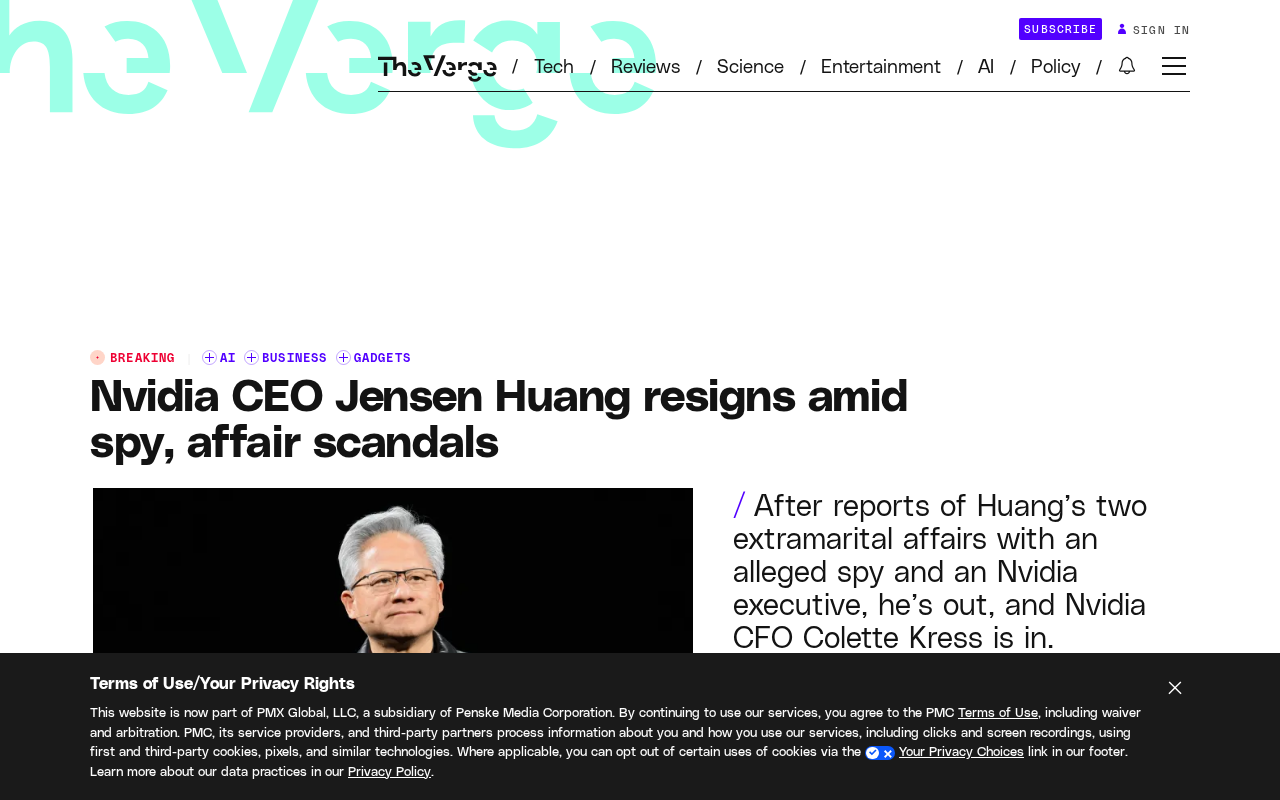
NVIDIA's board of directors has severed ties with Jensen Huang. The long-serving co-founder, president, and CEO has departed following two reports of extramarital affairs—one involving a woman alleged to be a Chinese spy, and the other involving an NVIDIA executive who reported directly to Huang.
How It Unfolded: A Lightning Announcement After a Late-Night Board Meeting
According to the original report, NVIDIA's board convened a late-night meeting on Wednesday, then issued a press release on Thursday announcing that Huang had resigned from his roles as CEO, president, and other positions. The release was brief and disclosed no further investigative details, but it explicitly identified the two extramarital affairs as the direct trigger for the board's decision.
The impact of this news lies in how deeply Huang was intertwined with NVIDIA. As co-founder and long-time leader, he was not only the company's strategist but also the central embodiment of its public image in the AI chip sector. The board's choice to announce the decision swiftly after a late-night meeting indicates that consensus on the "separation" had already been reached internally, rather than the matter being mired in protracted negotiation.
Two Affairs: How Personal Scandal Became a Governance Event
The first affair involved a woman alleged to be a Chinese spy. This allegation escalated what might otherwise have remained a matter of personal morality into a sensitive issue involving national security. For a semiconductor company at the center of the AI compute supply chain and highly dependent on global markets, such an association is enough to trigger alarm among both regulators and customers.
The second affair involved an NVIDIA executive who reported directly to Huang. This reporting relationship pushed the matter from "private relationship" into "conflict of interest under unequal power dynamics"—an intimate relationship between a CEO and a subordinate is a governance red line at any public company, and even more so at an enterprise of NVIDIA's scale.
With both incidents combined, the board no longer faced the question of "whether to tolerate the founder's private life" but rather the question of "whether the CEO position has been tainted by personal relationships."
The Board's Logic: Why "Separation" Rather Than "Suspension Pending Investigation"
Judging from the language of the announcement, the board chose the phrase "separated from" rather than a one-directional description like "resigned" or "was fired." This wording is common in negotiated departures and suggests the possible existence of severance or transition agreements.
More critical is the timeline: a late-night meeting followed by an announcement the next day, leaving almost no buffer period for the outside world. This typically means the board already possessed sufficient information and believed the cost of further delay would exceed that of immediate action. For a public company, any delay in disclosing a CEO's involvement in espionage allegations and internal conflicts of interest could invite scrutiny from securities regulators.
Potential Impact on NVIDIA: Short-Term Shock and Long-Term Governance Challenges
In the short term, Huang's departure will directly hit investor confidence. NVIDIA is in the midst of an AI chip demand surge, and a CEO change will raise market concerns about strategic continuity—especially since the outside world has long viewed Huang's personal judgment and NVIDIA's product roadmap as one and the same.
In the long term, this event exposes the governance fragility of founder-centric companies. When a CEO's personal conduct is tightly bound to corporate reputation, a single scandal is enough to shake the stability of the entire organization. The board's rapid separation is, in part, a signal to the market that "governance mechanisms are still functioning," but it also confirms the severity of the problem.
The press release did not mention succession arrangements, which will be the most closely watched variable going forward. Who steers the company during the transition, whether Huang retains a board seat, and whether related investigations will be further disclosed will all determine the ultimate trajectory of this crisis.
Founder-Centric Company refers to a corporate form in which strategic direction, brand image, and even organizational culture are highly dependent on a single founder. Typical characteristics include: long founder tenure, deep entanglement of personal prestige with corporate reputation, and major decisions that often bypass standard governance processes. NVIDIA, Tesla, Meta, and others fall into this category. The advantage is high decision-making efficiency and strong strategic coherence; the risk is "key-person dependency"—once the founder faces personal scandal, health issues, or errors of judgment, the shock transmits directly to the corporate level. In recent years, discussion of the governance discount applied to such companies has grown in capital markets, with institutional investors broadly calling for stronger independent director ratios and disclosure mechanisms for succession plans to reduce systemic risk stemming from a single individual.
"Separation" vs. "Resignation" carry different meanings in Anglo-American corporate law and governance practice. Resignation typically refers to an executive voluntarily stepping down; separation more often refers to a departure arrangement reached through negotiation between the board and the executive, frequently accompanied by a transition period, severance, or confidentiality clauses. Using "separated from" rather than "resigned" implies, at the regulatory disclosure level, that both parties have reached agreement on responsibility allocation and compensation terms, while avoiding the defamation or breach-of-contract litigation risks that "termination" might invite. For public companies, this choice of wording is itself a governance signal, and investors and regulators typically use it to gauge the depth of internal investigation and the degree of board control.
Frequently Asked Questions
Why did Jensen Huang leave NVIDIA? According to the board's announcement, the direct cause was two reports of extramarital affairs: one involving a woman alleged to be a Chinese spy, and the other involving an NVIDIA executive who reported directly to Huang.
Was this a resignation or a termination? The announcement used the phrase "separated from," which typically indicates a negotiated departure arrangement; specific terms were not disclosed.
Who will succeed as NVIDIA CEO? The press release did not disclose any successor information.
One-line Summary
NVIDIA's board made a swift break with CEO Jensen Huang over two affair scandals, raising governance and strategic continuity concerns.
Paragraph Summary
After a late-night meeting, NVIDIA's board swiftly announced the departure of co-founder, president, and CEO Jensen Huang, using the phrase "separated from"—suggesting a negotiated separation. The direct trigger was two reports of extramarital affairs: one involving a woman alleged to be a Chinese spy, elevating a personal scandal into an issue of national security and supply-chain trust; the other involving an NVIDIA executive reporting directly to Huang, touching the governance red line of power imbalance under the CEO. The event exposes the governance fragility of founder-centric companies—where a CEO's personal conduct is tightly bound to corporate reputation. The announcement disclosed no succession plan, which will hit investor confidence in strategic continuity in the short term and test the effectiveness of the board's governance mechanisms in the long term.
Related articles

Dify in Practice: Three Ways to Build an AI Literacy Teaching Assistant Chatbot
Bilibili creator Peter Sun Dasheng demonstrates three ways to build an AI literacy teaching assistant chatbot in Dify: manual Chatflow, AI-assisted workflow generation, and Agent creation via natural language, covering knowledge base integration, publishing permissions, and monitoring.

One Settings File Leaks a Thousand Keys: The Security Blind Spot in AI Coding Tools
Over 100,000 Claude Code settings files exposed on GitHub, 1,122 with real high-privilege keys. How a convenience feature bypasses version control, plus Anthropic's new models, evaluation credibility crisis, and local backlash against data centers.
Claude Fable 5.2 Review and AI Agent Memory Mechanisms Explained
An in-depth review of Claude Fable 5.2's coding vs. general-task performance, analysis of the redacted-data controversy in the AI-accelerating-AI report, and a breakdown of Agent Memory's layered memory and dreaming mechanisms.