Jensen Huang Steps Down as NVIDIA CEO: Who Is Interim Successor Colette Kress?

Jensen Huang steps down as NVIDIA CEO amid scandal; CFO Colette Kress takes over as interim CEO, raising questions about strategic continuity.
The article examines the sudden event in which NVIDIA CEO Jensen Huang steps down after becoming embroiled in a scandal, with CFO Colette Kress appointed interim CEO. The original text only mentions "embrolled in scandal" without disclosing details, leaving key information unclear, including the nature of the scandal, whether Huang retains other positions, and the length of the interim term. The article analyzes the logic of the common governance transition arrangement of a CFO becoming interim CEO: maintaining operational stability, continuing financial discipline, and buying time for the board to select a formal successor. It also notes that Huang, as an iconic figure deeply tied to NVIDIA's GPU strategy and AI computing narrative, may affect customer confidence and partner relationships upon departure, and the longer the transition period, the greater the strategic uncertainty. The article concludes by emphasizing that with incomplete information, official announcements should be monitored rather than a single RSS source.
NVIDIA CEO Jensen Huang has stepped down amid a scandal, and CFO Colette Kress is serving as interim CEO. This leadership change has drawn widespread industry attention: Who is Kress? Can she steady the ship? This article outlines the background of the event and Kress's career trajectory.
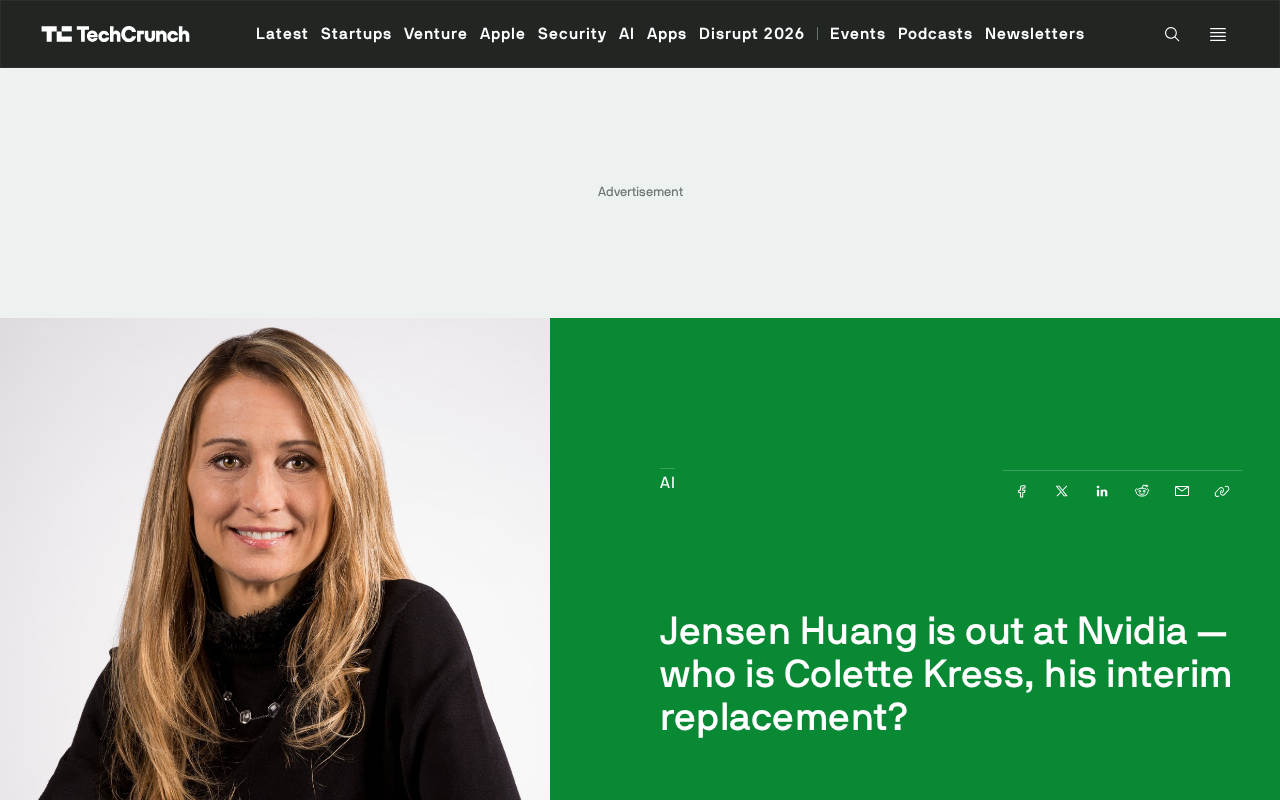
Jensen Huang Steps Down: A Sudden Scandal
According to the RSS source, NVIDIA's longtime CEO Jensen Huang has left the company after becoming embroiled in a scandal, and CFO Colette Kress has been appointed as interim replacement. The original text only mentions "embrolled in scandal" without disclosing specific details, so key information—such as the nature and scope of the scandal and whether Huang has fully exited the board—remains unclear.
The impact of this news lies in Huang's deep ties to NVIDIA—he is not only the company's CEO but also the iconic figure behind NVIDIA's GPU strategy and AI computing narrative. A sudden leadership change is extremely rare in NVIDIA's history, and the market has many questions about Kress's transitional role and the continuity of the company's strategy.
Corporate Governance Implications of an Interim CEO
An interim CEO is a transitional top executive appointed by the board during a vacancy in the formal CEO position, typically arising when a CEO suddenly departs, retires, or the company falls into crisis. Unlike a formal CEO, an interim CEO's mandate is often limited to "maintaining operational stability" rather than "driving strategic change," with terms ranging from a few weeks to more than a year. Common candidates include CFOs, COOs, or retired former executives. Governance research shows that appointing an internal finance executive as interim CEO helps signal "continuity of financial discipline," but may also be interpreted by the market as a sign that the board has not yet found a strategic successor. During an interim CEO's tenure, the board typically launches a formal CEO search in parallel, and whether the interim CEO is promoted depends on their transitional performance and the board's long-term strategic needs.
Jensen Huang's Founder-CEO Bond with NVIDIA
Jensen Huang is one of NVIDIA's co-founders in 1993 and has served as CEO for most of the company's history, making him a classic "founder CEO." Such leaders are often deeply tied to a company's technology roadmap, corporate culture, and capital market narrative—NVIDIA's transformation from a gaming graphics card maker to a core supplier of AI computing is inseparable from Huang's personal judgment on GPU strategy. Corporate governance research generally holds that the sudden departure of a founder CEO brings higher "key-person risk," because the trust of investors, customers, and partners is partly built on personal reputation. This is also the structural reason why the change has drawn intense market attention: NVIDIA faces not just a CEO succession but a test of strategic and narrative continuity.
Colette Kress: From CFO to Interim CEO
Colette Kress has long served as NVIDIA's Chief Financial Officer and is the core steward of the company's financial system. Against the backdrop of Huang's departure, having the CFO temporarily take over as CEO is a common corporate governance transition arrangement aimed at maintaining operational stability and buying time to find a formal successor.
As CFO, Kress's responsibilities cover financial planning, investor relations, capital allocation, and risk control. This experience makes her familiar with the company's overall operations, but the CEO role also requires greater responsibility for strategic decisions, product roadmap, and external communication. The original text does not provide Kress's detailed resume or past performance data, so her management style cannot be further quantified.
The appointment of an interim CEO usually means the board wants a smooth transition rather than a radical pivot. Kress's primary task may be to stabilize the team and investor confidence while working with the board to advance the formal CEO selection.
Differences Between CFO and CEO Responsibilities
Although the Chief Financial Officer (CFO) and Chief Executive Officer (CEO) are both C-suite executives, their responsibilities differ significantly. The CFO's core functions include financial planning and analysis, capital allocation, investor relations, risk control, and compliance disclosure, with work grounded in historical data and financial discipline. The CEO is responsible for the company's overall strategic direction, product roadmap, organizational culture, external ecosystem relationships, and board communication, with decisions that are more forward-looking and uncertain. The advantage of a CFO-to-CEO transition arrangement is a high degree of familiarity with the company's financial condition and operational details, enabling rapid stabilization of investor confidence; the challenge is the need to quickly establish authority in technical vision, product judgment, and external strategic communication—especially at technology-driven companies, where this gap may be magnified.
Potential Impact on NVIDIA
Huang's departure comes at a time when NVIDIA is at the center of AI chip competition. The company's business relies heavily on data center GPUs and AI computing demand, and leadership changes may affect customer confidence and partner relationships. The longer the interim CEO transition period, the greater the strategic uncertainty.
From a governance perspective, the CFO taking over as interim CEO helps ensure continuity of financial discipline, but in terms of technical vision and ecosystem building, Kress needs to quickly establish authority. The original text does not mention whether the board has launched a formal successor search, nor whether Huang's departure will affect the company's established product roadmap.
Open Questions
Public information is currently limited, and several key questions remain unanswered: What are the specific details of the scandal? Does Huang retain any position? How long is Kress's interim term expected to last? Has NVIDIA's board established a successor search committee? The answers to these questions will determine the actual impact of this change.
With incomplete information, market participants should focus on NVIDIA's official announcements and subsequent disclosures rather than relying on a brief report from a single RSS source.
Conclusion
Jensen Huang has stepped down as NVIDIA CEO due to a scandal, and CFO Colette Kress is serving as interim CEO. This change highlights the importance of corporate governance transitions and leaves many questions about the scandal details and succession plan. Kress's financial background provides a foundation for a stable transition, but the formal CEO candidate and strategic direction remain the focus of future attention.
Related articles

MiniMax H3 Image Open-Source Hands-On: 16 Reference Images, Poster Typography, and Agent-Based Image Generation Explained
Hands-on review of MiniMax's open-source H3 Image model: compared with GPT, Gemini, and Doubao on Chinese poster typography, 16 reference images, exploded views with Chinese labels, plus API integration with DeepSeek Harness for Agent-driven generation and recoloring.

DeepSeek Open-Sources Harness: A Plugin-Based Dev Tool with 270K Stars
DeepSeek's official open-source Harness hits 270K GitHub stars, written in TypeScript under MIT. We break down its plugin architecture, multi-model comparison, four use cases, and a three-step start.

New Claude Code Workflow: 9 Open-Source Skill Packs Take Over the Entire PR Lifecycle
Theo open-sources 9 AI agent skill packs for Claude Code and Codex, covering test verification, multi-model code review, PR submission, CI fixes, and auto-merge, with the main skill proving the problem first and humans retaining final merge authority.