Jepsen Publishes ParticleDB 1.1.4 Test Report, Renewed Interest in Distributed Database Verification

Jepsen publishes a ParticleDB 1.1.4 test report, sparking community discussion about database reliability.
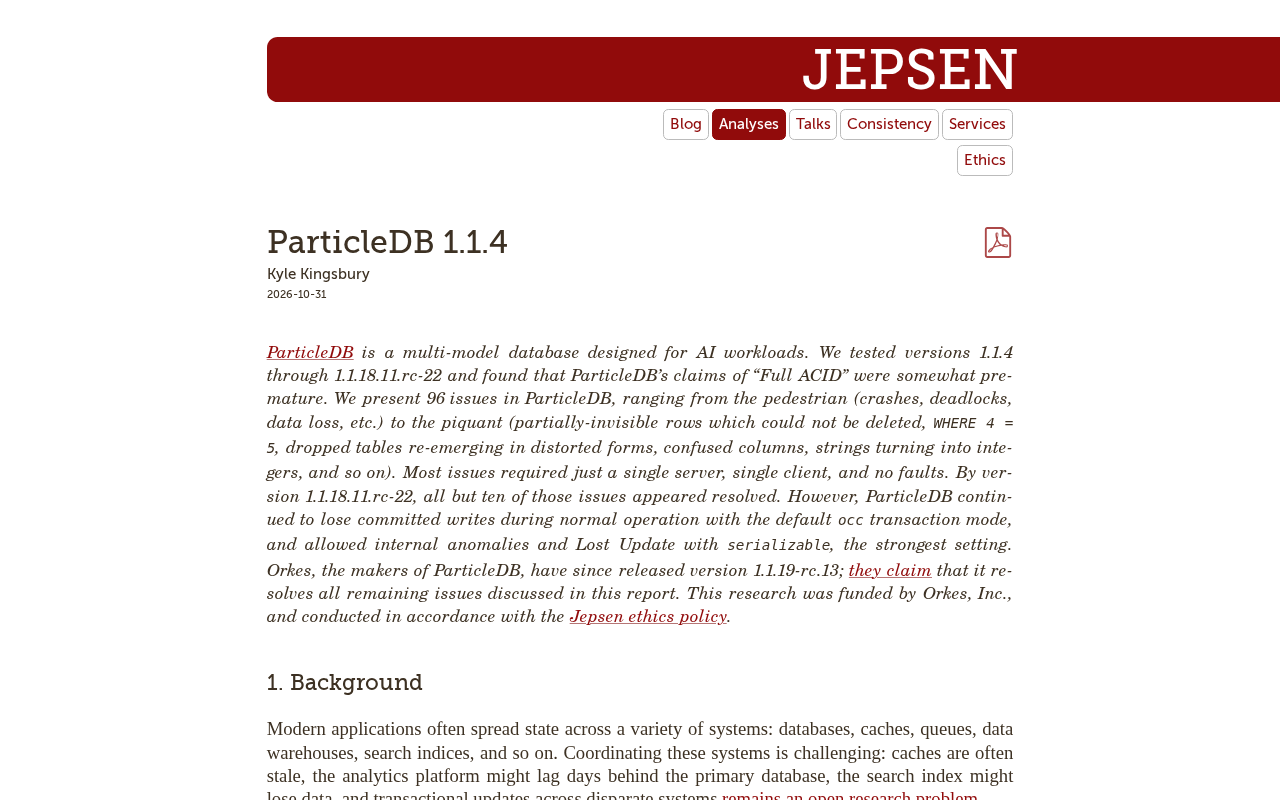
Jepsen published a test report on ParticleDB 1.1.4 on GitHub, and the Hacker News discussion received 236 points and 133 comments. Jepsen is known for fault injection and consistency checking, and its reports are often seen as an important third-party reference for database capability claims. This test follows the engineering verification approach and focuses on system behavior under abnormal conditions. The article notes that vendor documentation and benchmarks struggle to cover real edge cases such as network partitions and node failures, while Jepsen uses controllable fault scenarios to check whether the system maintains its claimed consistency semantics. Community discussion serves as a second layer of information, but empirical opinions must be distinguished from reproducible conclusions. Teams selecting databases should combine the original report, community feedback, and their own workload characteristics in their judgment.
Jepsen Releases ParticleDB 1.1.4 Test Results
The distributed systems verification team Jepsen has published a test report on ParticleDB version 1.1.4 on GitHub. The related discussion on Hacker News reached 236 points and 133 comments, drawing renewed attention from the developer community to database reliability verification.
Jepsen is known for performing fault injection and consistency checking on distributed databases, and its test reports are often regarded as an important third-party reference for the capabilities that database products claim. This test of ParticleDB 1.1.4 continues Jepsen's consistent engineering-style verification approach, focusing on the system's behavior under abnormal conditions.
Why Jepsen Testing Is Worth Attention
For technical teams in the process of selection, vendor documentation and benchmarks often struggle to cover real-world edge cases such as network partitions and node failures. Jepsen constructs controllable fault scenarios to check whether a system can still maintain the consistency semantics it claims, thereby exposing issues beyond paper specifications.
The test results for ParticleDB 1.1.4 therefore have reference value: they are not only an evaluation of a single version, but also provide an external perspective for the community to understand the project's design trade-offs. The active discussion on Hacker News further shows that developers' attention to database reliability has not cooled.
Jepsen's Testing Methodology
Jepsen is an open-source distributed systems testing framework written in Clojure. Its core idea is to run a set of concurrent clients on a database cluster while using a "nemesis" to artificially create anomalies such as network partitions, node crashes, clock skew, and process pauses. It then records the history of all operations and uses a checker to verify whether that history satisfies the consistency model claimed by the system (such as linearizability, sequential consistency, causal consistency, etc.). If the checker finds a violation, Jepsen generates a reproducible failure sequence and a detailed timeline diagram. This approach of "black box + fault injection + formal verification" can expose semantic flaws in distributed systems under extreme conditions more effectively than vendor self-run benchmarks.
Practical Implications of Consistency Models and CAP
Distributed databases often claim to support "strong consistency" or "eventual consistency," but in engineering these terms need to correspond precisely to formal definitions. For example, linearizability requires all operations to appear to take effect atomically at some point on a global clock, while sequential consistency allows different clients to observe different orders of operations. The value of Jepsen reports lies in using executable tests to check whether a system truly satisfies the model it claims, rather than merely staying at the level of documentation. For teams evaluating options, understanding whether the target system chooses to sacrifice availability (CP) or consistency (AP) during partitions, and the specific impact of that trade-off on business read/write paths, is more critical than simply looking at a slogan that says "supports ACID."
The Value and Boundaries of Community Discussion
The 133 comments on Hacker News form a second layer of information beyond the report. Discussion usually revolves around testing methodology, interpretation of specific failure scenarios, and the practical meaning of the results for production environments. This kind of community feedback can supplement the report's more technical wording, but it is also necessary to distinguish empirical opinions from reproducible conclusions.
Typical Composition of Hacker News Discussion
Discussion on Hacker News around Jepsen reports usually includes several types of content: responses and clarifications from project maintainers, cross-validation by other database engineers of similar failure modes, questions about whether the test configuration is fair, and users sharing production environment pitfalls. These discussions can sometimes reveal boundary conditions not covered by the report (such as behavior differences under specific version patches or specific deployment topologies), but they can also easily include unreproduced anecdotal conclusions. Readers are advised to treat discussion threads as "clues to problems" rather than "final rulings," and for specific technical claims raised in them, prioritize finding reproducible test cases or official issue links as supporting evidence.
How to View Such Test Reports
Jepsen reports are an important input for evaluating distributed databases, but they are not the only basis. When selecting options, teams should also make comprehensive judgments based on their own workload characteristics, operational capabilities, and version iteration pace. It is recommended to directly consult the original test content on GitHub and compare it with the specific issues raised in the Hacker News discussion to form an independent judgment about ParticleDB 1.1.4.
The information in this article mainly comes from the official Jepsen repository and the Hacker News discussion thread, and no additional inferences have been made about the test conclusions.
One-line Summary
Jepsen has published a ParticleDB 1.1.4 test report, sparking community discussion about database reliability.
Paragraph Summary
Jepsen published a test report on ParticleDB 1.1.4 on GitHub, and the Hacker News discussion received 236 points and 133 comments. Jepsen is known for fault injection and consistency checking, and its reports are often regarded as an important third-party reference for the capabilities databases claim. This test continues the engineering-style verification approach and focuses on system behavior under abnormal conditions. The article points out that vendor documentation and benchmarks struggle to cover real edge cases such as network partitions and node failures, while Jepsen uses controllable fault scenarios to check whether a system maintains the consistency semantics it claims. Community discussion forms a second layer of information, but empirical opinions must be distinguished from reproducible conclusions. Teams evaluating options should make comprehensive judgments based on the original report, community feedback, and their own workload characteristics.
Related articles

Qwen 3.8 Beats Opus at Coding—But Can Your Mac Run It?
Open-source Qwen 3.8 beats Opus 4.6 at coding at just 18GB, but how much Mac memory do you need? 24GB crashes; 32GB is the sweet spot. Full config guide inside.

Claude Code + Agent: Building a Fully Automated AI Testing Loop
Bilibili course breakdown: how test developers can use Claude Code terminal-based Agents to build a fully automated AI testing loop. Compares permission boundaries of terminal vs. device Agents, explains why enterprise projects choose Claude Code over Open Claude-type tools, and outlines the Node.js environment setup and DeepSeek model integration path.

Working with AI Agents Requires Nerves of Steel
The more autonomous AI agents become, the heavier the user's psychological burden. Drawing from a Hacker News discussion, this article analyzes black-box anxiety, behavior drift, and monitoring fatigue in agent collaboration, and offers practical approaches like sandbox isolation, permission control, and task granularity management to reduce cognitive load.