Jerk Oracle Retiming: Solving Fast-Motion Smearing and Ghosting Artifacts in MiniMax H3

Jerk Oracle retiming fixes MiniMax H3 fast-motion smearing by intelligently redistributing temporal token budgets.
MiniMax H3's video diffusion model compresses 4 frames into a single latent token, causing smearing artifacts during fast motion. The open-source Jerk Oracle solution detects high-jerk (third derivative of motion) burst points in latent space, inserts held frames to slow down critical moments, applies partial video-to-video denoising to preserve choreography, then drops held frames to restore real-time speed. Audio is jointly retimed with pitch preservation. Limitations include background motion clock-speed side effects.
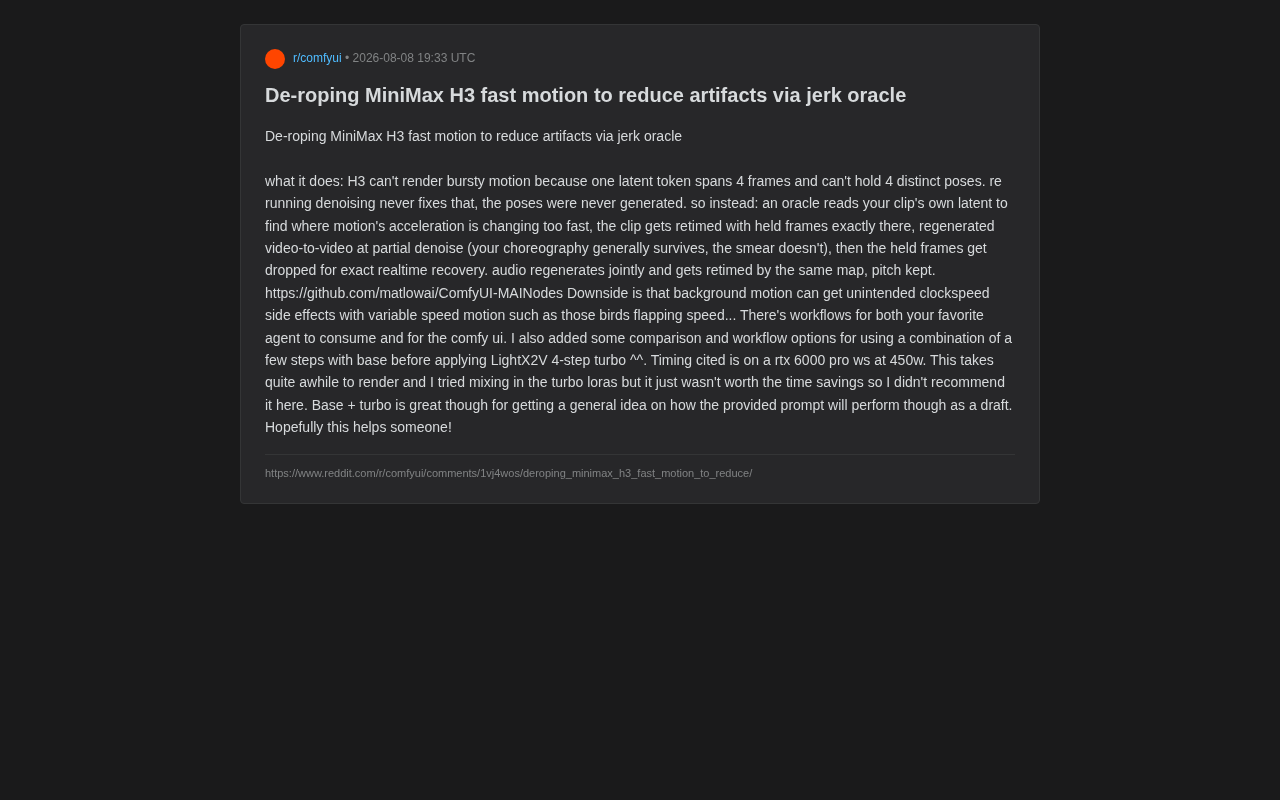
AI video generation models often produce smearing, ghosting, and other artifacts when handling fast, explosive motions — a common pain point with current video diffusion models. Recently, a developer shared an innovative solution on Reddit targeting the MiniMax H3 model: using a "jerk oracle" to "de-rope" fast motions, fundamentally reducing motion artifacts. This method has been open-sourced as a ComfyUI plugin project, offering the video generation community a noteworthy technical approach.
Root Cause: One Latent Token Spans 4 Frames
To understand this solution, you first need to grasp why the H3 model struggles to render explosive motion. According to the author's analysis, the core issue lies in the model's temporal compression mechanism: a single latent token spans 4 frames of video.
In video diffusion models, raw video data is first compressed into a low-dimensional "latent space" via a Variational Autoencoder (VAE) for processing. This compression occurs not only in the spatial dimension (reducing resolution) but also in the temporal dimension (merging multiple frames). H3's 4-frames-in-1 strategy means that if the output video is at 24fps, each latent token effectively represents a time window of approximately 167 milliseconds. This is sufficient for everyday movements, but for explosive motion scenarios like martial arts or sports, a person's body pose can change dramatically within 167ms. The design rationale behind this temporal compression is to reduce computational cost — fewer tokens means lower computational complexity for the attention mechanism (which scales quadratically with sequence length) — but the trade-off is sacrificed temporal expressiveness.
This means that within those 4 frames' time span, the model can only maintain a single coherent set of pose information and cannot simultaneously accommodate four distinctly different poses. When fast motion appears on screen — a punch, a sprint, or a flip — those 4 frames should show noticeably different poses, but constrained by a single token's expressive capacity, the model can only generate a blurry "averaged state," ultimately manifesting as smearing and ghosting.
The author highlights a critical insight: re-running denoising can never fix this problem. Because those missing poses were never generated in the first place, repeated denoising merely polishes existing information — it cannot conjure intermediate poses out of thin air. This insight directly addresses the common misconception that "running a few more sampling passes will make it better."
Core Solution: The Jerk Oracle Reads Latent Signals for Intelligent Retiming
Since the problem stems from insufficient temporal resolution, the author's approach is not to fix the frames but to redistribute time. The entire solution revolves around a mechanism called the "jerk oracle."
In physics, jerk refers to the rate of change of acceleration (the third derivative of position with respect to time). In classical mechanics, the first derivative of position with respect to time is velocity, the second is acceleration, and the third is called jerk. Jerk describes how rapidly acceleration changes — in everyday life, moments with high jerk values correspond to abrupt changes in motion state, such as the instant a boxer throws a punch or a dancer stops and pivots. In engineering, jerk is a critical parameter in elevator control, robotic trajectory planning, and train braking systems, since excessive jerk causes passenger discomfort or structural damage to mechanical components. Introducing the concept of jerk into video generation is a clever cross-disciplinary transfer: this oracle reads the latent representation of the video clip directly, estimating the third derivative of the motion signal in latent space to precisely locate temporal points where motion acceleration changes too rapidly — the "burst points" most prone to producing artifacts.
Held Frame Insertion and Retiming Strategy
Once these high-jerk regions are identified, the solution retimes the clip by inserting "held frames" at these critical positions. This effectively slows down the temporal rhythm at explosive motion points, giving the model a larger token budget to express continuous poses.
Video-to-Video Partial Denoising
The retimed clip is then regenerated through video-to-video partial denoising. In the standard diffusion model generation pipeline, images or videos start from pure noise and gradually become clear content through multiple denoising steps. Video-to-video partial denoising is a conditional generation technique: instead of starting from pure noise, it adds a certain proportion of noise to an existing video (corresponding to some intermediate timestep in the diffusion process) and then denoises from that intermediate state. The proportion of noise added determines the "degree of change" — more noise means greater deviation from the original video; less noise means greater fidelity to the original content.
The author emphasizes the use of "partial denoise" here, and the benefit is: your originally designed choreography is largely preserved, while the smearing and ghosting are eliminated. This is an elegant balance — fixing artifacts without destroying the user's intended motion. In essence, it finds the optimal balance between "preserving content" and "repairing defects."
Precisely Restoring Real-Time Playback Speed
In the final step, the previously inserted held frames are discarded, precisely restoring real-time playback speed. This way, the final output video maintains its original playback rhythm while eliminating artifacts at fast-motion points.
Audio Synchronization and Known Limitations
One highlight of this solution is its joint audio processing. The author mentions that audio is regenerated jointly with video and adjusted according to the same retiming map, with pitch kept intact.
When video is retimed (i.e., locally sped up or slowed down), synchronized audio also needs corresponding adjustment. Simply stretching or compressing the audio waveform would change its pitch — slowing down lowers pitch, speeding up raises it — producing unnatural results. Pitch-preservation techniques are typically implemented using algorithms like phase vocoders or WSOLA (Waveform Similarity Overlap-Add). The core idea is to decouple the temporal structure (rhythm, duration) from the frequency structure (pitch, timbre) of audio, allowing time to be independently stretched or compressed without affecting pitch. This solution integrates this professional-grade post-production technique into an automated pipeline, eliminating the need for manual audio post-processing and ensuring natural audio-visual synchronization.
However, the author also candidly acknowledges the solution's limitations. Due to the variable-speed motion processing, background motion may exhibit unintended "clock speed" side effects. He gives a specific example: the wing-flapping speed of birds in the frame may be affected and appear unnatural. This is an unavoidable knock-on effect of retiming — when you adjust the temporal rhythm for a foreground subject, periodic motions in the background that were originally normal get stretched or compressed as well.
Performance and Practical Workflow Tips
Regarding performance, the author provides clear hardware benchmarks: all timing data was measured on an RTX 6000 Pro workstation (450W TDP). He states frankly that this pipeline "takes quite a while to render."
You might have missed the author's hands-on findings about acceleration options. He tried mixing in turbo LoRA to save time, but concluded it "wasn't worth it" — the time savings didn't justify the quality loss, so he didn't recommend it for the production pipeline. LoRA (Low-Rank Adaptation) is a parameter-efficient fine-tuning technique that adjusts model behavior by injecting low-rank decomposition matrices into the model's weight matrices without modifying the original weights. Turbo LoRA specifically refers to LoRA adapters that have been distillation-trained to enable diffusion models to produce acceptable results with fewer denoising steps. LightX2V is an acceleration framework for video diffusion models that reduces computation through model architecture optimization and inference strategy improvements. The author's mention of "4-step turbo" means the denoising process — which might normally require 20–50 steps — is compressed to just 4 steps. While this aggressive step reduction dramatically increases speed, it's still not mature enough for final-output quality requirements.
However, he recommends a practical compromise: Base + Turbo combination for quick drafts. By running a few steps with the base model and then applying LightX2V 4-step turbo, you can quickly preview what a prompt will roughly produce — very efficient for draft evaluation. This is a solid efficiency tip for creators who need to iteratively refine their prompts.
Additionally, the project provides two workflow variants in the ComfyUI plugin (ComfyUI-MAINodes): one for direct consumption by AI agents and another for the ComfyUI graphical interface, accommodating both automated pipelines and manual creative workflows.
Conclusion and Reflections
The value of this solution lies not only in solving a specific technical problem but also in embodying a sound approach to dealing with model architecture limitations: rather than endlessly polishing downstream information that the model never generated, it's better to redistribute the model's limited expressive budget along the temporal dimension.
For the video generation field, a single latent token spanning multiple frames represents an inherent trade-off between compression efficiency and motion expressiveness. Until model architectures themselves are upgraded, "retiming" post-processing techniques like the jerk oracle provide the community with a pragmatic mitigation strategy. Of course, the knock-on side effects on background motion remind us that any temporal intervention comes at a cost — and this is precisely a direction worth optimizing in future iterations of such methods.
Related articles

Amphibious Transforming Drone: Beyond 100x Power Savings, What Are the Real Needs?
Is the amphibious transforming drone just a gimmick? Starting from the 100x power difference of the M4 Morphobot, explore real application scenarios and thesis topic ideas, analyzing boundary conditions where pure drones and pure ground robots both fail.

Warhound Raises $200 Million: Genetically Engineered "War Dogs" Paired with Anduril Gear
Warhound raises $200M, backed by Ben Lamm and Palmer Luckey, to genetically engineer dogs for military and law enforcement use and equip them with Anduril gear. This article analyzes its technology direction, funding logic, and ethical controversy.

Claude API Comes to Google Cloud: IAM Integration and SDK Access Guide
Anthropic hosts the full Claude API on Google Cloud with IAM-controlled permissions and unified billing. This guide covers the Vertex AI and Anthropic-hosted entry points, IAM role configuration, and SDK access.