Jev-Leftpad: A Minimalist Open Source Experiment That Sparked a Heated Debate

jev-leftpad trends on Hacker News, reigniting classic debates around dependency management and supply chain security.
The GitHub project `jev-leftpad` recently earned 205 upvotes and 72 comments on Hacker News, drawing attention through its nod to the 2016 `left-pad` incident — when a developer unpublishing a tiny npm package brought down build pipelines for React, Babel, and much of the front-end ecosystem. The new project's viral moment shows the community's enduring interest in questions like "are micro-packages ever necessary?" and "where should dependency boundaries lie?" With JavaScript now offering native methods like `padStart`, the practical case for such micro-packages has largely evaporated — making experimental projects like this one valuable less for their code than as a lens for debating engineering philosophy.
A Small Project That Made It to the Top of Hacker News
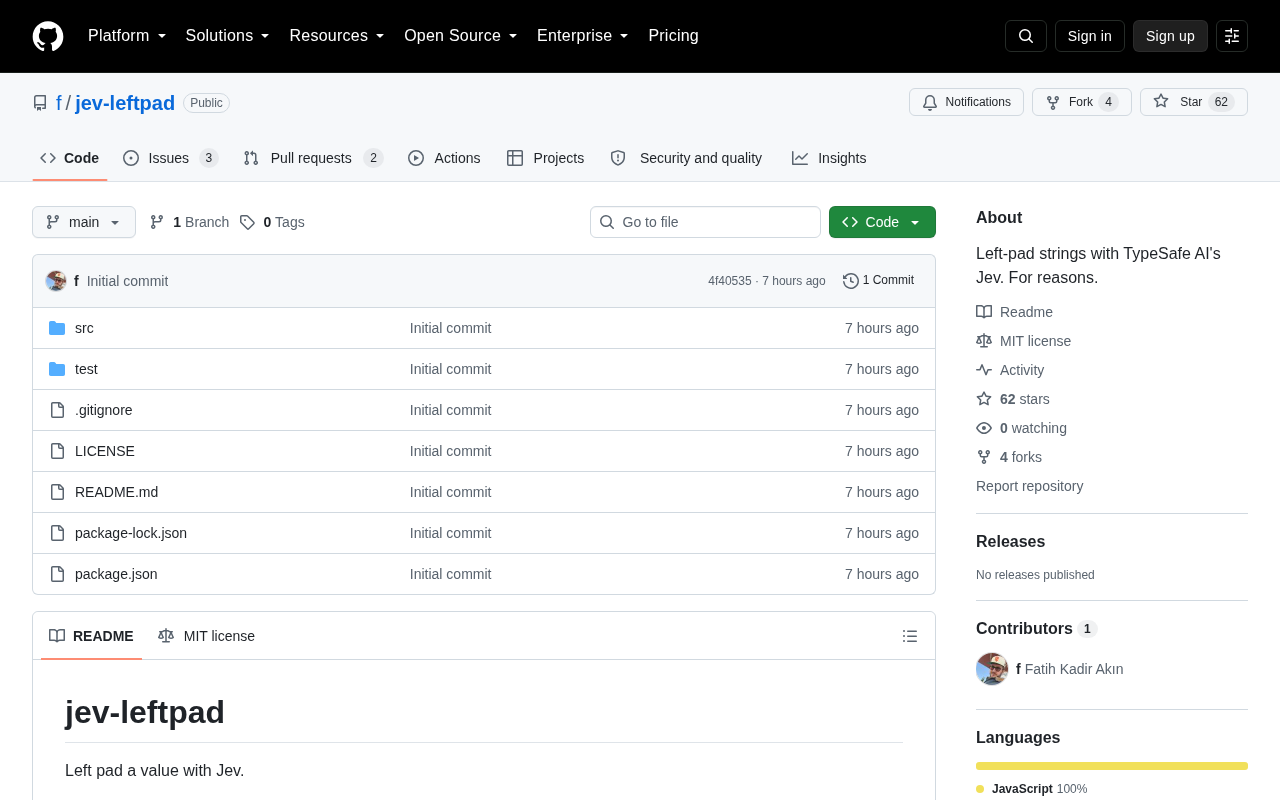
Recently, a GitHub project called jev-leftpad earned 205 upvotes and 72 comments on Hacker News, landing it on the community's trending discussion list. The project lives at github.com/f/jev-leftpad, and its name alone signals a deliberate nod to the infamous left-pad incident.
For developers who follow the open source ecosystem, left-pad is an unavoidable piece of history — a string-padding utility with barely a dozen lines of code that, when its author unpublished it from npm, triggered a cascading failure across the entire JavaScript ecosystem. Any new project named after leftpad is almost certainly paying homage to — or reflecting on — that moment.
What the Name Tells Us About the Project's Intent
The jev prefix in jev-leftpad likely points to a specific implementation approach or runtime environment — perhaps a JavaScript engine, validator, or experimental toolchain. This kind of naming is often a deliberate piece of developer humor: take the simplest, most universally recognized function (left-padding a string) and use it to demonstrate or validate a much bigger technical idea.
In the open source community, left-pad has long since outgrown its identity as a utility. It's become the go-to case study for discussions about dependency management, the boundaries of code reuse, and whether micro-packages are ever truly justified. The fact that a new leftpad implementation can quickly trend on Hacker News is itself a testament to how much staying power these topics have.
Why Small Projects Can Spark Big Conversations
In tech communities, the volume of discussion is rarely proportional to lines of code. It's precisely these "small but pointed" projects that tend to ignite the strongest exchanges of opinion — they compress complex engineering philosophy into a function simple enough for anyone to understand. Seventy-two comments typically means the community is using the project as a vehicle to debate deeper issues, not simply critiquing a string-padding implementation.
The Lasting Echo of the left-pad Incident
To understand why projects like this matter, you have to go back to the original event. A developer, embroiled in a trademark dispute, unpublished several of his npm packages — including left-pad, a tiny utility that simply pads the left side of a string with spaces or characters. Because a vast number of mainstream projects (including dependency chains for Babel, React, and others) indirectly relied on it, the entire front-end build ecosystem ground to a halt.
The incident has been cited ever since to illustrate several key points:
- The risks of extreme dependency fragmentation: Is it really necessary to package a dozen lines of code as a standalone dependency?
- The fragility of supply chain security: A single maintainer's unilateral decision can shake an entire ecosystem.
- The boundaries of code reuse: What functionality is worth abstracting into a package, and what should simply be inlined?
Projects like jev-leftpad are reinterpreted and debated by the community squarely within this context.
The incident occurred in March 2016. The trigger was a company called Kik demanding that npm force the transfer of a package also named kik. In protest over how npm handled the situation, the author Azer Koçulu pulled all of his packages from the registry — roughly 273 in total. left-pad was just one of them, but it caused the most widespread damage because of its indirect use in toolchains like React and Babel. Within hours, CI/CD pipelines around the world started failing. npm subsequently took the unprecedented step of restoring the package and revised its unpublishing policy, ruling that packages depended upon by a large number of projects could no longer be unilaterally deleted by their authors. This was the first time in npm's history that an emergency intervention was triggered by a dependency avalanche, and it directly fueled later discussions around "immutable publishing" mechanisms.
Takeaways for Developers
From an engineering practice standpoint, the ongoing conversation around leftpad is a reminder to examine your own dependency management strategy. Most modern standard libraries now ship built-in methods like padStart, making many functions that once required third-party packages entirely self-contained. This both reduces supply chain risk and keeps project structures cleaner.
At the same time, experimental projects like this one reflect a unique aspect of open source culture: using the smallest possible means to express, validate, or poke fun at a technical viewpoint. They rarely aim for practical utility — they exist as vessels for discussion.
It's worth noting that, given the limited information currently available (just a project link and community engagement metrics), the specific implementation details of jev-leftpad, the exact meaning of the jev prefix, and the core point its author intended to make still require a look at the repository itself and the original Hacker News thread for full confirmation.
padStart is a native string method formally introduced in JavaScript with the ES2017 (ES8) standard. Its syntax is str.padStart(targetLength, padString), and it can directly replace the core functionality of left-pad. Similarly, padEnd handles right-side padding. Both methods are supported in Node.js 8+ and all modern browsers, with no third-party dependencies required. This standardization process is itself one of left-pad's direct legacies — after the incident exposed the problem of micro-package proliferation, the community and standards committees accelerated the process of folding commonly used utility functions into the language core, reducing developers' unnecessary reliance on external packages.
Conclusion
jev-leftpad, as a minimalist open source project that made it to the top of Hacker News, derives its value primarily from the community discussion it carries — the classic questions of dependency management, supply chain security, and the boundaries of code reuse. For developers, rather than focusing on what this specific project implements, it's worth taking the opportunity to reconsider the dependency strategy in your own projects. Readers who want the full picture can visit the project repository and the comments section directly.
Related articles

Amphibious Transforming Drone: Beyond 100x Power Savings, What Are the Real Needs?
Is the amphibious transforming drone just a gimmick? Starting from the 100x power difference of the M4 Morphobot, explore real application scenarios and thesis topic ideas, analyzing boundary conditions where pure drones and pure ground robots both fail.

Warhound Raises $200 Million: Genetically Engineered "War Dogs" Paired with Anduril Gear
Warhound raises $200M, backed by Ben Lamm and Palmer Luckey, to genetically engineer dogs for military and law enforcement use and equip them with Anduril gear. This article analyzes its technology direction, funding logic, and ethical controversy.

Claude API Comes to Google Cloud: IAM Integration and SDK Access Guide
Anthropic hosts the full Claude API on Google Cloud with IAM-controlled permissions and unified billing. This guide covers the Vertex AI and Anthropic-hosted entry points, IAM role configuration, and SDK access.