Jev Model in Practice: How to Make Claude Code 10x Faster and Cut Costs by 70%

Jev is a System 1 AI model built purely for classification — 20-200x faster and 40-400x cheaper than traditional LLMs.
Jev, developed by TypeSafe and launched by ChatGPT co-inventor Diogo, is the world's first 'System 1' AI model. It only outputs binary judgments, menu selections, or range scores — with output tokens completely free and input priced at just $0.04 per million tokens. Rather than replacing Claude or GPT, Jev is designed to work alongside them: handling high-frequency classification tasks instantly while leaving deep reasoning to System 2 models. In practice, it delivers ~70% cost savings via intelligent model routing in agent workflows, compresses skill retrieval from 30 seconds to under 5 seconds, enables high-throughput business automation like fraud detection and churn prediction, and powers new app experiences like semantic image search and auto-page decluttering.
What Is Jev? A Disruptive "System 1" Model
Jev, a new model launched by Diogo — co-inventor of ChatGPT — has sparked widespread discussion in the AI community, with his launch post accumulating around 38 million views. Jev's pitch is straightforward: 20 to 200 times faster and 40 to 400 times cheaper than comparable models. Looking at the pricing, this isn't an exaggeration — it's roughly 24 times cheaper than Haiku and about 230 times cheaper than Claude 5.1.
How does it achieve such extreme cost efficiency? Two core reasons. First, Jev's output tokens are completely free — you only pay for input tokens, priced at just $0.04 per million. Second, and more importantly: Jev can only respond in three "shapes" — a true/false binary judgment, a selection from a menu of options, or a score within a range (such as 0 to 10).

This sounds like a severe limitation, but that's precisely the point. TypeSafe, the company behind Jev, positions it as the world's first "System 1" model. Anyone familiar with Thinking, Fast and Slow will immediately grasp the analogy: System 1 handles fast, intuitive, instantaneous judgments, while System 2 handles slow, deliberate reasoning. Models like Claude and GPT are fundamentally System 2 models — they generate text token by token, flexible but slower and more expensive. Jev focuses on classification decisions, trading away the flexibility of open-ended text generation in exchange for remarkable speed and cost advantages.
To be clear, Jev is not a traditional large language model. It's not meant to replace Claude or GPT — it exists as an entirely new category of tool.
Thinking, Fast and Slow by Nobel laureate Daniel Kahneman divides human cognition into two systems: System 1 operates automatically and quickly, consuming almost no conscious effort, handling pattern recognition and intuitive judgment (like instantly knowing 2+2=4); System 2 is slow and requires focused attention, used for complex reasoning, planning, and reflection. Mapping this to AI models, traditional LLMs auto-regressively generate text token by token — naturally corresponding to System 2, "thinking before speaking." Jev's design eliminates open-ended text generation at the architectural level, retaining only classification judgment, achieving orders-of-magnitude compression in latency and computation — conceptually corresponding to System 1's "instant intuition."
The Best Approach: Let System 1 and System 2 Work Together
If there's one thing to take away from this piece, it's this: use a System 1 model like Jev in combination with a System 2 model like Claude, not as a replacement.
The integration works just like any other model. You can connect directly to TypeSafe — at the time of writing, Jev has just removed its waitlist and is open to everyone. You can also access it through Open Router, which continuously adds the latest AI model releases. Whether you're using Claude Code or another agentic framework, configuration typically requires just a single prompt.
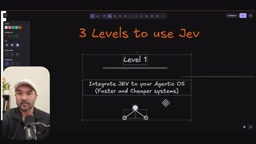
The author breaks Jev's practical applications into three tiers, each demonstrating increasing real-world value.
Open Router is a unified AI model access platform that aggregates hundreds of models from Anthropic, OpenAI, Google, Meta, and other major providers, allowing developers to switch between models on demand through a single API. Its core value lies in normalizing API format differences across providers while offering transparent, comparable pricing. In agent frameworks, Open Router is commonly used as a "model proxy layer" — routing logic can dynamically select the most suitable underlying model based on task type, budget constraints, or latency requirements. Accessing Jev through Open Router means developers don't need to maintain a separate TypeSafe SDK, and can seamlessly embed Jev's classification capabilities into existing agent workflows.
Tier 1: Optimize Your Agent Workflow
The first tier is integrating Jev into your own agent operating system for faster responses and lower token consumption. Two use cases are already being tested in practice.
Intelligent Model Routing
In reality, no one should default to the most expensive model for every task. Consistently using Claude or Opus quickly burns through your quota, and many tasks are perfectly handled by Sonnet or even Haiku. The problem is that deciding "which task should use which model" previously had to be done manually — there was no fast, low-cost automated solution.
Jev fills that gap. The author ran a comparative test: 12 prompts, one group using Jev for model routing, the other defaulting to Claude 5.1 for everything. The results showed that because 9 of the 12 tasks didn't require a top-tier model, Jev routing delivered roughly 70% cost savings.

A practical example: when the author asked Claude to "find the file path where the Jev routing script is located," Jev classified it as a simple task and routed it to the cheapest Haiku model rather than defaulting to Opus 5. The author recommends creating a toggle command during testing (e.g., /jev on) to control per-session whether routing is enabled.
More Efficient Skill Retrieval
The second use case is accelerating skill matching. The author's workspace contains around 145 skills. Across 14 tests, Jev found the correct skill in under 5 seconds on average, compared to roughly 30 seconds with the default Opus 5. The logic is straightforward: the input is a task description, Jev near-instantly selects the best match from the skill list as a "menu of options," then hands it off to Claude to load.
Tier 2: High-Throughput Business Automation
The second tier pushes Jev into real commercial scenarios. Its classification capabilities combined with low cost make previously impractical automation economically viable.

The author demonstrated a classic scenario: 100 emails that need to be classified as hot leads, cold leads, or non-leads. Jev completed all classifications in under one second — outperforming both Haiku and Claude on speed and cost by a wide margin.
This is Jev's home turf — when you have a large volume of items, each tied to a business classification decision. The author lists several high-value scenarios: enterprise invoice fraud detection, spam filtering, community content moderation, high-volume refund request processing, and customer churn prediction for subscription businesses. The logic is clear: identify where large batches of items flow into your business requiring classification, and with Jev, complex automation pipelines may compress down to just a few prompts.
Worth noting: the "classification-as-a-service" model Jev represents is fundamentally different from traditional ML text classifiers (such as BERT-based classification models). Traditional classifiers require collecting labeled data for specific tasks, training and deploying dedicated models — high engineering overhead with significant migration costs. Jev's advantage lies in large-scale pretraining with out-of-the-box zero-shot or few-shot classification capabilities. You simply describe your classification rules in natural language, with no training data required, and handle new business scenarios immediately. This transforms "high-throughput classification" from an engineering project requiring a dedicated ML team into lightweight work achievable with a few prompts, dramatically lowering the barrier for small and mid-sized teams to adopt AI classification capabilities.
Tier 3: Enable Entirely New Application Patterns
The third tier covers applications that were previously impractical due to cost or speed constraints, but are now viable thanks to System 1 models.
The author's own use case is semantic search across images and video. His media library contains hundreds of images. Traditional filename search (essentially Ctrl+F) can only match keywords in file names, returning limited results. After integrating Jev, search becomes meaning-based rather than filename-based — a significant improvement for any application that relies heavily on search functionality.
Another example is a Chrome extension called Unclutter, built by developer Kitse. When enabled, it automatically cleans up page elements classified as "clutter." Under the hood, Jev is judging each page element one by one: Is this an ad? Is this a cookie banner? Then removes them in one shot.
Final Thoughts
Jev represents more than just another cheaper model — it represents a new paradigm for using AI: explicitly dividing fast intuitive judgment (System 1) and deep reasoning (System 2) into distinct roles that work together in an orchestrated pipeline. For developers and entrepreneurs, the real question worth asking is: within your workflows and business operations, which high-frequency classification decisions could be handed off to a near-zero-cost System 1 model for instantaneous resolution?
Related articles

Gaussian Process Bandit Optimization: Exploration Strategies and Inference Regret Guarantees
Cumulative regret guarantees in Bayesian optimization fail to reflect final recommendation quality. This article examines a new study that provides inference regret guarantees for Gaussian process bandit optimization through exploration query strategies and fill distance analysis, validated on hyperparameter optimization and control tasks.

The Most Detailed Codex Guide on Bilibili: From Installation to Real-World Practice
The most detailed Codex guide on Bilibili: from app store installation to daily work mode configuration, with a real coffee shop project demonstrating file organization, data extraction, dashboard creation, and other practical tasks. Learn to use Plan Mode and desktop pets to leverage Codex efficiently.

Appearance Compensation in Volume Rendering: Why RGB Accuracy Cannot Guarantee Density Correctness
Volume rendering research reveals that volumetric data perfectly reproducing external RGB views may still contain density errors: appearance compensation can double central density and keep external rays unchanged even when L2 error exceeds 14.52%. Density recovery depends on appearance capacity, spatial resolution, and measurement design.