Jottoo: Automatically Turn AI Meeting Notes into Trackable Tasks
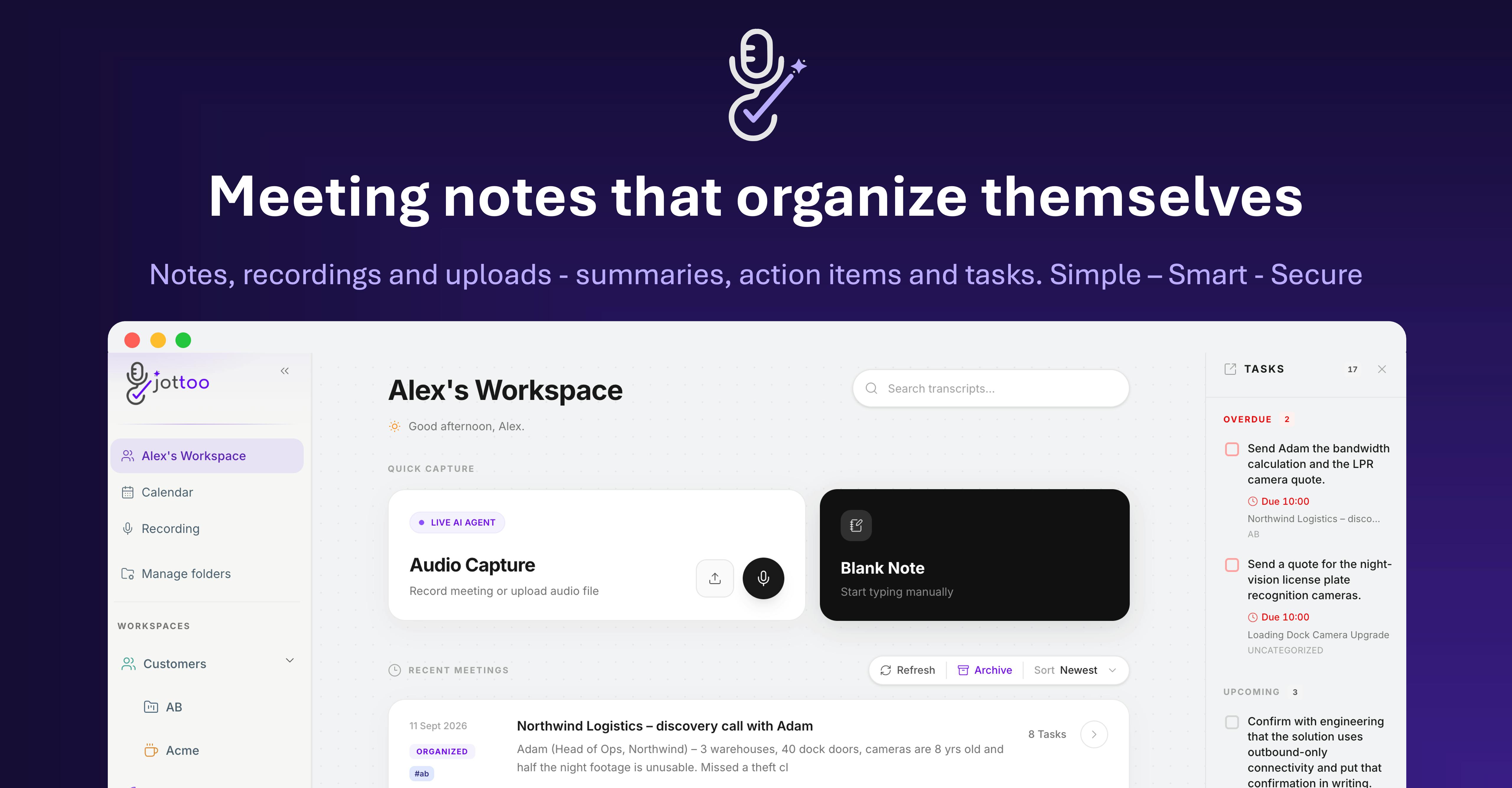
Jottoo turns AI meeting notes into trackable tasks without bots or plugins, at a flat $13.99/month.
Jottoo is an AI meeting tool designed to close the loop from recording to execution. It supports audio, file uploads, or typed input, and automatically extracts deadline-tagged, trackable tasks — going beyond transcription and summaries. Its standout design choice is a bot-free approach, reducing privacy and compliance friction. It also offers conversational Q&A over historical meetings, turning past records into a searchable knowledge base. Priced at a single flat rate of $13.99/month, it's accessible for individuals and small teams, though its real value hinges on the accuracy of AI task extraction and user acceptance of the manual recording step.
Where Do Action Items Go After a Meeting?
Taking meeting notes isn't the hard part — the real challenge is making sure the action items scattered across those notes actually get followed up on. Traditional meeting tools solve the "write it down" problem but toss the burden of follow-through right back to the user. Jottoo aims to close that gap. It doesn't just transcribe meetings — it extracts action items from the discussion and turns them into trackable tasks with deadlines.
The product recently launched on Product Hunt, earning 78 upvotes and 8 comments, ranking 11th, under the Productivity, SaaS, and Artificial Intelligence categories. It was built by Fady Sharobeem.
Core Idea: From "Recording" to "Tracking"
Jottoo's value proposition can be summed up in one line: AI meeting notes that turn into tracked tasks. Its workflow supports three input methods — audio recordings, uploaded files, or typed text — and automatically organizes the content into a clean, deadline-tagged task list.
That automation step is the product's core differentiator. Most meeting tools stop at transcription and summaries, leaving users to manually copy action items into a separate task manager. Jottoo bakes that step into the workflow, so meeting outputs arrive in an immediately actionable format — reducing the information loss that happens when data gets shuffled between tools.
No Bot Joining Your Calls
One notable design decision: Jottoo doesn't send a recording bot into your video meetings, and there's no plugin to install. This sets it apart from many products that rely on automated meeting bots.
The "no bot" approach has two practical implications. First, it reduces privacy and compliance concerns — there's no third-party bot appearing on the participant list, and no awkward signal to other attendees that the call is being recorded by an external tool. Second, it lowers the barrier to entry: users can record first and upload later, or simply type their notes, making it platform-agnostic and more flexible.
The mainstream "meeting bot" approach (used by tools like Otter.ai, Fireflies, tl;dv, etc.) works by creating a virtual attendee account that automatically joins Zoom, Google Meet, or Teams calls when given a meeting link, receiving the audio stream in real time for cloud-based transcription. This is fully automated and requires no manual intervention — but it introduces several risks: some corporate security policies explicitly prohibit third-party bots from joining internal meetings; in client-facing or compliance-sensitive calls, a bot's presence can raise legal questions around consent requirements (many jurisdictions require all parties to be notified before recording); and these bots depend on platform API access, meaning service disruptions can occur when platforms change their policies. Jottoo sidesteps this approach, at the cost of giving up fully invisible, hands-free automation.
A Conversational Memory Bank for Past Meetings
Beyond task tracking, Jottoo offers a Q&A capability over historical meetings: users can ask questions about any past meeting and get instant answers.
This effectively turns your entire meeting history into a searchable, conversational knowledge base. As teams grow and meetings accumulate, questions like "what exactly did we decide last time?" can mean digging through chat logs and documents for answers. Delegating that to AI-powered semantic search is a direction most meeting tools are currently exploring — Jottoo includes it as a standard feature.
The underlying technology behind this kind of "conversational knowledge base" is typically called RAG (Retrieval-Augmented Generation). The basic principle: historical meeting transcripts are converted into vector embeddings stored in a vector database. When a user asks a question, the system retrieves semantically relevant passages and passes them — along with the question — to a large language model (LLM) to generate a grounded answer. This allows the AI to "cite" specific meeting content rather than hallucinate. Compared to simple keyword search, semantic retrieval understands synonyms and contextual intent — for example, "the budget issue we discussed last time" can match a passage that says "Q3 financial allocation." This technology is now widely used in enterprise knowledge management tools. In the meeting notes context, the key challenges are handling cross-meeting, cross-timeline reasoning, and accurately attributing sources when retrieval results are ambiguous.
Pricing: A Single Plan at $13.99/Month
On the business model front, Jottoo keeps things simple — one flat plan at $13.99 per month. No tiered pricing, no per-seat or per-minute billing.
This single affordable tier is quite friendly for individuals and small teams, eliminating the cognitive overhead of comparing features across plan levels. For the developer, a single pricing structure also reduces product and operational complexity. Whether a single plan can meet the needs of larger organizations with heavy meeting loads, team collaboration requirements, and permission management is still an open question.
A Few Things Worth Watching
From a product philosophy standpoint, Jottoo addresses a genuine pain point: the whole point of meeting notes is to drive action, not to generate pages of text that nobody follows up on. Connecting the "record → extract tasks → track execution" loop into a single workflow is the right direction.
That said, a few key questions remain. Task extraction accuracy is the make-or-break factor — whether AI can reliably identify what's an action item, who owns it, and what the deadline should be is the core challenge for this category of tool. Additionally, the "no bot" design means users need to actively record meetings in real time, which actually adds a manual step compared to auto-joining solutions — a friction point in certain scenarios.
For individuals or small teams looking for something lightweight, privacy-conscious, and capable of turning meetings directly into a to-do list, Jottoo offers a clear-headed, transparently priced option. Its real-world value will ultimately come down to how well the AI performs at that core task: extracting actionable items that are actually worth acting on.
Related articles
AI Agent Fundamentals: The Three Core Components — Brain, Memory, and Tools
A beginner's guide to AI Agents: covering the three core components (brain, memory, tools), four stages of LLM deployment, and why Agents matter for real business use cases.
Boycotting Software That Doesn't Support Linux: One Developer's Philosophy of Choice
A Linux-only developer shares his philosophy of boycotting non-Linux software — without sacrificing productivity — and explains how coding agents like Claude Code are closing the gap with commercial tools.
Why Do All AI-Generated Projects Look the Same? The Aesthetic Homogenization Problem in Vibe Coding
Why do vibe coding projects all use purple gradients and dark glassmorphism? We break down the technical roots of AI aesthetic homogenization and how to escape it.