jQuery 4.1.0 Released: The Steady Evolution of a Veteran Library
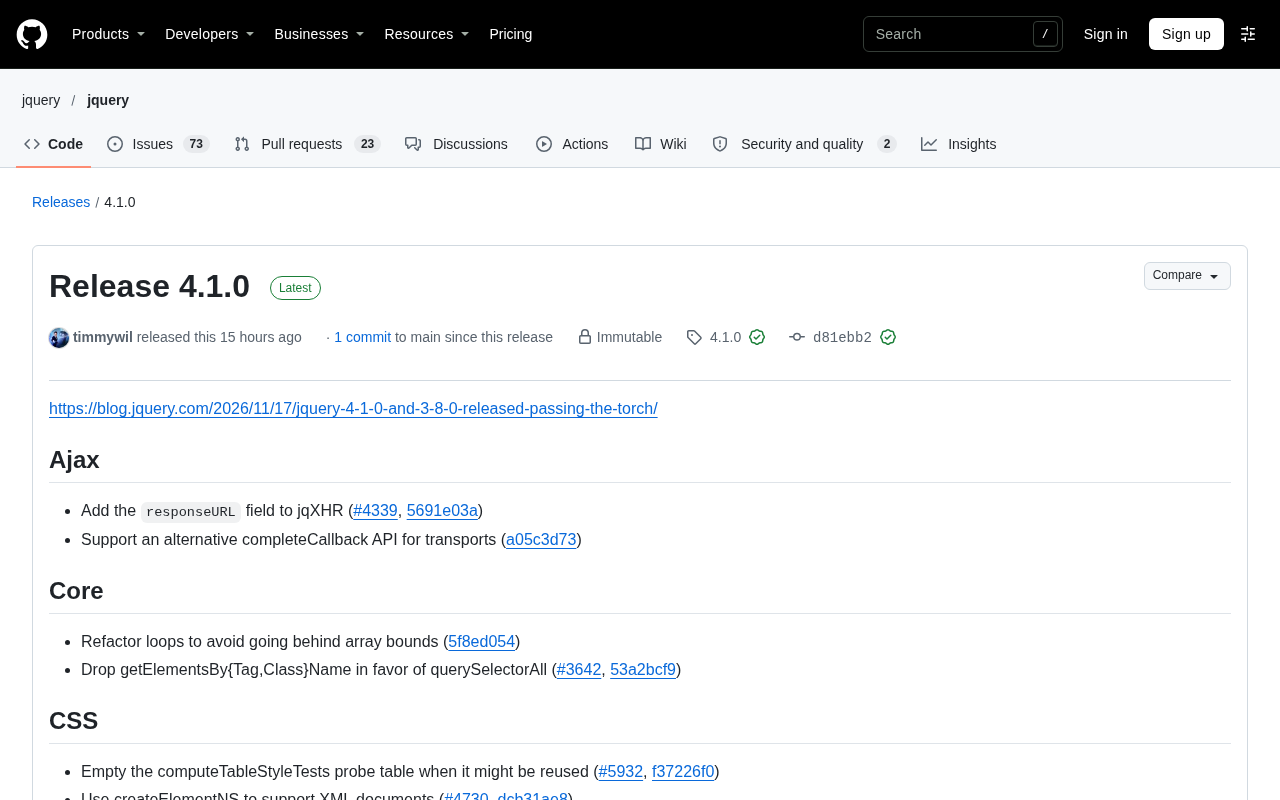
jQuery 4.1.0 released, continuing stability and compatibility maintenance, still drawing community attention.
The jQuery team has officially released version 4.1.0, sparking discussion on Hacker News with 302 points and 159 comments. The article notes that although modern front-end frameworks keep emerging, jQuery remains vital in specific scenarios due to deep dependence from enterprise back-office systems, traditional websites, and CMS plugin ecosystems, with high migration costs leading to maintenance rather than rewrites. As an iterative release, 4.1.0 continues its commitment to stability and compatibility, providing ongoing bug fixes, performance improvements, and security patches for legacy projects. The author argues that technology choices should not blindly chase novelty—stability and familiarity matter just as much, and the continued investment of a mature open-source project is itself a form of value.
jQuery 4.1.0 Officially Released
The jQuery team has released version 4.1.0, sparking widespread discussion on Hacker News with 302 points and 159 comments. As a library that once dominated front-end development, every jQuery update touches a nerve for many developers.
What This Release Means
Although modern front-end frameworks keep emerging, jQuery still plays an important role in a large number of legacy projects and specific scenarios. As an iterative release, 4.1.0 continues the jQuery team's commitment to stability and compatibility. For teams still using jQuery, updates like this mean a continued supply of bug fixes, performance improvements, and security patches.
Judging from the community reaction, the 159 comments include both nostalgia for the old days and rational discussion of jQuery's current state. The heat of this discussion itself shows that jQuery has not completely exited the stage of history—rather, it has found its place within the front-end ecosystem.
Who Still Uses jQuery?
jQuery's enduring vitality stems from several practical factors. A large number of enterprise back-office systems, traditional websites, and CMS plugin ecosystems depend deeply on jQuery. High migration costs and unclear benefits lead many teams to choose continued maintenance over rewriting. In addition, jQuery's concise DOM manipulation and Ajax wrapper remain attractive for small projects or rapid prototyping.
The release of 4.1.0 reminds us that technology choices are not always about chasing the newest thing—stability and familiarity matter just as much. For developers maintaining legacy code, paying attention to jQuery version updates is a necessary step to keep projects healthy.
Ajax wrapper refers to jQuery's layer of abstraction over the browser's native XMLHttpRequest object, with typical APIs including $.ajax(), $.get(), $.post(), and $.getJSON(). Before fetch was standardized, jQuery smoothed over browser differences with a unified interface, automatically handling details such as JSON parsing, timeouts, error callbacks, and cross-origin configuration, so developers did not need to worry about the underlying status code flow. This wrapper also worked with Deferred to enable Promise-style chaining, and was the de facto standard for making asynchronous requests in front-end development from 2006 to 2015. Even today, many server-rendered pages and legacy back-office systems still use $.ajax() for data interaction, which is one reason the jQuery plugin ecosystem is hard to replace wholesale.
DOM manipulation refers to the process of reading and modifying page element structure, styles, and attributes through scripts. Native APIs such as querySelectorAll, createElement, and classList behaved inconsistently across early browsers and required verbose code, whereas jQuery used the $() selector plus chained calls (e.g., $('#list').addClass('active').find('li').hide()) to compress common insertion, deletion, traversal, and event binding into one or two lines. It also built in implicit iteration—a single call can batch-process all matched elements, eliminating the need to write loops by hand. This expressiveness is especially friendly for small projects and prototyping, and is the direct reason so much jQuery code remains in legacy projects to this day.
How to View This Update
For new projects, whether to choose jQuery requires weighing specific needs. But for existing projects, keeping up with releases like 4.1.0 helps gain better browser compatibility and bug fixes. The diverse viewpoints reflected in community discussions also mirror the diversity and pragmatism of the front-end tech stack. jQuery 4.1.0 may not be a groundbreaking release, but it represents the continued investment of a mature open-source project—and for its many dependent users, that in itself is a form of value.
Related articles

Claude Code Hands-On Tutorial: Installation in China and AI Coding Productivity Guide
Bilibili Claude Code tutorial breakdown: installation in China, PyCharm and other IDE integration, hands-on examples, memory mechanisms, three permission modes, MCP tools and skill configuration — helping developers understand the usage path and token cost constraints of AI coding productivity tools.

AI Wrote 90% of the Code—How Do You Prove It Runs? The Claude Code Team Publishes a 39-Item Incident Checklist
The Claude Code team reveals how to verify AI-written code: 39-item incident checklist, end-to-end, property-based, and differential testing, plus a three-tier commit gate.
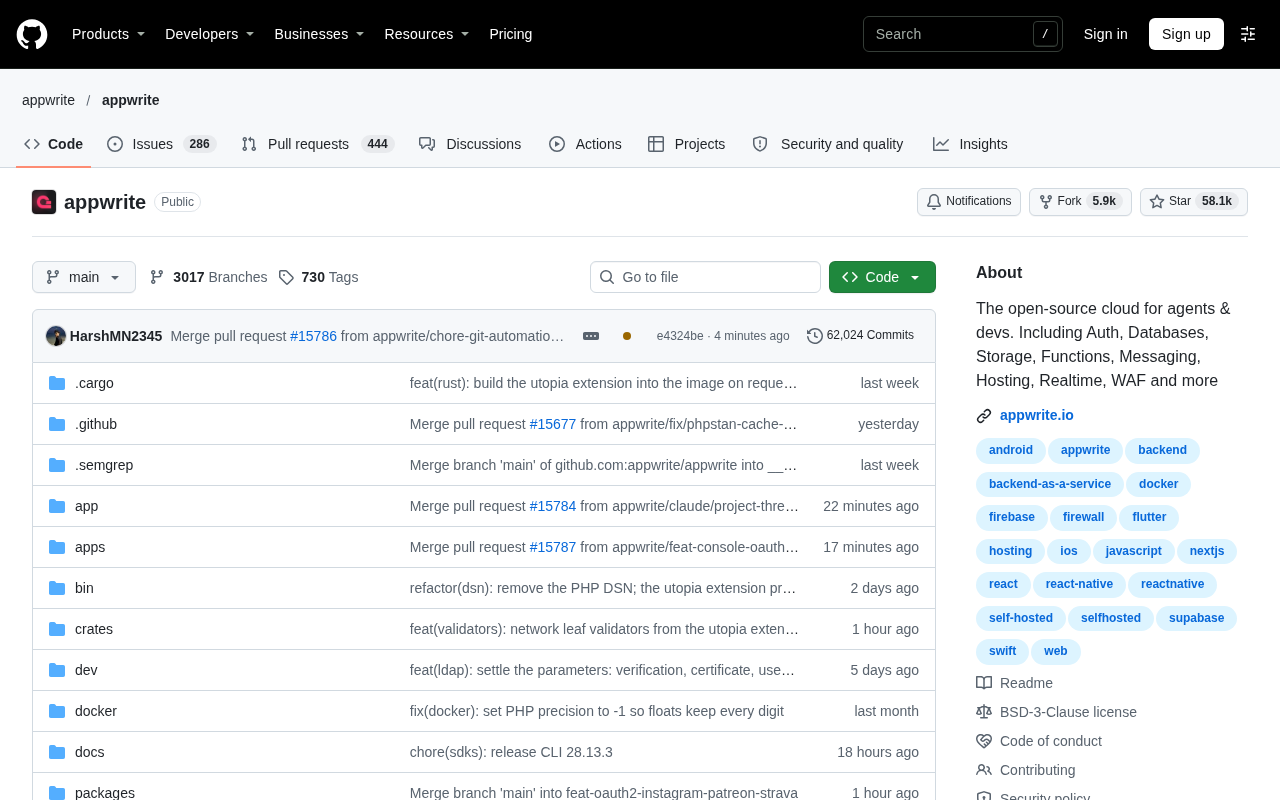
Appwrite: The Open-Source Cloud Built for AI Agents
Appwrite is an open-source cloud platform offering Auth, databases, storage, functions, messaging, hosting, realtime, and WAF for AI agents and developers. With 58K+ GitHub stars, it supports self-hosting.