Jules AI Autonomous Agent Prompt Library: Let AI Optimize Your Codebase Around the Clock
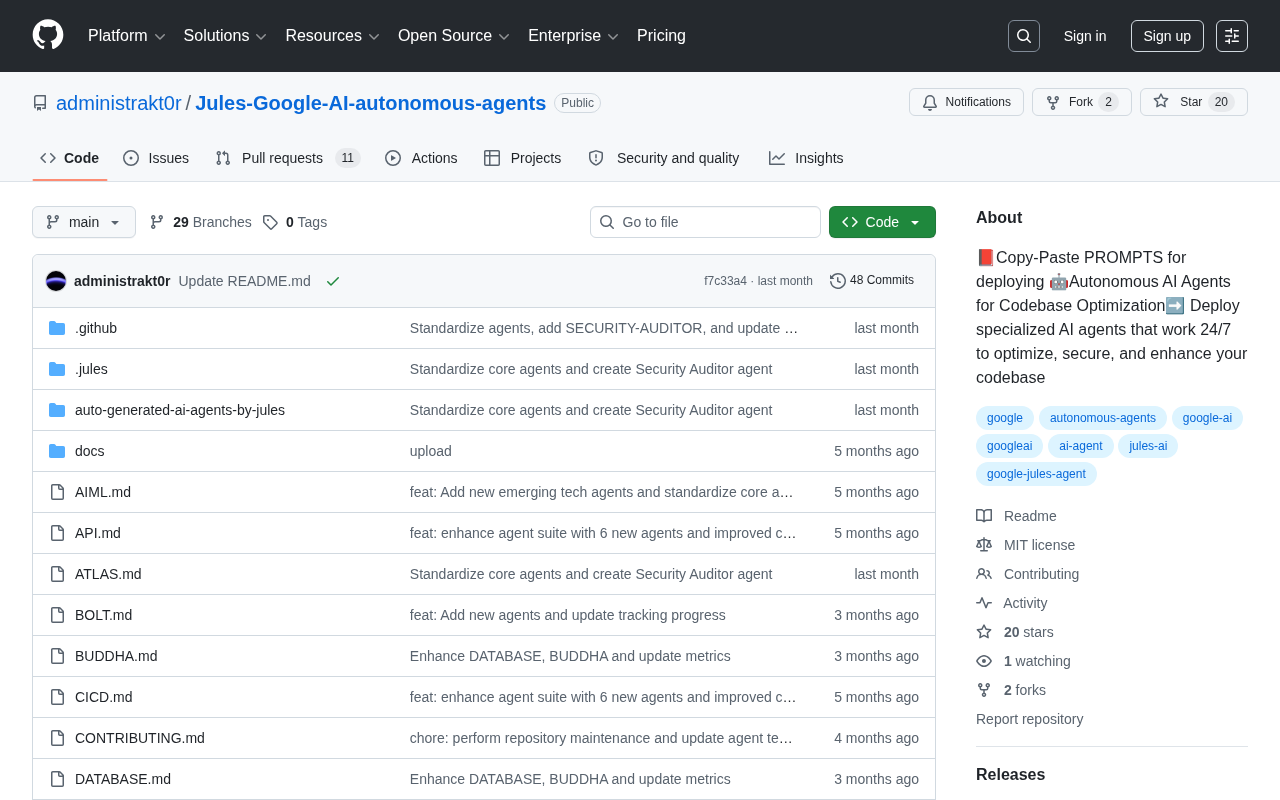
A zero-barrier copy-paste prompt collection for running AI agents that continuously optimize, secure, and enhance your codebase.
The GitHub project `Jules-Google-AI-autonomous-agents` provides a ready-to-use prompt template collection for codebase maintenance — no code required, just copy and paste. It transforms AI-assisted code review from a one-off interaction into a standardized, continuous workflow, with specialized agents handling code optimization, security hardening, and feature enhancement. The project is essentially "assetizing prompt engineering." That said, its limitations are real: the project is early-stage (17 stars), effectiveness depends heavily on the underlying model, true automation still requires manual toolchain integration, and AI output should never be blindly trusted for security changes. It reflects AI coding's broader shift from generating code to continuously maintaining and governing it.
A Prompt Toolkit Focused on Codebase Optimization
As AI coding tools become increasingly mainstream, how to get AI agents to genuinely and continuously participate in project maintenance has become a question many developers are asking. The open-source GitHub project administrakt0r/Jules-Google-AI-autonomous-agents offers a lightweight answer — not a complex framework, but a collection of copy-paste prompts designed to deploy autonomous AI agents for codebase optimization.
The project's core philosophy is straightforward: use pre-crafted prompts to run specialized AI agents 24/7, continuously optimizing, hardening, and enhancing your codebase. In other words, it tries to transform "AI reviewing and fixing your code" from a one-off interaction into a repeatable, standardized workflow.
What "Copy-Paste PROMPTS" Actually Means
The project's biggest selling point is its extremely low barrier to entry. It centers on "Copy-Paste PROMPTS" — developers don't need to write any code or set up an environment. Just copy the prompts from the repository into your AI tool of choice and you're off. The project is primarily organized as shell scripts, leaning toward script and text assets rather than heavyweight software engineering.
This design addresses a real pain point in how AI tools are used today: what actually determines an AI agent's effectiveness is usually not the model itself, but the quality of the prompts. A well-crafted, clearly structured prompt can significantly improve AI performance in scenarios like code review, vulnerability detection, and refactoring suggestions. By distilling this know-how into ready-to-use templates, the project is essentially "assetizing" prompt engineering.
Prompt Engineering refers to the practice of carefully designing the instruction text fed to a large language model (LLM) in order to guide it toward more accurate and expected outputs. Unlike adjusting model parameters or fine-tuning, prompt engineering operates entirely at the inference level — no training costs required. For code-related tasks, a good prompt typically specifies a role (e.g., "You are a senior security audit engineer"), the scope of the task, the desired output format, and any constraints — dramatically reducing ambiguity and irrelevant outputs. Solidifying such refined prompts into reusable templates is an increasingly common practice in both enterprise and open-source communities, giving rise to a dedicated asset category: the "prompt library."
What Autonomous Agents Can Do
According to the project description, these AI agents are designed as "specialized" roles, each responsible for different areas of work. They primarily cover three categories:
Code Optimization
Improving the performance and structure of existing code — identifying redundant logic, proposing refactoring approaches, and enhancing readability.
Security Hardening
Scanning for potential security vulnerabilities, helping developers identify weak points in their code, and providing remediation suggestions. This is especially valuable in projects with complex dependencies and frequent iterations.
Feature Enhancement
Assisting with adding or improving features while keeping existing functionality stable, allowing the codebase to continuously evolve.
The "24/7 operation" framing refers more to the fact that these agents can be invoked repeatedly and continuously, rather than requiring a human to be watching at all times. It reflects a philosophy of "keeping AI resident in the development process" rather than using it for one-off Q&A sessions.
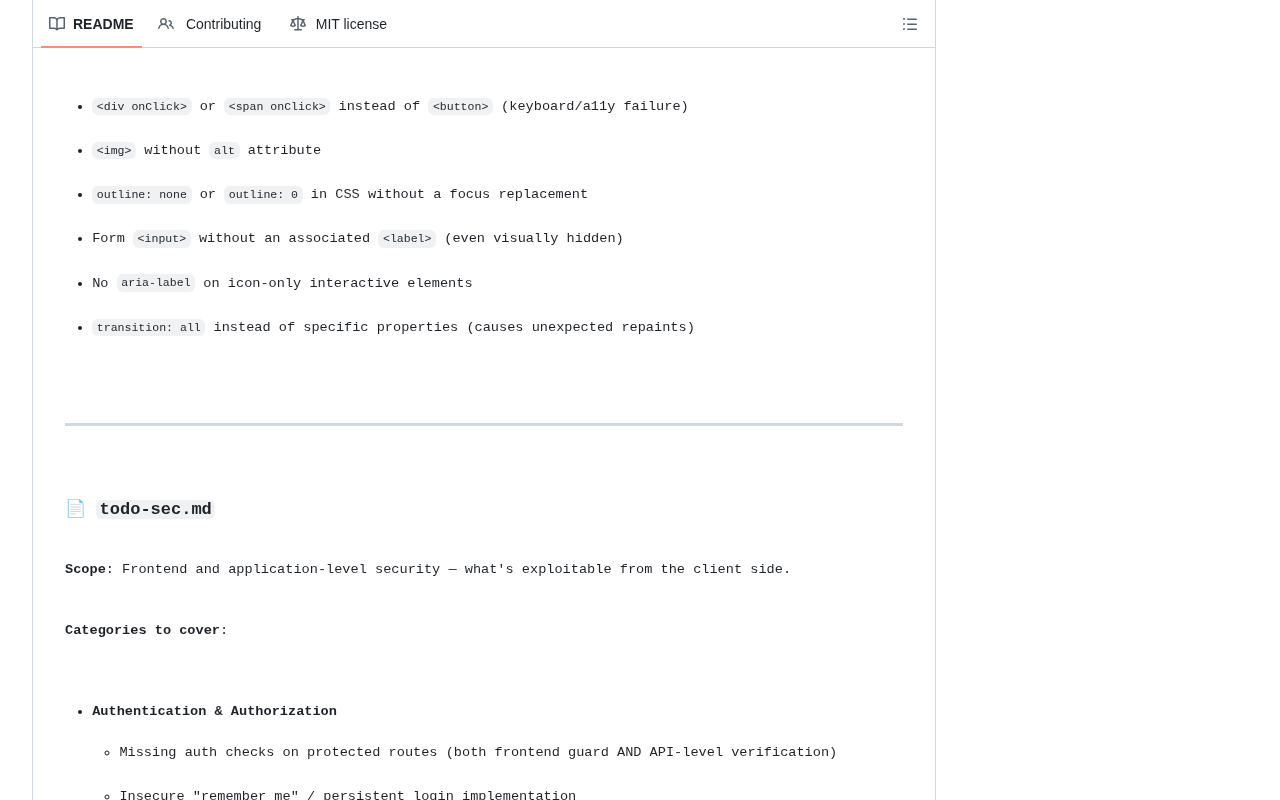
Autonomous AI Agents are AI systems that can autonomously plan steps, invoke tools, and iteratively execute tasks toward a given goal — as opposed to single-turn Q&A AI interactions. A typical agent workflow looks like: receive task goal → break down into subtasks → invoke tools for code analysis, search, or execution → adjust next steps based on results → repeat until goal is achieved. Current mainstream implementations include OpenAI's Assistants API, LangChain Agents, AutoGPT, and similar frameworks. The "autonomous agents" described in this project are relatively lightweight — they essentially inject structured prompts into a code-capable AI tool like Google Jules, which handles the actual code reading and modification. This is distinct from building a full multi-step autonomous reasoning chain.
A Realistic View of the Project's Scope and Limitations
It's worth being clear-eyed about this project's scale — it currently has only 17 stars and 1 fork, placing it firmly in the early-stage personal open-source category. It reads more like a curated sharing of practical experience than a battle-tested, production-ready solution.
In terms of value, its significance lies in lowering the barrier for ordinary developers to experiment with "autonomous AI agents." For those who want to quickly experience AI-assisted code maintenance without investing effort in building complex agent frameworks, dropping in pre-built prompts is a highly cost-effective path.
But its limitations are equally apparent: first, effectiveness is heavily dependent on the capabilities of the underlying AI model — the prompts themselves can't compensate for a model's shortcomings. Second, the degree of "autonomy" is limited; a truly automated closed loop still requires developers to manually connect the toolchain. Third, code security and optimization suggestions must always be reviewed by a human — AI output should never be blindly trusted, especially for security-related changes.
It's worth noting that "Jules" in the project name refers to Google's AI coding agent Jules — an asynchronous programming assistant deeply integrated into GitHub workflows that can directly read repository code, create branches, and submit Pull Requests. Unlike GitHub Copilot, which focuses on real-time code completion, Jules is designed specifically for longer-running background tasks like fixing bugs and refactoring modules — a natural fit with this project's philosophy of "keeping AI resident in your codebase." Understanding Jules's capability boundaries helps you more accurately assess the practical effectiveness of this prompt collection: prompt quality determines how clearly a task is described, but the upper bound of actual code manipulation still depends on Jules's own model and tool-calling capabilities.
What This Means for Developers
This project reflects a broader industry trend: AI programming is expanding from "writing code" to "maintaining and governing code." Developers have historically used AI to generate new code, but increasingly the focus is shifting to how AI can continuously watch over existing codebases — optimizing, auditing, and hardening them.
For developers looking to introduce similar practices to their own teams, there are two key takeaways: first, treat high-quality prompts as team assets to be accumulated and reused, rather than improvising them from scratch each time. Second, clearly define the boundaries of AI agents — position them as "collaborators" rather than "decision-makers," with humans always maintaining oversight at critical junctures. The real value of lightweight tools like this isn't to replace engineers, but to hand off repetitive code governance work to AI — freeing people to focus on the parts that require genuine judgment.
Related articles
Altman: Taking OpenAI Public This Year Would Be 'Ill-Advised'
OpenAI CEO Sam Altman says going public this year would be 'ill-advised,' even as the company has confidentially filed IPO paperwork. Here's what it means for AI.
An Open Letter to Dario: If AI Safety Is Real, Open the Model Weights
Developer Jacob's open letter to Anthropic CEO Dario Amodei went viral on Hacker News, challenging the contradiction between AI safety rhetoric and closed-source models: if safety truly matters, why not open the weights?
Ludwig: Building Custom LLMs and Neural Networks with Declarative Low-Code Configuration
Ludwig is an open-source low-code ML framework that builds custom LLMs and neural networks via declarative YAML config — no boilerplate training code required.