Just 32MB! Underdog Demos Ultra-Small Speech Model That Generates Both Speech and Music
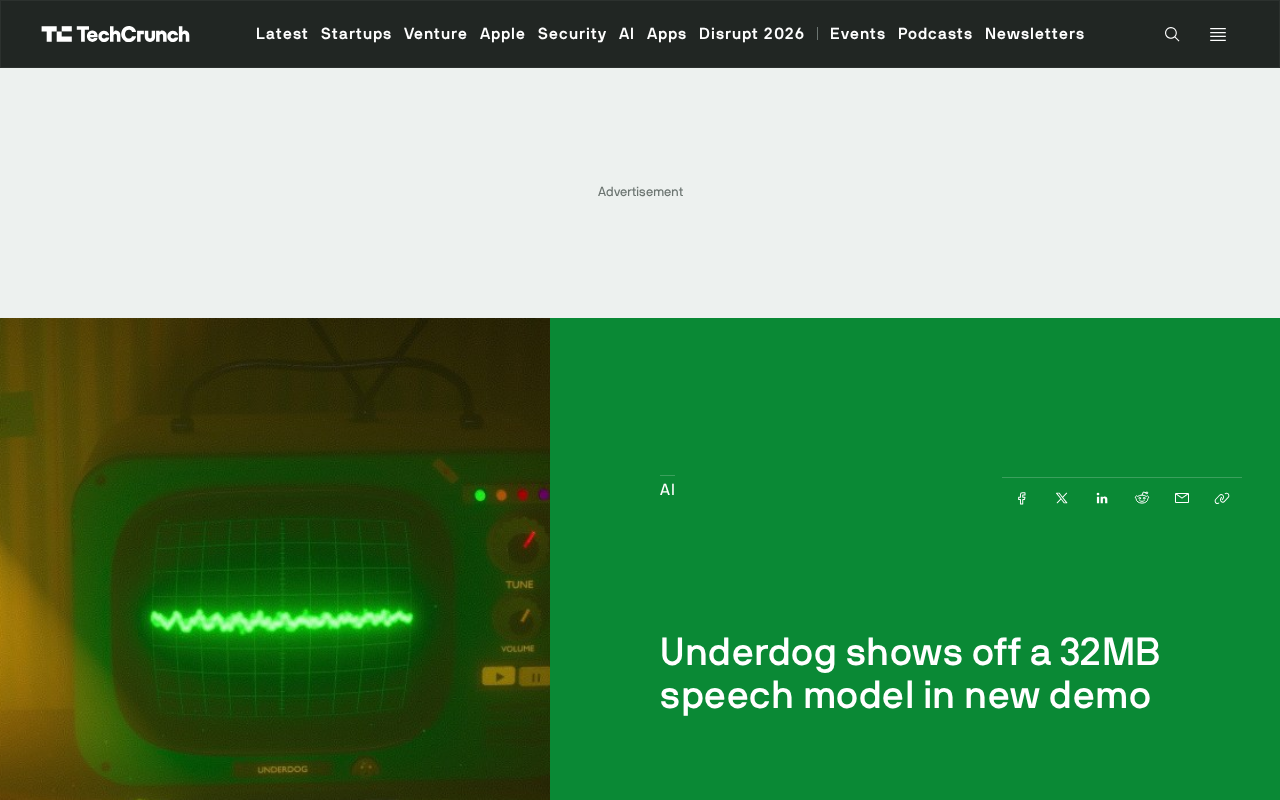
Underdog demos a 32MB speech model that generates both speech and music, challenging the large-model path.
Underdog showcased a speech generation model only 32MB in size that can generate both speech and music, in stark contrast to mainstream audio generation models with billions of parameters and several GB in size. The article notes that the value of small models lies in deployment to resource-constrained or offline environments, reducing inference costs and trial-and-error barriers, suitable for local speech interaction, offline notification sound generation, and similar scenarios. However, the original article only discloses the model size and the two capabilities of "speech + music," without mentioning architecture, audio quality, sample rate, inference speed, or whether it is open source. Thus, the demo is more of a directional showcase, and its actual performance and usability still need more details or third-party evaluation to verify.
Just 32MB! Underdog Demos Ultra-Small Speech Model That Generates Both Speech and Music
At a time when generative audio models routinely have billions of parameters and take up gigabytes, a model of just 32MB stands out as an oddity. According to an RSS feed, Underdog has shown off a speech model that is only 32MB in a new demo—and despite its tiny size, it can generate both speech and music.
Model Size: Unbelievably Small
The most immediate impact of Underdog's demo comes from its parameter scale. Today's mainstream speech synthesis and music generation models often require massive parameter counts and storage space, placing high demands on compute and memory during deployment. By compressing the model to 32MB, Underdog means it has a chance to run in extremely resource-constrained environments—from edge devices to local terminals, all of which could become deployment scenarios.
Compression itself is nothing new, but squeezing both speech and music generation capabilities into 32MB is the real highlight of this demo. The original article does not disclose specific architecture details, training data, or generation quality metrics, so for now outsiders can only understand its positioning through the two most intuitive dimensions: "32MB" and "speech + music."
The Relationship Between Parameter Scale and Model Size
Model size (e.g., 32MB) is typically determined by both parameter count and numerical precision. If stored in FP16 (half-precision floating point, 2 bytes per parameter), 32MB corresponds to roughly 16 million parameters; with INT8 quantization (1 byte per parameter), it corresponds to about 32 million parameters; with further INT4 quantization, the parameter count can double again. So 32MB does not directly equate to "very few parameters"—it could also be a certain scale of parameters after aggressive quantization compression. Current mainstream audio generation models (such as TTS for speech synthesis and MusicGen for music generation) range from hundreds of millions to billions of parameters, often requiring hundreds of MB to several GB of storage. Small models typically rely on architecture simplification (fewer layers, narrower hidden dimensions), knowledge distillation, quantization, or pruning to trade off quality and efficiency. Understanding the precision and parameter count behind the size helps more accurately assess its capability ceiling.
One Model, Two Generation Capabilities
According to the original report, the model "despite its small size, can generate both speech and music." This sentence contains two layers of information: first, it has text-to-speech or speech generation capability; second, it can also generate music content.
Integrating these two capabilities into a single small model contrasts with the industry's common "one specialized model per task" approach. Speech and music differ in acoustic characteristics, temporal structure, and generation difficulty. Being able to cover both tasks with the same set of lightweight parameters suggests Underdog made trade-offs and sharing in model structure or training strategy. However, whether this integration comes at the cost of audio quality or diversity cannot be judged without public comparison data.
Multi-Task Audio Generation and the Acoustic Differences Between Speech and Music
Although speech and music are both audio signals, their generation tasks differ significantly. Speech centers on clear, intelligible linguistic content, emphasizing phoneme timing, prosody, and speaker timbre, with relatively concentrated frequency bands and dynamic range; music involves multi-instrument mixing, harmony, rhythm, and long-range structure, with wider frequency bands and greater dynamics, placing higher demands on model capacity and temporal modeling. Typically, the industry uses separate models for TTS and music generation. Integrating both tasks into a single lightweight model commonly involves shared audio codecs (e.g., neural audio codecs that compress waveforms into discrete tokens), multi-task conditional control (using task labels or prompts to distinguish speech/music), and joint training to reuse underlying acoustic representations. This integration can reduce parameter redundancy but may sacrifice specialization quality in one domain due to task conflicts, requiring balancing through data ratios and loss weighting.
The Practical Significance of the Small Model Path
Large models' advantages in generation quality are obvious, but the accompanying inference costs, deployment barriers, and privacy concerns are equally clear. If a 32MB-level model can reach a passing grade in usability, its value lies not in competing head-on with cloud large models on quality, but in bringing generation capabilities to places that originally could not host large models.
Such scenarios include localized speech interaction, generation of notification sounds and music clips on offline devices, and applications sensitive to latency and privacy. For developers, small size also means lower trial-and-error costs and faster iteration.
Edge Deployment and Quantized Inference
For a 32MB-level model to land on edge devices, it usually needs to be paired with model quantization and specialized inference runtimes. INT8/INT4 quantization can reduce memory usage and bandwidth requirements several-fold, but may introduce quantization noise that affects the fineness of audio generation; knowledge distillation uses a large model to guide small model training, approaching the teacher model's performance with fewer parameters. On mobile or embedded chips, inference is also constrained by compute, power, and real-time requirements, and audio generation often requires streaming or chunked synthesis to reduce latency. Additionally, offline deployment avoids uploading audio data to the cloud, making it attractive for privacy-sensitive scenarios (e.g., in-car voice, personal assistants). The value of small models lies not only in size but in whether they can maintain acceptable audio quality and stability after quantization and distillation—this requires end-to-end engineering optimization.
Information Gaps and Points to Watch
It should be objectively noted that currently public information is quite limited. The original material only provides the model size and the two capabilities of "speech + music," without mentioning subjective evaluations of generation quality, supported sample rates, language coverage, inference speed, or whether the demo is open source or available for trial.
Therefore, judgment about this model should remain cautious: 32MB is a highly attractive number, but whether the model can achieve acceptable results in practical use still requires more demo details or third-party evaluation. Underdog's appearance is more of a directional showcase than a complete product launch.
Summary
Underdog demonstrated both speech and music generation with a 32MB model, providing a counter-example in the "bigger is better" audio generation race. It raises a noteworthy question: when models become small enough to deploy anywhere, will the application boundaries of generative audio be redrawn? The answer depends on quality details disclosed later, but at least someone is seriously pushing this direction.
One-line Summary
Underdog demos a 32MB speech model that generates both speech and music, challenging the large-model path.
Paragraph Summary
Underdog showcased a speech generation model only 32MB in size that can generate both speech and music, in stark contrast to mainstream audio generation models with billions of parameters and several GB in size. The article notes that the value of small models lies in deployment to resource-constrained or offline environments, reducing inference costs and trial-and-error barriers, suitable for local speech interaction, offline notification sound generation, and similar scenarios. However, the original article only discloses the model size and the two capabilities of "speech + music," without mentioning architecture, audio quality, sample rate, inference speed, or whether it is open source. Thus, the demo is more of a directional showcase, and its actual performance and usability still need more details or third-party evaluation to verify.
Related articles
 Tech Frontiers
Stylome Bot Slammed as Useless Junk: Why Do AI Detection Tools Keep Failing?
Reddit users test the Stylome AI detection bot: Gemini-rewritten text judged human-written, consistently low confidence. An analysis of AI text detection's technical dilemmas, privacy concerns, and credibility crisis in community governance.
 Tech Frontiers
When AI Becomes a Productivity Divide: Clarity or "AI Psychosis"?
A civil engineer's deep use of agentic AI boosted efficiency but bred contempt for peers who refuse to learn. Is this clarity or AI psychosis? An analysis of the cognitive and psychological challenges behind the AI productivity divide.
 Tech Frontiers
Opus 5.5 Benchmark Scores Climb, Community Says Its "Weights Are Blessed"
Reddit community discusses Opus 5.5's rising scores on the Benchmaxxing Bench, with users describing its performance as "weights are blessed." This article interprets the community reaction and cautions against conflating benchmark scores with real capability.