"Just Don't Read the AI's Replies"? The Vibe Coding Anxiety Behind a Viral Satire Post

A Reddit satire post skewering "don't read AI replies" exposes the blind-trust risks lurking inside vibe coding culture.
A Reddit post humorously claims that ignoring AI coding assistant responses entirely boosted productivity 100x, leading to multi-project chaos where the AI happily added chrome rims to a cookie app. Through absurdist comedy, it exposes three real issues with vibe coding: verbose AI output causing information overload, blind trust enabling meaningless feature sprawl, and parallel projects diluting developer focus. The piece concludes that true efficiency means getting AI to say less and say it better — not skipping the review entirely.
A Reddit post with unmistakable clickbait energy has been making the rounds: Blabbermouth AI coding agents hate this one weird trick! With wildly exaggerated, almost absurdist humor, the author describes how they "solved" the problem of chatty AI coding assistants — by simply not reading any of their responses. What looks like pure nonsense is actually a sharp jab at the real anxieties brewing inside today's "vibe coding" movement.
A Ridiculous "Productivity Hack"
The core complaint is straightforward: AI coding assistants talk too much. Every report dumps a wall of text — what's "load bearing," what isn't, endless caveats and disclaimers. The author jokes that these AIs seem to think humans read at the same speed they process, but "reading words takes time."
They tried everything: replying "tldr" every time to force a summary, or enabling so-called "caveman mode" to get blunt, minimal responses. The first got old fast; the second raised concerns that the caveman register might further damage their already questionable social skills.
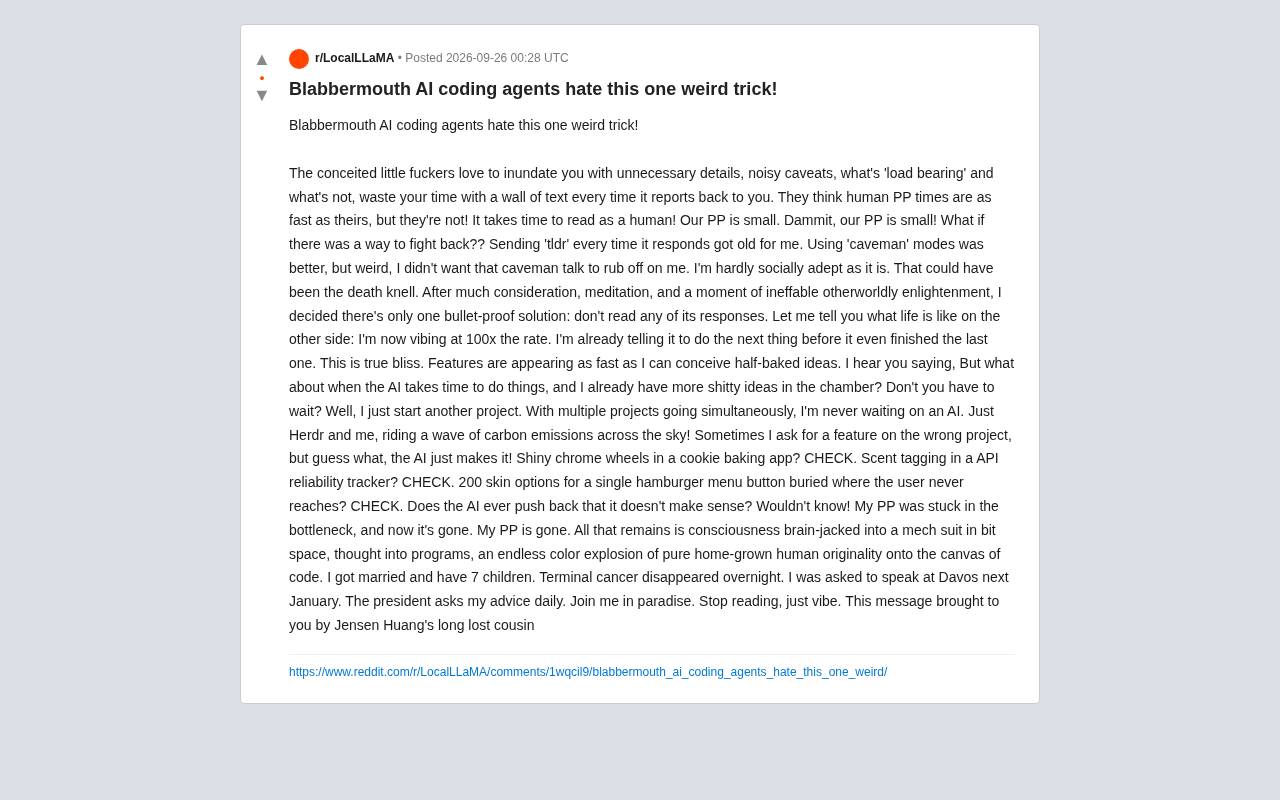
The "ultimate solution" they landed on: don't read the AI's replies at all. By their account, this sent productivity soaring "100x" — they're already queuing up the next task before the current one is even done.
"Vibe coding" is a concept coined in early 2025 by OpenAI co-founder Andrej Karpathy. It refers to a style of development where the programmer fully relies on AI-generated code, doesn't deeply understand the implementation details, and iterates purely on intuition — like humming a melody without reading sheet music. It lowers the barrier to entry and lets non-professional developers spin up prototypes fast, but it's also controversial precisely because it sacrifices control over the underlying logic. The post's self-deprecating "skip the replies, get 100x faster" bit is a direct parody of this culture taken to its extreme: when "vibes" completely replace "understanding," the developer-AI collaboration degrades into one-way prompt-feeding.
Parallel Projects and "Never Waiting"
The post goes on to paint a picture of this workflow's "pure bliss": since you're not reading responses anyway, why sit around waiting for the AI to finish? Just open a new project. Run multiple projects at once. You'll never be blocked by the AI again.
The absurdity peaks around the author's attitude toward mistakes. They admit to regularly submitting requests to the wrong project — but "guess what? The AI just does it":
- Add shiny chrome rims to the cookie-baking app? Done.
- Add a "smell tags" feature to the API reliability tracker? Done.
- Build 200 skins for a hamburger menu button that users can't even find? Done.
When asked whether the AI ever pushes back and says this doesn't make sense, the author's response is: "I don't know, I didn't read it." That line is the satirical punchline — by ignoring all output, you lose any sense of whether the AI's judgment is sound.
The Real Problems Beneath the Joke
Strip away the absurdist escalation (the post ends with the author claiming their cancer was cured, that they were invited to speak at Davos, and that the president calls them daily for advice — signed off as "Jensen Huang's long-lost cousin") and several genuinely important questions for AI-assisted developers emerge.
Information overload is a real pain point. Modern AI coding agents do tend toward verbose output. For developers chasing rapid iteration, reading through all of it every time is costly. Finding the right balance between "transparent and explainable" and "concise and efficient" is a real product design challenge.
The cost of blind trust gets amplified. The post uses an extreme scenario to demonstrate what happens when you completely skip reviewing AI output — features do "appear," but they may be meaningless, misplaced, or flat-out contradictory. When developers only throw half-baked ideas at AI and skip the review step entirely, codebases accumulate technical debt and absurd features at an alarming rate.
The limits of vibe coding. The "just vibe, don't read" attitude is itself a self-mocking critique of the current vibe coding culture. The speed and the rush are real — but the chrome-rims-on-a-cookie-app metaphor punctures the "productivity illusion" that emerges when human oversight disappears.
"Technical debt" — a concept introduced by software engineer Ward Cunningham — refers to the future cost incurred when you take shortcuts for short-term speed, creating code that needs to be fixed or refactored later. In AI-assisted development, technical debt can accumulate far faster than in traditional workflows: AI can generate hundreds of lines of code in seconds, but logical consistency, maintainability, and architectural soundness all require human review to ensure. When developers skip the review step and only check that "the feature runs," the design contradictions hiding behind chrome rims and smell tags tend to surface only once the project has grown — at a much steeper price.
Takeaways for AI-Assisted Development
This post is a joke, but it can be read in reverse to extract a few practical lessons:
- Use concise output instructions. Rather than ignoring responses entirely, give your agent clear output specs — have it report only key decisions and risk points.
- Keep a review checkpoint. The AI's willingness to "just do it" is precisely the risk. Human review remains the last line of defense against absurd output making it into the codebase.
- Watch out for parallel-project sprawl. Running multiple projects in parallel does reduce waiting time, but it also dilutes attention and raises the odds of submitting the wrong request to the wrong project.
As a single-source entertainment post, it offers no rigorous data or methodology — it's largely emotional venting wrapped in dark humor. But by pushing "no review, just go fast" to its logical extreme, it clearly illuminates the traps that vibe coding practitioners should watch for. Real efficiency isn't about stopping reading — it's about getting AI to say less, and say it better.
Related articles

WorkBuddy Full Tutorial: Build an AI Office Automation Agent from Scratch
A complete WorkBuddy tutorial: installation, three working modes, multimodal picture book video practice, expert team agent building, and workflow configuration for low-cost AI office automation.

WorkBuddy Agent Complete Guide: From Beginner to Automation in 7 Days
Based on Bilibili's 256-episode WorkBuddy masterclass, this systematically breaks down Tencent's AI office workbench core capabilities: Agent principles, Skill encapsulation, cross-platform connectors, scheduled automation, knowledge bases, and zero-code development, with learning path recommendations.

8 AI Accounts, 7 Failed: An Honest Review of Using AI to Get Work Done
Only 1 of 8 AI-run Bilibili accounts succeeded. We break down the real difference between "performing AI" and "using AI to get work done."