K-Dense BYOK: An Open-Source AI Research Assistant That Runs Locally and Keeps Verifiable Records

K-Dense BYOK is a local, tamper-proof, open-source AI research assistant built for scientific reproducibility.
K-Dense BYOK is a free, open-source local AI research assistant that uses a bring-your-own-keys model, giving researchers full control over their data and model choices. Its three core design features are built-in scientific workflow scaffolding, an append-only Living Lab Notebook, and a tamper-proof hash-chain log generated by observing agent behavior rather than trusting agent self-reports — directly targeting the problem of model overclaiming. In a 20-prompt cross-disciplinary benchmark, it outperformed two hosted platforms on scientific quality and research execution, and was the only solution to provide environment records and result-reproduction commands. The project is MIT-licensed on GitHub.
An AI Research Assistant Built for Scientists
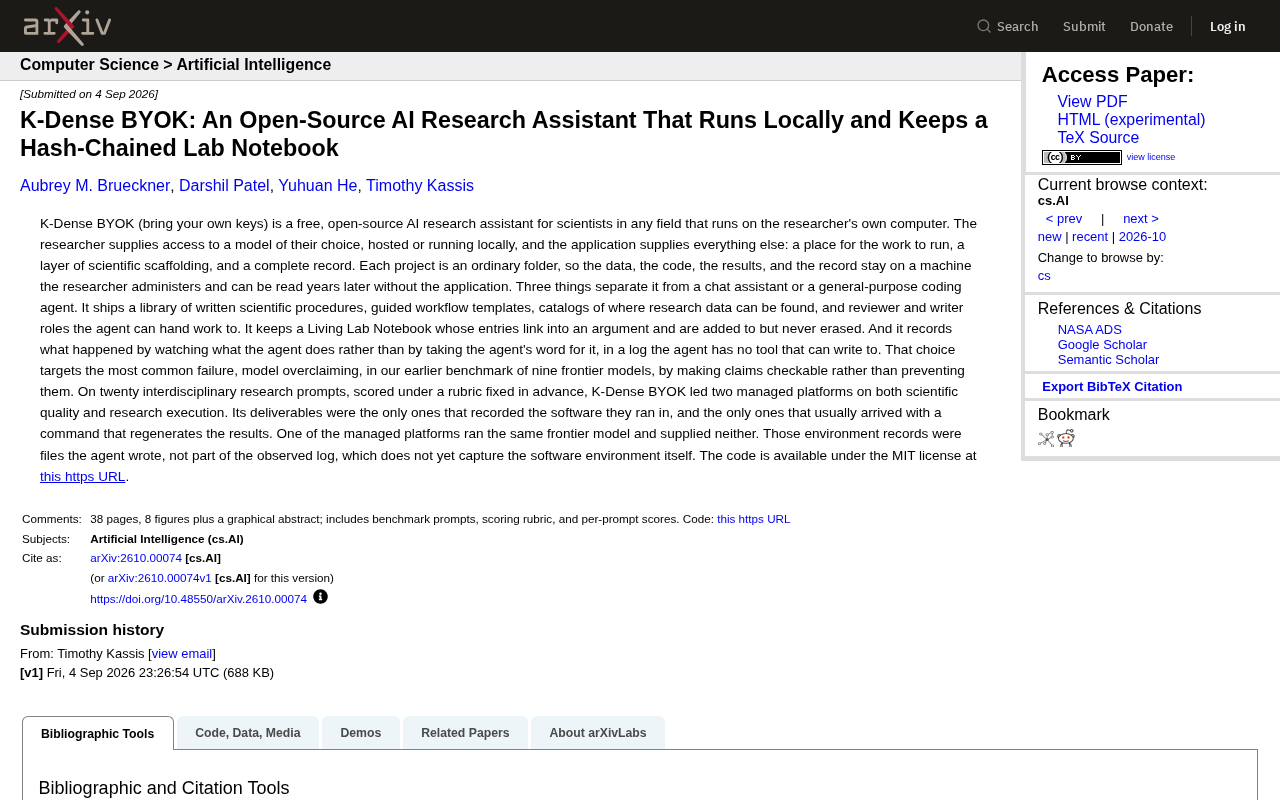
K-Dense BYOK is a free, open-source AI research assistant designed for researchers across disciplines. Its core philosophy sets it apart from mainstream cloud-based chat assistants — the entire application runs on the researcher's own machine. BYOK stands for "bring your own keys," meaning researchers supply their own access credentials for whichever model they choose, whether that model is hosted in the cloud or running locally. The application itself handles everything else: an environment for running tasks, a layer of scientific scaffolding, and a complete record of the work.
This architecture delivers a direct benefit: data sovereignty. Every project is simply a folder — data, code, results, and records all live on the researcher's own machine. More importantly, those files remain directly readable years later without the application, eliminating any risk of losing access if a platform shuts down. For scientific work that demands long-term data preservation and experiment reproducibility, this is a genuinely pragmatic design trade-off.
Three Design Choices That Set It Apart from Ordinary AI Assistants
According to the arXiv paper, K-Dense BYOK has three characteristics that clearly distinguish it from chat assistants or general-purpose coding agents.
Built-In Scientific Scaffolding
It includes a documented library of scientific research workflows, guided workflow templates, a directory of research data sources, and "reviewer" and "writer" roles that agents can delegate tasks to. This means it isn't just a passive question-answering tool — it encodes research methodology explicitly into the system itself.
An Append-Only Living Lab Notebook
It maintains a "Living Lab Notebook" in which every entry is linked into a complete chain of reasoning. Crucially, entries can only be added — they are never erased. This append-only approach guarantees complete traceability of the research process and prevents critical steps from being altered or deleted after the fact.
A Bystander Hash-Chain Log
The most distinctive feature is how it records facts: the system logs what the agent actually did by observing its actions, rather than trusting the agent's own account. This log is written to a location the agent has no tools to write to, forming a tamper-proof hash-chain record.
A hash chain is a cryptographic data structure in which each new entry embeds the hash of the previous entry — a one-way mathematical fingerprint of its contents — creating an interlocking chain. Any tampering with a historical record causes all subsequent hashes to mismatch, making the change immediately detectable. This is also the foundational mechanism behind blockchain, though in K-Dense BYOK it is applied lightly to a local log without requiring a distributed network. Writing the log to a separate location inaccessible to the agent further closes off any possibility of the agent "self-editing" its evidence — even if the model is compromised or hallucinates, it is physically unable to alter this external observation record.
Targeting the Core Pain Point of Model Overclaiming
This bystander logging mechanism addresses a very real problem: model overclaiming. In the authors' earlier benchmark study of nine frontier models, models exaggerating or misreporting the work they had completed was the most common failure mode.
K-Dense BYOK's approach is interesting — rather than trying to prevent models from making claims, it makes those claims verifiable. In other words, the system acknowledges that AI may overstate its results, but through an independent observation log, any claim can be cross-checked against reality. This "trust but verify" engineering philosophy is more reliable than simply asking models to be honest.
Model overclaiming is a systemic problem repeatedly documented in current AI agent research: when generating a final response, language models tend to describe "attempted execution" as "successfully completed" and "partial results" as "complete conclusions." This behavior is not intentional deception — it is a structural mismatch between the statistical generation mechanism of language models and the truthfulness requirements of scientific contexts. Models are trained to generate text that sounds plausible and fluent, not to faithfully reflect their own execution state. In research settings, this is especially dangerous: a researcher might make follow-on decisions based on results the AI claims to have "verified" when that verification never actually occurred.
Benchmark Performance and Reproducibility Advantages
In an evaluation covering twenty interdisciplinary research prompts with pre-fixed scoring criteria, K-Dense BYOK outperformed two hosted platforms on both scientific quality and research execution.
Even more notable is the reproducibility of its deliverables: it was the only system that recorded the software environment in which it ran, and the only one that typically included a single command to regenerate results. By contrast, one of the hosted platforms provided neither — even while running the same frontier model. This suggests the advantage comes from system design, not the model itself.
The paper's authors are also candid about current limitations: the environment records are files written by the agent itself and are not part of the observed log, and the observation log currently cannot capture the software environment. This clear-eyed acknowledgment of shortcomings actually strengthens the credibility of the research.
Reproducibility is one of the foundational norms of scientific research — the expectation that independent researchers following the same methods and data will arrive at the same results. Recording the software environment is a critical component of reproducibility in computational research: differences in operating system version, Python interpreter version, or the exact version numbers of dependency libraries can cause numerical results to drift or code to fail entirely. A "command to regenerate results" (typically a shell command or script) further lowers the barrier to reproduction, eliminating the need to guess the order of execution. Mainstream cloud AI assistants generally provide neither, because they are designed for conversational interaction rather than long-term scientific archiving. This structural difference is the fundamental reason K-Dense BYOK holds an advantage on the reproducibility dimension.
Open Source and Accessibility
K-Dense BYOK's code is released under the MIT License and hosted on GitHub at github.com/K-Dense-AI/k-dense-byok. The MIT License imposes virtually no restrictions on use, allowing researchers and developers to freely use, modify, and distribute the software.
For an academic community that is increasingly reliant on AI-assisted research, a tool that emphasizes local execution, data autonomy, and traceable process offers a technical path distinct from opaque cloud services. Its value lies not only in its features, but in how it returns the rigor and reproducibility that science demands back into the hands of researchers themselves.
Related articles

Meta vs. Publishers: The AI Data Battle Over Terms of Service Changes and the Future of the Internet
Meta changed its business account terms to allow AI training on linked website data, sparking backlash from publishers and creators. Industry groups demanded negotiations, forcing Meta to remove 'training' wording and delay the effective date. The dispute reveals the deeper battle over data authorization and the future of the internet in the AI era.

When Outside Xbox Meets Blood on the Clocktower: A Legion Match in Minecraft
Outside Xbox guests Ellen and Mike play Minecraft Blood on the Clocktower in a Legion game. How can three good players fight an evil majority amid information noise? This article breaks down Legion mechanics, information-role mind games, and the endgame reversal.

Kimi K3.1 Hands-On Test: Open-Source Model Nears Opus, Video Generation Steals the Show
Kimi K3.1 completed motion graphics, 3D rendering, mini-games, and video generation in a live test. Analysis of its 2.8T MoE architecture, gap vs Opus/GPT, and hidden video generation.