K-means vs Random Forest: How to Choose the Right Algorithm from First Principles

Why Random Forest beats K-means for predicting pre-defined customer categories — a deep dive into supervised vs. unsupervised learning.
An exam question asking students to choose between K-means and Random Forest for predicting customer spend categories reveals a fundamental ML concept: supervised vs. unsupervised learning. When categories are pre-defined and labels exist, it's a classification task — not clustering. Random Forest handles mixed feature types far better than K-means, which breaks down on high-cardinality categorical data due to the curse of dimensionality.
A Community Debate Sparked by One Exam Question
A machine learning exam question on Reddit sparked a lively debate. The question asked students to select an appropriate algorithm for predicting customer spend categories, with K-means clustering and Random Forest as the options. On the surface it looked like a basic question, but two sharply divided camps emerged in the community — and the debate cuts right to the heart of one of machine learning's core conceptual distinctions: Supervised Learning vs. Unsupervised Learning.
The fundamental divide between Supervised Learning and Unsupervised Learning comes down to whether training data contains labels. Supervised learning aims to learn a mapping function from input features X to output labels Y. The algorithm trains on historical data with known answers and makes predictions on new samples — classification (discrete labels) and regression (continuous labels) are its two main subtasks. Unsupervised learning, on the other hand, works with raw data that has no labels at all. The goal is to discover the underlying structure, patterns, or representations within the data — clustering, dimensionality reduction, and density estimation are its primary paradigms.
It's worth noting that the theoretical foundations of these two paradigms trace back to the early days of Statistical Learning Theory. The VC theory established by Vladimir Vapnik and Alexey Chervonenkis in the 1960s–70s provided the mathematical basis for the generalization ability of supervised learning. Unsupervised learning's development, meanwhile, benefited from early research in information theory and cluster analysis. In modern deep learning, these two paradigms have given rise to new hybrid forms: self-supervised learning uses the data itself to generate pseudo-labels and has achieved breakthroughs in language models (like the GPT series) and visual representation learning — fundamentally blurring the traditional boundary between supervised and unsupervised approaches.
This distinction affects not only algorithm selection but also evaluation: supervised learning has clear metrics like accuracy and F1 score, while assessing the quality of unsupervised learning is much harder, typically relying on the Silhouette Score or expert judgment. Confusing the two doesn't just lead to the wrong algorithm choice — it causes a fundamental directional error in the entire modeling pipeline.
The question's key description contains several easily misleading terms — "partition", "cluster", and "predicting". It's precisely this combination of words that makes the answer less than obvious.
The Case for K-means: Keyword Matching Logic
Those in favor of K-means made a straightforward argument: the question explicitly uses the words "partition" and "cluster" — the textbook definition of K-means.
How K-means works: you specify the number of clusters k in advance, and the algorithm automatically assigns customers into k groups based on feature similarity. This is a classic unsupervised clustering use case. The K-means algorithm was proposed by Stuart Lloyd in 1957 (formally published in 1982). Its core objective is to minimize the Within-Cluster Sum of Squares (WCSS), achieved by iteratively updating cluster centroids.
The algorithm's heavy reliance on Euclidean distance means it performs well in geometric space but has fundamental shortcomings when dealing with non-numeric data. K-means also has several well-known limitations: it's sensitive to the initial choice of cluster centers (the improved K-means++ mitigates this with probabilistic initialization); it assumes clusters are convex and isotropic, performing poorly on non-spherical distributions; and it's highly sensitive to outliers — a single extreme value can significantly shift a centroid.
The K-means++ improvement mechanism is worth understanding in depth. Proposed by David Arthur and Sergei Vassilvitskii in 2007, its core idea is to select the first cluster center randomly, then select each subsequent center with probability proportional to the square of its distance from the nearest already-chosen center — points farther away are more likely to be selected as new centers. This "distance-weighted randomization" ensures that initial centers are as spread out as possible across the data space. It can be theoretically proven that K-means++ achieves expected error within O(log k) times the optimal solution. The vast majority of modern implementations (including scikit-learn's default configuration) use K-means++ initialization.
At face value, if the task is to "partition" customers into several "clusters", K-means does seem like the most intuitive answer. This camp's logic is built on keyword matching — the question uses clustering terminology, so the answer should naturally be a clustering algorithm. For students accustomed to standardized test patterns, this reasoning isn't entirely unreasonable.
The Case for Random Forest: Analyzing the Task's True Nature
However, the other camp offered a deeper analysis, arguing that Random Forest is the correct answer, for two reasons.
Reason 1: "Predicting" Implies Supervised Learning
The question uses the word "predicting", and the three spend categories are pre-defined — not discovered by the algorithm itself. This means the dataset already contains labeled samples — each customer has a known spend category label.
This is crucial: K-means is an unsupervised algorithm whose job is to "discover" latent grouping structure from unlabeled data. But when categories are already pre-determined and you need to "predict" which category a new customer belongs to, this is fundamentally a supervised classification problem. Using K-means on a classification task with existing labels wastes all the label information and deviates entirely from the task objective.
Reason 2: Ability to Handle Mixed Feature Types
The second reason is more practical. The feature set described in the question is of mixed types:
- Numerical features: income, age
- High-cardinality categorical features: country, state, address, profession
K-means relies on Euclidean distance to measure similarity between samples, and Euclidean distance performs poorly on categorical features. High-cardinality categorical features are discrete variables with a large number of distinct values — for example, profession might have hundreds of categories, country has 200+, and address values are nearly unique. When these features are one-hot encoded, each value generates a new binary dimension, causing the feature space to explode in size. This is a classic cause of the Curse of Dimensionality.
The Curse of Dimensionality was first described by Richard Bellman in 1957 in research on dynamic programming. Its mathematical essence can be understood from two angles: the volume effect — in a d-dimensional hypercube, the volume fraction occupied by a hypersphere of radius ε shrinks exponentially as d increases, meaning data becomes extremely sparse in high-dimensional spaces; and the distance concentration effect — as dimensionality approaches infinity, the ratio of maximum to minimum distance between any two points approaches 1, meaning all pairwise distances become roughly equal. In high-dimensional sparse spaces, the discriminative power of Euclidean distance degrades drastically, rendering K-means's distance metric essentially meaningless.
Random Forest, by contrast, was proposed by Leo Breiman in 2001. It is an ensemble learning method based on the idea of Bagging (Bootstrap Aggregating). It improves predictive performance by building a large number of decision trees and aggregating their results via voting (for classification) or averaging (for regression).
Random Forest's effectiveness is theoretically grounded in the Bias-Variance Tradeoff: a single unpruned decision tree has low bias but high variance. Bagging draws bootstrap samples (with replacement) from the training set to build multiple independently trained trees, applying the law of large numbers to transform multiple high-variance estimators into a low-variance aggregate. Random Forest adds feature randomization on top of Bagging — typically considering only √p features at each split (where p is the total number of features) — which further reduces the correlation between trees and improves the ensemble effect. Random Forest has two key randomization mechanisms: bootstrap sampling of training data (each tree sees approximately 63.2% of training samples), and random subsampling of features at each node split rather than considering all features. This dual randomness creates diversity among the trees, effectively reducing variance in the ensemble and preventing overfitting.
For mixed-type features, decision tree split conditions are based on information gain or Gini Impurity thresholds — no distance metric between features is needed. This gives decision trees a natural compatibility with categorical variables and greater robustness to high-cardinality categorical features.
Who Has the Correct Answer?
Overall, the case for Random Forest is clearly more compelling. The "trap" in this question is that clustering terminology (partition, cluster) is used to package what is fundamentally a supervised classification task.
The key to identifying the true nature of the task: are the categories pre-defined?
- If categories are unknown and need to be discovered by the algorithm — that's clustering (K-means)
- If categories are known and you need to predict which one a new sample belongs to — that's classification (Random Forest)
The two clear signals in the question — "predicting" and "pre-defined categories" — almost definitively identify this as a supervised learning problem. K-means's natural disadvantages with mixed features further rule it out as the optimal solution.
Three Practical Principles for Algorithm Selection
The value of this exam question goes far beyond identifying the correct answer — it reveals several easily overlooked points in machine learning practice.
First, don't let keywords lead you astray. The question deliberately uses "cluster" and "partition" to test whether students truly understand the applicable scenarios for each algorithm, rather than just doing keyword matching. In real projects, business stakeholders' phrasing is often imprecise — engineers need to see through the language to understand the true nature of the task.
Second, identify the task type before selecting an algorithm. For any modeling task, the first step is always to determine whether it's supervised or unsupervised learning — whether labels exist, and whether the goal is prediction or discovery. These questions must be answered first.
Third, pay attention to feature data types. Algorithms and data need to match. When the data contains many high-cardinality categorical features, distance-based algorithms (like K-means, KNN) often struggle — high-dimensional sparse spaces cause Euclidean distance to lose its discriminative power. Tree-based models (like Random Forest, gradient boosting trees) handle features through conditional splits rather than distance metrics, making them generally a more reliable choice.
Industrial approaches for handling high-cardinality categorical features are worth addressing separately: Target Encoding is a mainstream industrial solution. Its core idea is to replace the original category label with the mean of the target variable for that category (e.g., replacing "profession = engineer" with "the average spend of all engineers"), compressing categorical information into a single numeric value and avoiding dimensionality explosion. However, target encoding carries a risk of data leakage and must be combined with cross-validation encoding or Bayesian smoothing to prevent overfitting. Embedding layers — originating from word embedding techniques in natural language processing — map high-cardinality categories to low-dimensional dense vectors. In industrial settings like Netflix's recommendation system and Alibaba, they have become the standard approach for handling ultra-high-cardinality features like user IDs and item IDs. These methods are also designed for supervised learning scenarios, making them entirely consistent with the framework in which Random Forest operates.
For machine learning beginners, this question is an excellent mental exercise: true algorithm selection ability isn't about memorizing the names of each algorithm — it's about understanding their underlying assumptions, applicable boundaries, and data requirements.
Key Takeaways
Related articles
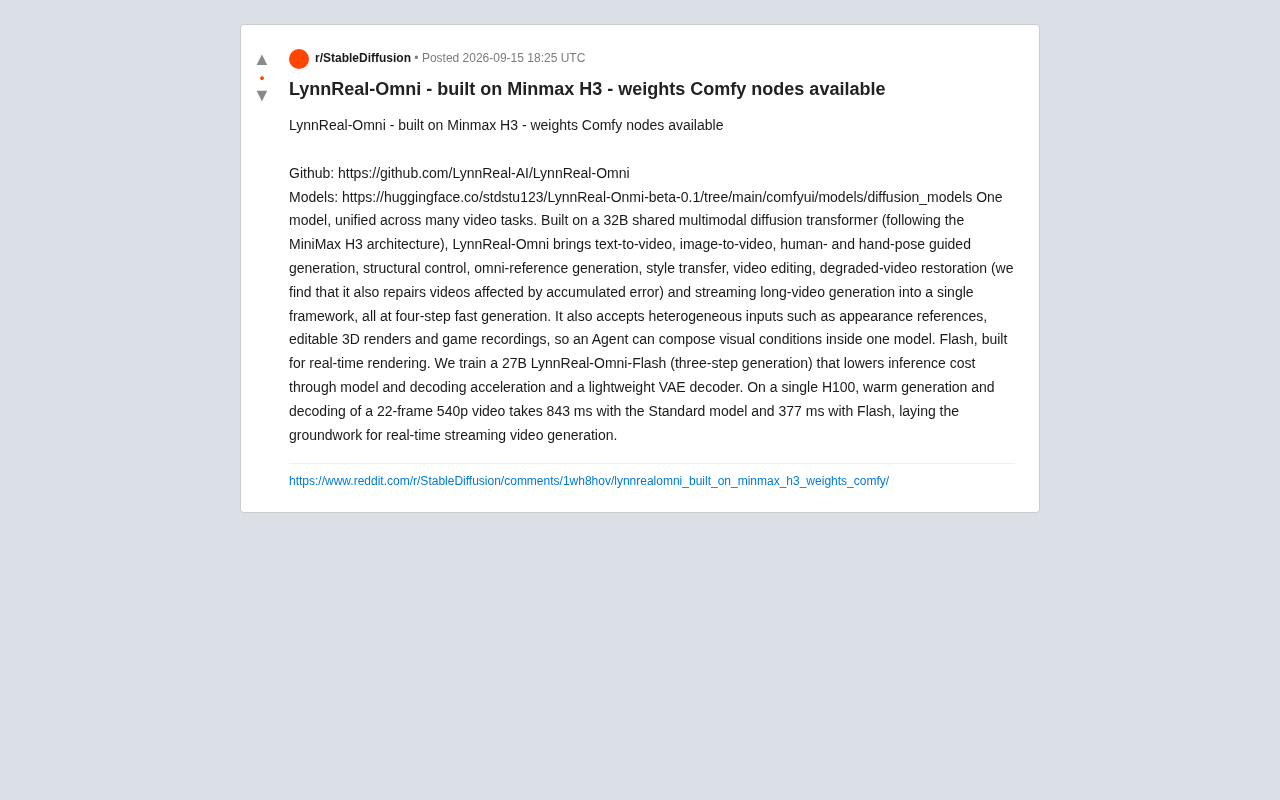
LynnReal-Omni: 32B Unified Video Diffusion Model Goes Open Source with Multi-Task Coverage in Four Steps
LynnReal-Omni is a 32B unified video diffusion model on MiniMax H3, covering text-to-video, pose guidance, style transfer, restoration in 4 steps. Flash version generates 540p video in 377ms on one H100.

Anthropic Co-Founder: AI 'Kill Switch' May Need to Be Mandatory by Law
Anthropic's co-founder tells the BBC that AI 'kill switches' may need to be legally mandated. We analyze the industry logic, technical challenges, and the tension between regulation and innovation.

The AI Data Center Boom Is Colliding With Cities Scarred by Heavy Industry
The AI data center boom is clashing with post-industrial communities. Philadelphia's case reveals structural conflicts between AI growth, energy use, water, and environmental justice.