Kagi Launches Email Service, Challenging Gmail's Paid Ad-Free Model
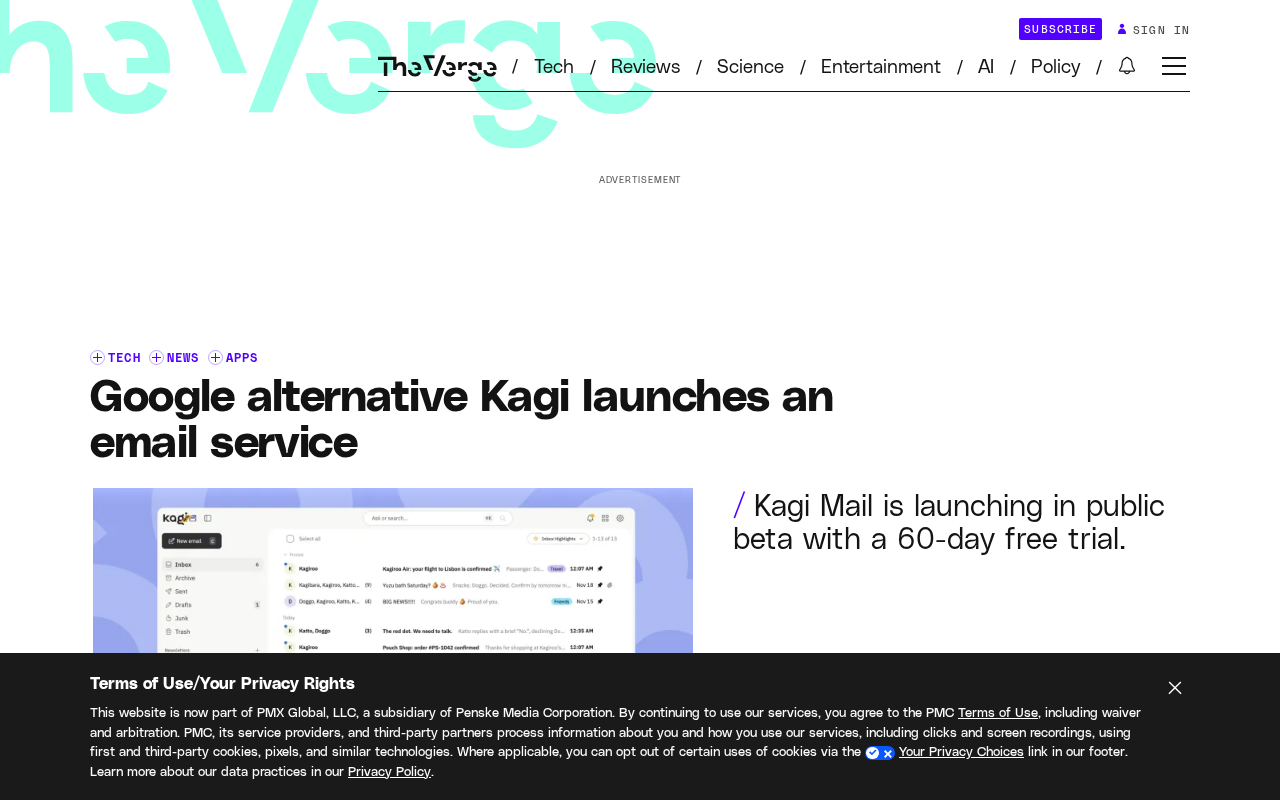
Kagi launches the ad-free, surveillance-free Kagi Mail public beta, extending its anti-Google product matrix to email.
Kagi announced that Kagi Mail has entered public beta, built around four principles: no surveillance, no ads, open standards, and no lock-in. This is its third challenge to Google's core products after its paid search engine and Orion browser. The article argues that search, browsing, and email are the three most important data entry points for ad targeting, and that Kagi is attempting to build a complete "pay for privacy" alternative. However, as identity infrastructure, email has far higher migration costs than search, and Kagi Mail faces dual tests in stability, anti-spam capability, and pricing. The article also notes that paid privacy is growing from a marginal demand into a sustainable niche market; once the three products form a closed loop, Kagi's subscription ecosystem value will rise significantly. It is unlikely to pose a substantial threat to Google in the short term but represents a persistent alternative narrative.
Kagi, which built its business on paid ad-free search, is now taking the fight to Gmail. According to RSS feed sources, Kagi today announced that Kagi Mail has entered public beta, positioning itself around "no surveillance, no ads, open standards, no lock-in," aiming to offer a new choice for email users tired of data monetization.
From Search to Browser to Email
Kagi has already challenged two of Google's core products: first, a paid search engine where users pay directly for ad-free, untracked search results; second, the Orion browser, positioned as a Chrome alternative emphasizing privacy and performance. Now with the launch of Kagi Mail, the company is extending its "anti-Google" product matrix into the communications layer.
This path is hardly surprising. Search, browsing, and email are the three entry points through which ordinary users interact with the internet most frequently, and they are also the most important data sources for ad targeting and user profiling. By choosing to build across all three simultaneously, Kagi is in effect constructing a complete "pay for privacy" alternative.
The Four Principles Kagi Mail Claims
According to the official announcement, Kagi Mail's positioning revolves around four key terms:
- No surveillance: Email content is not scanned for advertising or user profiling, a direct contrast to Gmail's long-standing practice of analyzing email content;
- No ads: No advertising is embedded in the email interface; revenue comes from user payments rather than attention monetization;
- Open standards: Follows email protocols rather than a closed ecosystem, allowing users to use third-party clients;
- No lock-in: Emphasizes data portability, ensuring users are not bound to the Kagi platform.
Together, these four points fundamentally challenge the "free email" business model. Gmail's free service is built on advertising revenue, while Kagi Mail attempts to prove that users are willing to pay for a communications experience free from analysis and advertising interruptions.
Open standards refers to email systems following publicly available internet protocols rather than proprietary vendor ecosystems. Traditional email relies on core protocols including SMTP (Simple Mail Transfer Protocol, responsible for sending email), IMAP (Internet Message Access Protocol, responsible for syncing email between clients and servers), and POP3 (Post Office Protocol 3, responsible for downloading email). Following these protocols means users can connect to Kagi Mail using any third-party email client (such as Thunderbird or Apple Mail) without being confined to the official app. This stands in contrast to how Gmail operates: while Gmail provides IMAP/SMTP interfaces externally, its full feature set (such as labels, search syntax, and smart categorization) depends deeply on its proprietary web interface and backend systems, so third-party clients often only receive a subset of functionality. Kagi's emphasis on open standards is essentially a commitment that email data will not be "enclosed" by the platform under the guise of features, and that users can freely choose how to use it.
Can Paid Email Work?
From a business logic perspective, Kagi Mail faces greater challenges than search. Search is a high-frequency, replaceable behavior, and the barrier for users to switch to a paid search engine is relatively manageable; email, however, is identity infrastructure, tied to account recovery, subscription notifications, work communications, and many other critical scenarios, making migration costs extremely high.
Kagi's "open standards" and "no lock-in" commitments are precisely a response to this pain point—it attempts to reduce users' fear of migration. But whether Kagi Mail in its public beta can match mainstream email services in stability, anti-spam capability, and storage capacity remains the key factor determining whether users are willing to entrust their core communications to it.
Another variable is price. Kagi Search already uses a subscription model; how Kagi Mail is priced and whether it is bundled with the search subscription will directly affect its appeal. For users already paying for search, a bundle is a natural value-add; but for ordinary email users, paying separately for an email service requires a stronger justification.
The reason email migration costs are far higher than for search is that email is a critical node in the internet identity system. Registration verification, password recovery, and subscription notifications for virtually all online services depend on email addresses. Once an address is changed, users must manually update binding information for dozens or even hundreds of services one by one, while also bearing the risk of account lockout from missed updates. Moreover, email addresses themselves carry social significance—a long-used address has become the established channel through which others contact you. Academic research often refers to this phenomenon as "switching cost"—encompassing not only money but also the time, effort, and rebuilding of relationship networks. For this reason, most users, even if dissatisfied with Gmail's privacy policies, tend to "complain but not migrate." Kagi's "no lock-in" commitment (such as data portability and support for standard protocols) attempts to reduce part of this switching cost, but it cannot eliminate the structural friction caused by identity binding—which is also the fundamental challenge of the paid email business model.
Significance for the Niche Privacy Market
The emergence of Kagi Mail further confirms that "paid privacy" is transforming from a marginal demand into a sustainable niche market. Some users are experiencing fatigue with the ad-driven internet model and are willing to pay subscription fees for untracked products. This market is not large, but user stickiness is high and willingness to pay is strong.
For Kagi, once search, browser, and email form a closed loop, the value of its subscription will increase significantly—the higher the sunk cost for users within one ecosystem, the more stable the retention. For Google, Kagi Mail is unlikely to pose a substantial threat in the short term, but it represents a persistent alternative narrative: email need not come at the cost of surveillance.
Kagi Mail is currently in public beta, with specific feature details and pricing strategy awaiting further official disclosure.
As a business model, "paid privacy" operates on the logic of letting users replace advertising revenue with subscription fees, thereby cutting off the platform's incentive to monetize through user profiling. This approach was not pioneered by Kagi: Proton Mail (end-to-end encrypted email), Fastmail (paid ad-free email), DuckDuckGo (privacy search), and other products have been cultivating this niche market for years. Their common characteristic is that they do not pursue mass scale but instead serve user groups that are privacy-sensitive and have strong willingness to pay—such as journalists, lawyers, security professionals, and enterprise clients. The sustainability of this market is built on "high user stickiness and low churn rates": once privacy concerns are awakened, users tend to be more willing to pay long-term. By integrating search, browser, and email into a subscription package, Kagi is in effect replicating the mature playbook of this niche market, using a product matrix to increase users' overall subscription value and thereby raising per-user revenue without significantly expanding user scale.
One-line Summary
Kagi launches the ad-free, surveillance-free Kagi Mail public beta, extending its anti-Google product matrix to email.
Paragraph Summary
Kagi announced that Kagi Mail has entered public beta, built around four principles: no surveillance, no ads, open standards, and no lock-in. This marks its third challenge to Google's core products, following its paid search engine and Orion browser. The article argues that search, browsing, and email are the three most important data entry points for ad targeting, and that Kagi is attempting to build a complete "pay for privacy" alternative. However, as identity infrastructure, email has far higher migration costs than search, and Kagi Mail faces dual tests in stability, anti-spam capability, and pricing strategy. The article also notes that paid privacy is growing from a marginal demand into a sustainable niche market. Once the three products form a closed loop, the value of Kagi's subscription ecosystem will increase significantly. While it is unlikely to pose a substantial threat to Google in the short term, it represents a persistent alternative narrative.
Related articles

The Gemini 4 Trio and 3.8 Flash: A Full Comparison of Positioning, Pricing, and Benchmarks
A comparison of Gemini 4 Neon, Carbon, Argon, and Gemini 3.8 Flash: positioning, context, API pricing, Artificial Analysis and Arena benchmark scores, and available entry points.

AI Coding Model Leaderboard: Opus 5.5 Crowned, Gemini Neon Stages a Comeback
Tech blogger Matthew Berman releases an AI coding model tier list: Claude Opus 5.5 holds S-tier, Gemini Neon surprises with A-tier, OpenAI Astra lands B-tier. How do open-source models like DeepSeek fare? We break down the scoring logic and practical takeaways.

New Jersey Joe Sandwich: Meat and Coleslaw on Triple-Decker Rye
New Jersey Sloppy Joe isn't a ground beef burger—it's triple-decker rye bread with meat, Swiss cheese, and coleslaw, plus Russian dressing. Learn the authentic Essex County method and family recipe.