Kairos: Be Your Own Data Detective — A Personal Analytics Engine Spanning Health, Finance, and Social Data

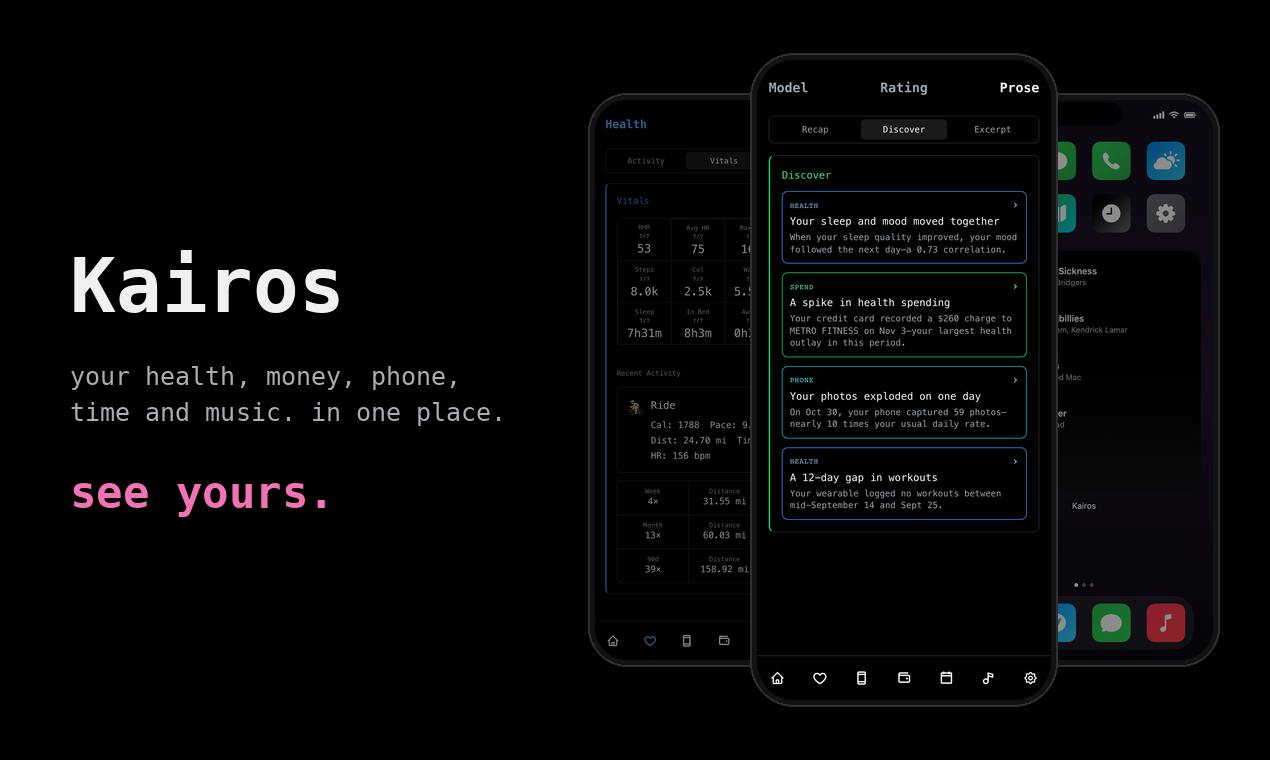
Kairos is a personal analytics engine spanning health, finance, and social data, focused on longitudinal self-comparison.
Kairos is a personal analytics engine introduced on Product Hunt that connects multiple data streams—health vitals, bank transactions, calendar, music, and messages—and cross-references daily subjective ratings of energy, mood, and focus with objective data to help users discover what influences their state. It explicitly rejects cross-user comparisons and leaderboards, following the restrained principle of "the system describes, the user decides" without drawing conclusions for users. Its value lies in signals at the intersections of multi-source data, making it suitable for quantified-self enthusiasts and privacy-sensitive users. However, initial traction is limited, and the depth of data integration and product maturity still need validation.
In an age of exploding data, each of us produces massive amounts of information: smartwatches track heart rate and sleep, banking apps record every purchase, calendars fill up with meetings and appointments, music apps know your emotional ups and downs, and chat histories hold clues to your social energy. Yet most of this data lies scattered across isolated silos, with little opportunity to talk to each other. A new product on Product Hunt called Kairos is trying to piece these fragments into a map that belongs to you alone.
Its positioning is clear: a personal analytics engine that spans health, finance, and social data. According to its Product Hunt page, Kairos connects various data streams—health vitals, bank transactions, calendar, music, messages, and more—to uncover patterns in your personal data, and it emphasizes that it "never makes cross-user comparisons."
Not Just a Dashboard, but a "Pattern-Discovery Machine"
Most health or budgeting tools on the market only answer "what happened": how many steps you took today, how much you spent on dining this month. Kairos wants to answer "why" and "what drives you."
One of its core mechanisms is subjective scoring: take a little time each morning to rate your energy, mood, and focus. The system then cross-references these subjective feelings with objective data streams, letting you see what is truly affecting your state—perhaps anxiety after a certain type of purchase, or a correlation between a certain kind of music and high-focus periods.
This design approach is restrained. Kairos's stated principle is "the system describes, you decide": it doesn't give you scores or rankings, doesn't draw conclusions for you, and only surfaces correlations. For users who dislike being lectured by algorithms, this stance is actually more appealing.
Subjective scoring and Ecological Momentary Assessment (EMA): Kairos has users rate their energy, mood, and focus daily. In behavioral science, this method is called "Ecological Momentary Assessment"—real-time, repeated sampling of an individual's subjective state in natural environments to reduce recall bias. Aligning EMA data with passive sensor data (such as step count, heart rate, spending records) in time series is a common starting point for causal exploration in personal analytics engines—it cannot directly prove causation, but it can highlight correlations for users to verify themselves.
Privacy First: Compare Only with Yourself, Not with the World
Kairos's most distinctive differentiator is its explicit rejection of cross-user comparison. Most health apps like to use leaderboards and peer comparisons to create motivation, but this also means your data must enter some kind of aggregated pool. Kairos chooses the opposite direction: all insights unfold only along the longitudinal timeline of your own data.
Judging from the product description, it takes "personal patterns" rather than "social benchmarks" as the starting point for analysis. This is both a product philosophy and a response to privacy anxiety—especially when the data involves both financial transactions and private messages, users are particularly sensitive about "who their data is being compared with." Specific data storage and encryption methods are currently limited in public information; actual experience should be based on in-product documentation.
Differential privacy and federated learning: When a product emphasizes "no cross-user comparison," privacy-enhancing technologies (PETs) are often involved behind the scenes. Differential privacy adds calibrated noise to aggregated data so that individual records cannot be reverse-engineered; federated learning lets models train locally on user devices, uploading only gradients rather than raw data. Kairos's public information does not state whether it uses such technologies, but to maintain trust while connecting bank transactions and private messages, on-device processing and minimized uploads are usually architectural choices that must be considered.
The Value of Multi-Source Data Lies at the Intersections
The limitations of a single data source are obvious: health apps don't know your financial stress, and budgeting tools don't know your sleep quality. Kairos's ambition is to layer these dimensions together and look for signals at the intersections.
According to its Product Hunt page, the data streams it can connect include health vitals, bank transactions, calendar, music, and messages. For example: do meeting-heavy days come with energy dips? How does mood fluctuate after certain types of spending? Is there a relationship between late-night music listening habits and next-day focus? These kinds of questions cannot be answered by any single tool, and multi-source fusion is precisely where the value of a personal analytics engine lies.
It is worth noting that the more data sources you connect, the higher the setup cost and authorization concerns. Its initial traction on Product Hunt—77 upvotes and 9 comments—shows it has struck a chord with some users' needs, but product maturity and the depth of integration across platforms still need longer-term validation.
Personal data silos and the right to data portability: Health, financial, and social data belong to different platforms, with different formats and authorization systems. Kairos's multi-source integration depends on open APIs from each platform or manual user exports—for example, bank transactions can be accessed through Open Banking standards (such as Plaid), and health data can be read via Apple HealthKit or Google Fit. The right to data portability (GDPR Article 20) provides a legal basis for users to export their own data, but cross-source identity alignment (mapping the same user's IDs across different platforms) and real-time synchronization remain engineering challenges, which directly determine the granularity and timeliness of cross-analysis.
Who Should Use Kairos
It is clearly not for lazy users who want a "one-click health report." Kairos is better suited to people willing to do a self-check-in every morning, who are enthusiastic about the quantified self, and who care about data privacy.
If you already wear a watch, use budgeting software, and have a packed calendar, yet always feel that this data "lives its own separate life," Kairos provides exactly the thread that ties it together. How many truly useful insights this thread can pull out depends on how much recording you are willing to invest and how complete the product is at data integration.
Key takeaways:
- Kairos is a personal analytics engine spanning health, financial, and social data, emphasizing the discovery of personal patterns rather than cross-user comparison
- Through daily energy, mood, and focus ratings cross-analyzed with objective data streams, it helps users understand the drivers of their states
- It follows the restrained principle of "the system describes, the user decides," and does not draw conclusions for users
- Data sources cover health vitals, bank transactions, calendar, music, and messages, with value lying in multi-dimensional intersections
- Suitable for quantified-self enthusiasts and privacy-sensitive users; product maturity still needs validation
Related articles

ChatGPT Plus Subscription Pitfall Guide: Go/Plus/Pro Tier Comparison and Quick Activation
A complete ChatGPT Plus subscription guide based on a Bilibili tutorial: from registering an account, comparing Go/Plus/Pro tiers, to the practical steps for quickly completing your subscription.

GPT-6.2 Sol/Astra Released! A Step-by-Step ChatGPT Plus Subscription Guide and Tier Comparison
GPT-6.2 Sol/Astra is out—here's a ChatGPT Plus subscription guide: register an account, compare Go/Plus/Pro tiers, and subscribe in a minute.

Comparing Three Channels for Subscribing to GPT Plus in China: Is Website Top-Up the Easiest?
How to subscribe to GPT Plus in China? This article compares website top-up, credit card, and mobile top-up channels—process, cost, and risk—with steps and tips to help you choose wisely.