KanaSensei: An AI Adaptive Learning Tool to Master Japanese Kana in Two Weeks
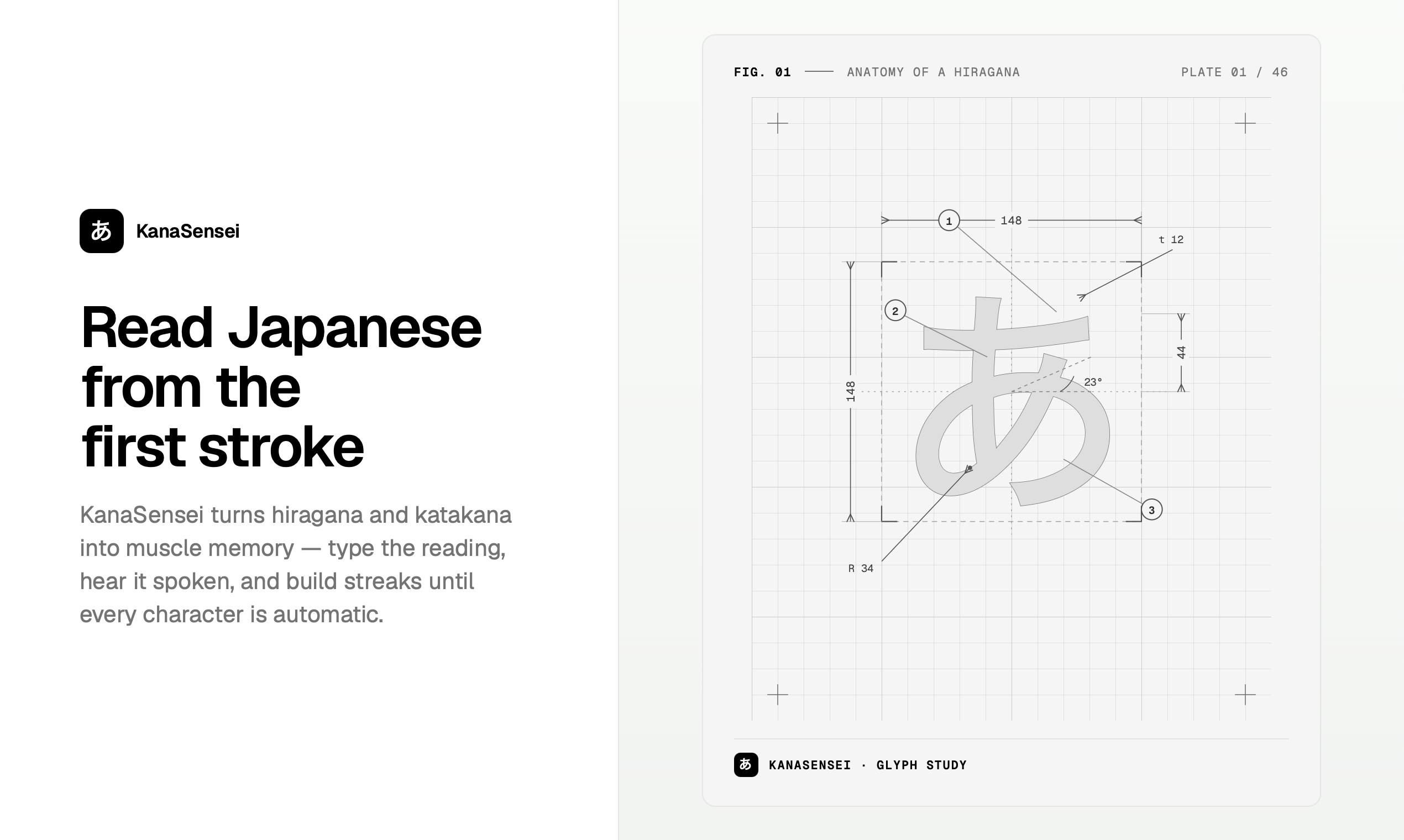
KanaSensei uses AI-adaptive drills and mnemonics to help beginners master Japanese kana in two weeks.
KanaSensei is a lightweight web-based tool designed to help Japanese beginners master hiragana and katakana within two weeks. It combines adaptive drills powered by spaced repetition, visual mnemonics, native speaker audio, and gamified progress tracking. By focusing exclusively on kana recognition rather than trying to be a comprehensive language platform, it delivers a more efficient and targeted learning experience in this critical first step of Japanese study.
A Lightweight Learning Tool Dedicated to Japanese Kana
For anyone looking to get started with Japanese, the first hurdle is often memorizing the gojūon chart — over a hundred basic characters spanning hiragana and katakana. The Japanese writing system consists of three character sets: hiragana, katakana, and kanji. Hiragana and katakana are collectively known as "kana," with each set containing 46 basic characters. When you add voiced consonant variants (dakuten), semi-voiced variants (handakuten), and combination characters (yōon), the total number of characters to master exceeds 100. Hiragana is primarily used for native Japanese words and grammatical particles, featuring rounded, flowing strokes; katakana is mainly used for loanwords, onomatopoeia, and emphasis, with sharp, angular strokes. The gojūon chart arranges kana by vowel and consonant — similar to the English alphabet — and serves as the absolute foundation of Japanese reading and writing. Without mastering kana, subsequent vocabulary building, grammar study, and reading practice are simply impossible.
This seemingly simple yet incredibly tedious memorization task has discouraged countless beginners. KanaSensei, launched on Product Hunt, attempts to solve this pain point with a systematic approach and makes a compelling promise: learn to read Japanese kana in two weeks.
Built by developer Samuel, the product is categorized under Education, Language Learning, and Online Education. After launch, it received 81 upvotes and ranked #7 on the daily leaderboard. While the comment count is still modest, its clear product positioning makes it quite representative in the niche of kana learning.
Core Features of KanaSensei: Turning Kana Memorization into Quantifiable Training
KanaSensei is a purely web-based application — no downloads or installations needed. Just open your browser and start learning. It centers on the core goal of kana recognition and reading, with several complementary learning mechanisms working together.
Adaptive Drill System: Intelligently Adjusting Your Learning Pace
The most noteworthy feature is its Adaptive Drills system. Traditional kana memorization relies heavily on rote repetition and fixed-order flashcards, but KanaSensei dynamically adjusts practice content based on the learner's performance — increasing the frequency of characters you struggle with while reducing repetition of those you've already mastered.
The theoretical foundation of this mechanism is spaced repetition, a memory strategy from cognitive psychology validated by extensive research. Its core principle traces back to German psychologist Hermann Ebbinghaus's "forgetting curve" theory from 1885: newly formed memories decay at an exponential rate after learning, but each successful recall during review significantly strengthens memory durability, allowing the next review to be scheduled further into the future. Algorithms based on this principle (such as SuperMemo's SM-2 algorithm) maintain a "memory strength" metric for each knowledge item and trigger reviews at the optimal moment — just before the predicted point of forgetting. Well-known memory software like Anki and SuperMemo use this as their core mechanism. KanaSensei's adaptive drill system applies a similar approach: the system tracks the accuracy rate and response time for each kana character, shortening review intervals and increasing frequency for error-prone characters while gradually extending intervals for well-memorized ones, thereby maximizing memory efficiency within limited practice time.
Compared to traditional gojūon chart memorization methods, this intelligent learning path makes every minute of practice more valuable.
Mnemonics: Reducing Memory Load Through Association
Beyond repetitive drilling, KanaSensei also provides mnemonics. Kana characters can often be memorized by associating their shapes with visual images — linking a character's form to a concrete scene to dramatically reduce the cognitive burden of memorization.
The effectiveness of mnemonics stems from the human brain's natural advantage in remembering information that is concrete, emotionally colored, and spatially structured — known in cognitive science as "Dual Coding Theory," proposed by psychologist Allan Paivio in 1971. This theory holds that when information is encoded simultaneously in both verbal and visual forms, there are more retrieval pathways and lower forgetting rates. A classic application in kana learning involves associating character shapes with specific images: for example, the hiragana "ぬ" can be imagined as a bowl of noodles, which helps remember both the shape and the pronunciation "nu" through the word "noodle." James Heisig's Remembering the Kana systematically employs this method and is widely regarded as a classic textbook for rapid kana memorization. This approach is especially effective for visual and associative learners, condensing what would otherwise require dozens of mechanical repetitions into just a few meaningful associations.
Native Speaker Audio: Getting Pronunciation Right from the Start
The app includes built-in native speaker audio. Kana isn't just about visual recognition — correct pronunciation matters too. Native recordings ensure learners establish accurate sound-character mappings from the very beginning, avoiding the additional time cost of correcting pronunciation later.
Language acquisition research shows that pronunciation accuracy is highly correlated with the quality of phonetic input learners first encounter. Linguist Catherine Best's Perceptual Assimilation Model points out that adult learners unconsciously "assimilate" foreign language phonemes into the closest phoneme categories in their native language, leading to perception and pronunciation errors. Japanese phonology differs significantly from both Chinese and English: for example, the aspirated fricative consonant in "つ" (tsu), the flapped consonant in the "ら" row (ra) — which falls between English r and l — and vowel length contrasts (such as the semantic difference between "おばさん" and "おばあさん") are all common stumbling points for Chinese and English speakers. If learners rely on synthesized speech or non-native pronunciation models from the start, they can easily form incorrect phonological mental representations, making later correction far more difficult than initial acquisition. KanaSensei's design choice to include native speaker recordings ensures learners build correct sound-character mappings at the kana stage, laying an accurate phonetic foundation for subsequent vocabulary and sentence-level listening and speaking practice.
Challenge Mode and Progress Tracking: Maintaining Learning Motivation
To sustain motivation, the product also includes challenge mode and progress tracking. The former uses gamified tests to verify mastery, while the latter presents learners' overall progress in a visual format.
This employs core gamification strategies — applying game mechanics (such as points, leaderboards, achievement badges, level unlocking, and instant feedback) to non-game contexts to boost user engagement. The psychological foundation rests on two theoretical frameworks: B.F. Skinner's operant conditioning theory, which uses positive reinforcement to consolidate target behaviors; and Edward Deci and Richard Ryan's Self-Determination Theory, which holds that intrinsic motivation stems from three basic psychological needs — autonomy, competence, and relatedness. KanaSensei's challenge mode satisfies the need for competence through timed tests and combo counters, while visual progress tracking provides learners with a clear sense of direction and control. Duolingo's success has thoroughly demonstrated gamification's massive impact on learning retention — according to its public data, streak mechanics have multiplied daily active user retention rates several times over. For a task like kana learning that demands high-frequency repetition over a short period, gamification is a critical tool for combating boredom and maintaining a two-week learning habit.
Why Kana Learning Deserves a Dedicated Tool
Some might ask: with mature language learning platforms like Duolingo and Anki already available, why do we need an app specifically for kana?
The answer lies in focus. Comprehensive language learning apps cover a broad range but often only scratch the surface when it comes to kana, with learning paths that aren't targeted enough. For example, Duolingo's Japanese course interleaves vocabulary and sentence patterns while teaching kana, making it difficult for learners to concentrate on character recognition in a short timeframe. Anki, while boasting a powerful spaced repetition engine, requires users to create or search for their own card decks and lacks optimizations specific to the kana learning scenario. KanaSensei dedicates all its energy to the single, clear goal of kana recognition and reading — from its practice algorithms to mnemonic design, everything is optimized around this objective, enabling a superior experience in this specific niche.
For beginners, spending two weeks intensively conquering kana to build a solid pronunciation foundation for subsequent vocabulary and grammar study is a widely validated, highly efficient learning path. KanaSensei hits precisely at this critical moment of need — it doesn't try to do everything, but instead does one small thing thoroughly.
Product Positioning and Market Observations
From a product perspective, KanaSensei is a classic lightweight vertical tool: single objective, purely web-based delivery, and a low barrier to entry. In the software product space, this strategy has abundant precedents for success — Notion started from the single function of note-taking, Calendly only does scheduling, and Loom only does asynchronous video messaging. The core logic is: in niche scenarios that major platforms can't cover in detail, establish a foothold through exceptional user experience and lower customer acquisition costs. For products like KanaSensei, pure web delivery (PWA or static site) means zero distribution costs, cross-platform compatibility, and no app store review processes or revenue sharing.
The advantage of such products lies in manageable development and maintenance costs with clear user acquisition paths; the challenge is how to continue providing value or achieve monetization after users complete their kana learning (i.e., reach the two-week goal). This is the classic "ceiling effect" facing lightweight vertical tools — once users complete the core task, the product's usage lifecycle may only span two to four weeks. Common strategies to address this include: horizontal content expansion (such as adding kanji and vocabulary modules), conversion to paid subscriptions or one-time purchases, and leveraging SEO and word-of-mouth to continuously acquire new users.
Looking at the Product Hunt data, the 81-vote result indicates the product has gained recognition within its niche audience, but achieving broader impact will require further expansion in content depth or community engagement.
For readers considering getting started with Japanese, KanaSensei offers a low-cost option to try — spend two weeks testing your commitment to learning while building your first foundation stone. For product entrepreneurs, it's also a case study worth examining: even in markets dominated by giants, there's still room to gain a foothold with a hyper-focused single-point product.
Summary
KanaSensei uses a four-part toolkit of adaptive drills, mnemonics, native audio, and progress tracking to make the tedious task of Japanese kana learning more systematic and sustainable. It's not a disruptive product, but it's an excellent example of refining a niche need to perfection. If you're about to embark on your Japanese learning journey, why not give it a try for two weeks?
Related articles

Amphibious Transforming Drone: Beyond 100x Power Savings, What Are the Real Needs?
Is the amphibious transforming drone just a gimmick? Starting from the 100x power difference of the M4 Morphobot, explore real application scenarios and thesis topic ideas, analyzing boundary conditions where pure drones and pure ground robots both fail.

Warhound Raises $200 Million: Genetically Engineered "War Dogs" Paired with Anduril Gear
Warhound raises $200M, backed by Ben Lamm and Palmer Luckey, to genetically engineer dogs for military and law enforcement use and equip them with Anduril gear. This article analyzes its technology direction, funding logic, and ethical controversy.

Claude API Comes to Google Cloud: IAM Integration and SDK Access Guide
Anthropic hosts the full Claude API on Google Cloud with IAM-controlled permissions and unified billing. This guide covers the Vertex AI and Anthropic-hosted entry points, IAM role configuration, and SDK access.