Kane CLI: An Independent Reviewer for Your AI Coding Agent

Kane CLI is an independent testing tool that solves the "AI grading its own work" problem in AI coding workflows.
Kane CLI is designed to address a structural flaw in AI coding workflows: when agents like Devin or Cursor both write and verify code, their validation is inherently unreliable. Kane CLI acts as an independent reviewer — running full end-to-end quality verification rather than checking individual task logic in isolation. Key features include tamper-evident, replayable run receipts; zero additional AI cost for reruns; and a claimed #1 ranking on the Prism benchmark. The product is positioned as "Devin builds, Kane checks," installable via a single NPM command. However, all key claims in the demo come from the product team itself, so real-world compatibility with your tech stack and CI/CD pipeline warrants careful evaluation.
Why AI Coding Agents Need an Independent Testing Tool
Devin tests. Cursor tests. Factory tests too — nearly every AI coding agent today claims it can verify code quality. So what's the point of Kane CLI? The core logic comes down to one sentence: the person who writes the code shouldn't be grading their own work.
This is a structural problem that has long gone unaddressed. When an AI agent is responsible for both generating code and judging whether that code is correct, it's essentially caught in a closed loop of self-evaluation. Agents will often run the checks they designed themselves, then confidently declare "task complete, ready to merge." But the reliability of this kind of self-certification is questionable — it's like letting students grade their own exams.

What Kane CLI Does Differently
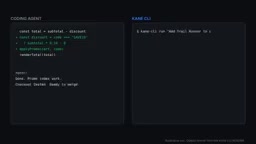
According to the demo video, after an AI agent declares code "ready to merge," Kane CLI takes over and runs a genuine end-to-end verification process. In the checkout scenario shown in the demo, the agent believed everything was fine — but after Kane CLI ran the full real-world flow, it found a problem: the order total was calculated incorrectly, resulting in Exit 1.
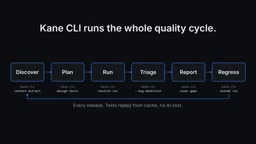
This detail reveals the fundamental difference between the two approaches: AI agents check individual tasks, while Kane CLI runs a complete quality cycle. The former focuses on whether local logic is internally consistent; the latter verifies whether the entire business flow actually works end-to-end. This separation of responsibilities is a modern AI-era revival of the classic software engineering division between "development" and "QA."
Reproducible, Shareable, and Tamper-Evident "Receipts"
Another feature Kane CLI emphasizes is that every run leaves a "receipt." These records have three properties: replayable, shareable, and tamper-evident.
For team collaboration, this solves a longstanding pain point: when AI-generated code breaks something, how do you reproduce the issue, establish accountability, and prove to your team that verification actually took place? Tamper-evident run records make the test results themselves trustworthy, rather than relying on an agent's verbal assurance of "I tested it."
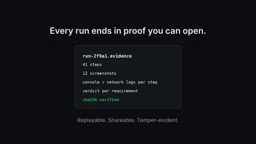
In engineering practice, tamper-evidence is typically implemented through cryptographic means — for example, hashing and signing run logs, or writing records to immutable storage so that any after-the-fact modification can be detected. This is conceptually similar to a blockchain's "immutable ledger," but far more lightweight — the goal isn't decentralization, but auditability of test results. In high-compliance environments (such as financial or medical software) or multi-party outsourcing projects, this kind of trusted record is especially valuable: it can answer questions like "who ran which tests, at what time, against which version of the code, and what were the results" — without relying on anyone's word.
Cost and Performance: Reruns Don't Burn AI Credits
The video specifically highlights a selling point that will make "CFOs smile": rerunning tests doesn't incur additional AI call costs.
This is practically significant in a landscape where most AI tools charge per token or per API call. If every regression test requires a fresh large model invocation, costs scale linearly with iteration frequency. Kane CLI decouples quality verification from AI inference, meaning teams can freely rerun tests as often as needed without worrying about the bill.
On performance, the video claims Kane CLI ranks first on the Prism benchmark — though only by "a hair." As they put it, "a win is a win." Given that this data comes from the product team itself, readers should maintain some skepticism about this benchmark claim.
The Prism Benchmark is one of the evaluation suites used to assess how AI coding agents perform on real-world software engineering tasks. It typically includes subtasks like code generation, debugging, and cross-file modifications, using "task completion rate" or "passing test cases" as its core metrics. Similar to better-known benchmarks like SWE-bench, Prism focuses on measuring an agent's practical usability in end-to-end tasks rather than raw code snippet generation quality. It's worth noting that different benchmarks vary significantly in task distribution, difficulty, and scoring methodology — leading on one benchmark doesn't necessarily translate to strong performance in other contexts. When referencing such rankings, understanding the benchmark's specific composition and test methodology is more valuable than the ranking alone.
The Division of Labor: Devin Builds, Kane Checks
The entire product can be summarized in one line: Devin builds, Kane checks. It doesn't try to replace existing coding agents — it fills in the missing piece: an independent reviewer that has no involvement in writing the code.
Setup is straightforward: a single NPM command is all it takes. For developers already using various AI coding agents, this means you can add an independent "reviewer" to your workflow at minimal onboarding cost.
CI/CD (Continuous Integration / Continuous Delivery) is the standard automated build, test, and deployment pipeline in modern software engineering. Kane CLI's claim of one-line NPM installation means it needs to occupy an appropriate slot in an existing CI/CD system — such as GitHub Actions, GitLab CI, or Jenkins — typically as a gate before code is merged. For teams with well-established CI/CD workflows, the real integration cost isn't just the install command. It also involves engineering decisions like: which scenarios require Kane validation, whether a Kane failure should block a merge, and how to manage the receipt files Kane generates. These details are rarely covered in demo videos.
A Measured Perspective
Looking at the source material, this is clearly a product demo with an overtly promotional tone. The problem it identifies — that AI agents shouldn't self-evaluate — does speak to a genuine pain point in current AI coding workflows. The design directions of role separation, traceable run records, and zero AI cost for reruns all align with solid engineering intuition.
That said, it's worth pointing out that the key claims in the video — such as ranking first on the Prism benchmark and the checkout error demonstration — are all presented unilaterally by the product team, without third-party verification. Before actually adopting Kane CLI, developers should pay closer attention to its coverage of their specific tech stack, how tests are written within it, and how well it integrates with existing CI/CD pipelines — rather than drawing conclusions from a demo alone.
Related articles

AI Reverse-Engineers Monitor Firmware in 15 Minutes — Has the Hacking Barrier Been Flattened?
A security researcher used AI to reverse-engineer Dell monitor firmware in 15 minutes—entropy analysis, key extraction, MD5 verification—revealing encryption design flaws.

Mistral Voxtral 3: Real-Time Voice at 4 Cents per Minute, Challenging OpenAI
Mistral Voxtral 3 cuts real-time voice agent costs to 4 cents per minute, bundling three speech recognition models, a speech generation model, and a real-time voice toolkit, supporting 50+ languages and self-hosting. This article analyzes its pricing structure, sub-second response performance, and its strategic divergence from OpenAI and Gemini on data privacy versus out-of-the-box convenience.

WebMCP: Every Website as Its Own MCP Server, So AI Agents No Longer Rely on Screenshots
WebMCP lets websites expose tools via the document.modelcontext API, becoming directly callable MCP servers. This article explains its architecture, the Claude Code remote-debugging demo, Chrome's current support stage, and its impact on the agent ecosystem.