KANSteer: Nonlinear Guidance for Text-to-Image Generation Beyond the Linear Representation Hypothesis

KANSteer uses Kolmogorov-Arnold Networks to model concept steering as curves, challenging the linear representation hypothesis in text-to-image models.
Mechanistic interpretability research has long relied on the Linear Representation Hypothesis (LRH), treating concepts as linear directions in activation space. The paper *Beyond the Linear Representation Hypothesis* empirically shows that real intermediate-state activations in text-to-image models rarely fall on the straight line between two endpoint concepts, undermining LRH's universality. The proposed KANSteer uses Kolmogorov-Arnold Networks (KAN) to model concept traversal as a curve through intermediate states rather than a straight line, with learnable one-dimensional coordinate functions that automatically adjust steering direction along the trajectory while remaining interpretable. Experiments across multiple concepts and diffusion Transformer architectures show KANSteer better follows real trajectories and enables smoother intermediate attribute traversal than linear steering.
The Limits of the Linear Representation Hypothesis
Mechanistic interpretability research has long relied on the Linear Representation Hypothesis (LRH) — the assumption that models encode high-level concepts as linear directions in activation space. This assumption is elegant in its simplicity and underpins a large body of activation steering work: find a linear direction between two endpoint concepts, then nudge generation results along that line.
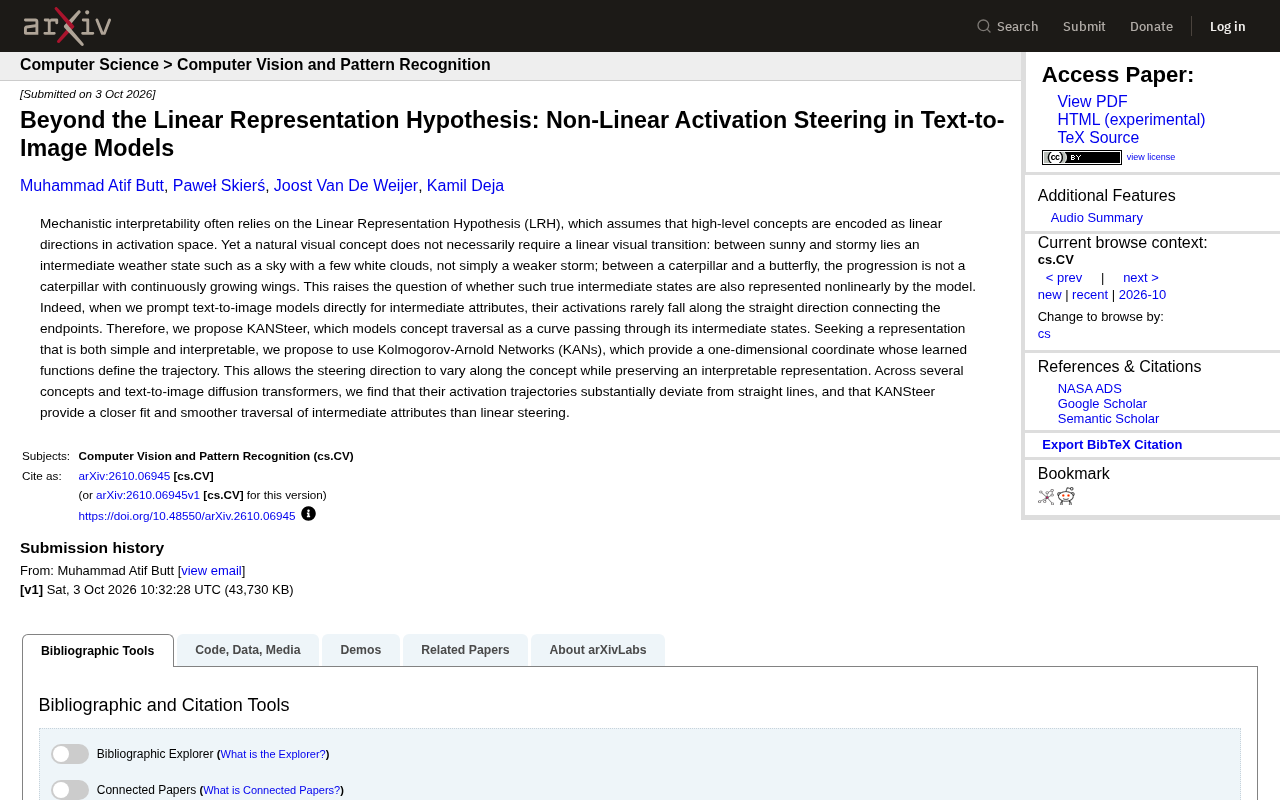
But do visual concepts really transition along straight lines? A new arXiv paper, Beyond the Linear Representation Hypothesis, offers an intuitive counterexample: the midpoint between a clear sky and a thunderstorm isn't a "weaker thunderstorm" — it's a sky dotted with a few white clouds. Likewise, the transition from caterpillar to butterfly is hardly a caterpillar with gradually growing wings. These real intermediate states suggest that concept transitions may be nonlinearly encoded inside the model.
Activation steering is one of the core techniques in mechanistic interpretability. The basic operation is: first find an activation direction vector representing a concept (e.g., approximating "queen" by computing "king" − "man" + "woman"), then add this direction vector to the model's intermediate-layer activations during inference to steer outputs without changing weights. This approach depends on the linear representation hypothesis — vector arithmetic only carries semantic meaning if concepts exist as linear directions in activation space. If the distribution of a concept is itself curved, pushing activations along a fixed direction will drift away from the true concept manifold, distorting control or producing semantically unnatural intermediate states.
Empirical Finding: Activation Trajectories Are Not Straight Lines
The researchers directly prompted text-to-image models with "intermediate attribute" descriptions and observed where the resulting activations landed. They found that these activations rarely fell on the straight line connecting the two endpoint concepts. In other words, forcing linear-direction steering makes the model take a "shortcut" through concept space, skipping over genuinely existing intermediate forms.
The implication is significant: linear steering is not just a mathematical simplification — it may also be semantically distorting. It can turn a clear sky into a thunderstorm, but it struggles to land precisely on "cloudy," a real intermediate state. For applications requiring fine-grained control over the generation process, this is a meaningful limitation.
KANSteer: Modeling Concept Traversal as a Curve
To address this, the paper proposes KANSteer, whose core idea is to model concept traversal as a curve passing through intermediate states rather than a straight line.
Why KAN?
The key tool enabling this curve is Kolmogorov-Arnold Networks (KAN). KAN has recently attracted attention for its interpretability — it uses learnable one-dimensional functions to approximate complex mappings. In KANSteer, KAN provides a one-dimensional coordinate whose learned functions define the trajectory of a concept's movement through activation space.
This design offers two advantages:
- The steering direction adapts with the concept: at different positions along the trajectory, the steering direction automatically adjusts rather than remaining fixed along a single line.
- Interpretability is preserved: the combination of a one-dimensional coordinate and learned functions keeps the representation simple and readable, without collapsing into an uninterpretable black box.
Kolmogorov-Arnold Networks (KAN) were proposed in 2024 by MIT and collaborators, grounded in the Kolmogorov-Arnold representation theorem: any continuous multivariate function can be decomposed into a finite composition and superposition of univariate continuous functions. Unlike traditional multilayer perceptrons (MLPs) that apply fixed activation functions at nodes, KAN places learnable activation functions on the network's "edges," with each edge corresponding to a trainable spline function. This makes every connection a visualizable, interpretable one-dimensional function curve, rendering the network's behavior more transparent than an MLP. In the context of KANSteer, this property is especially valuable: the one-dimensional coordinate transformation learned by the network directly corresponds to a concept's movement path through activation space, allowing researchers to directly observe the shape of that path rather than guessing at the black-box mapping logic.
Balancing Simplicity and Interpretability
The researchers deliberately emphasize choosing representations that are "both simple and interpretable." This reflects a longstanding tension in mechanistic interpretability: overly complex models can fit real trajectories but sacrifice readability, while the linear assumption is readable but overly coarse. KAN's one-dimensional coordinate sits neatly between the two — a practical middle ground.
Experimental Results and Implications
The paper validates KANSteer across multiple concepts and several text-to-image diffusion Transformers, arriving at two main conclusions:
- Model activation trajectories deviate significantly from straight lines, directly challenging the universality of the linear representation hypothesis for visual concepts at an empirical level.
- Compared to linear steering, KANSteer more closely follows the true trajectory and achieves smoother traversal between intermediate attributes.
For researchers, this work suggests that the mechanistic interpretability toolkit should not be constrained by linear assumptions. For certain modalities — especially vision — nonlinear geometry may be the true structure of concept representations. For practitioners, curve-based steering in the style of KANSteer may enable more fine-grained and intuitive generation control, such as producing controllable intermediate states along continuous attributes like weather conditions or biological morphological transitions.
It is worth noting that, as a preprint, KANSteer has currently been validated primarily on specific concepts and model architectures. Its generalizability, computational overhead, and applicability to broader generation tasks remain to be examined in follow-up work. But the core question it raises — "are concepts truly linear?" — is valuable in its own right.
Diffusion Transformers (DiT) are one of the mainstream architectures in text-to-image generation today, with representative models including Stable Diffusion 3 and FLUX. Unlike earlier U-Net-based diffusion models, DiT frames the denoising process on Transformer blocks, giving the model stronger global context modeling and making activation space analysis more aligned with existing research in the language model domain. KANSteer's choice to validate the nonlinear representation hypothesis on DiT architectures is partly because activations in such models are easier to extract and analyze, and partly because the findings have more direct relevance to current mainstream generative models.
Related articles

Agent Skills Beginner's Guide: From Concepts to Multi-Agent Collaboration in Practice
A comprehensive guide to Agent Skills: core concepts, components, the importance of Description, standardization, beginner learning paths, and multi-agent collaboration.

One Neuron Detects Both Cats and Cars? We Reproduced It and Found a New Explanation
The cat-car neuron reinterpreted: researcher Cammarata argues it distinguishes pointy from round, not cats from cars. We reproduced the experiment and found the new explanation holds on most inputs—but cars are the exception. The interpretability debate continues on language models.

MCP Server + Python Assistant: A MicroStation Design Efficiency Revolution
Explore the early preview of the MCP Server and Python Assistant in MicroStation 2026: custom tools in five minutes, intelligent sheet index checks, and how AI is reshaping drawing workflows to unleash design creativity.