Kendall Square Annual Conference: Rebuilding Community Ties Amid the Innovation Wave

Kendall Square's annual meeting focuses on how innovation clusters can shift from output density toward shared prosperity and community building.
The Kendall Square Association's 18th Annual Meeting, themed "how new technologies can become a force for shared social prosperity," brought long-avoided community issues to the forefront. The article notes that while innovation clusters can concentrate talent and capital, they often come with side effects such as rising rents, space commercialization, and marginalization of original residents. The annual meeting explored the possibility of technology as community infrastructure, arguing that innovations such as AI and biotech should serve communities rather than merely serve capital, and that community participation should be embedded into the innovation process. The article argues that institutionalized community dialogue mechanisms are the hidden infrastructure of an innovation ecosystem, and that community trust directly affects talent retention, policy support, and local collaboration. Kendall Square's experience offers a reference for rapidly expanding innovation hubs such as Shenzhen, Bangalore, and Tel Aviv, and also signals a role shift and maturation for the tech industry.
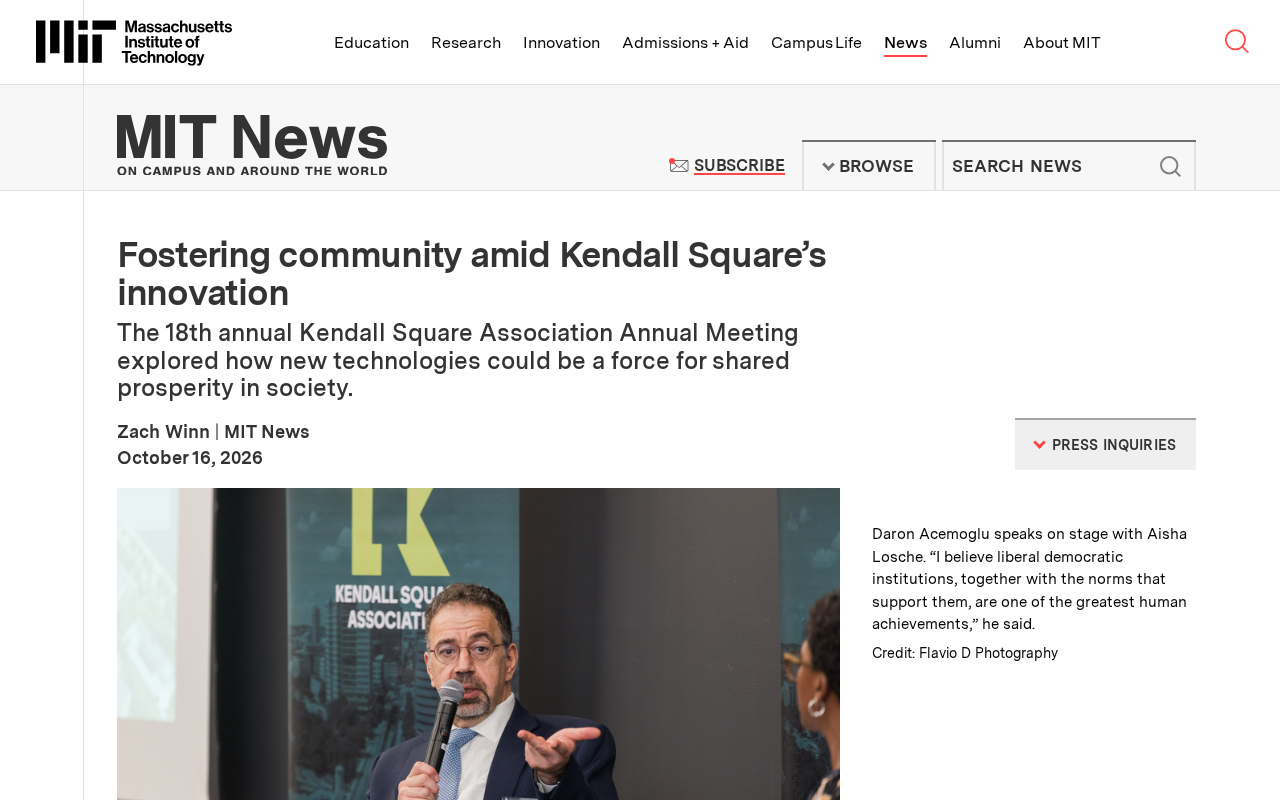
When one of the world's most innovation-dense districts starts talking about "community," that in itself is worth noting. The Kendall Square Association's 18th Annual Meeting set its theme in a direction that seems to run counter to hardcore tech narratives: how new technologies can become a force for shared social prosperity.
The "Community Paradox" of Innovation Clusters
Kendall Square is often called "the most innovative square mile on Earth," home to MIT, numerous biotech companies, and AI startups. But a high density of innovation resources does not automatically translate into community cohesion. Researchers, engineers, and entrepreneurs flow through rapidly; rents climb, space becomes commercialized, and original communities are marginalized—these are the common side effects faced by innovation clusters.
By choosing "shared prosperity" as its discussion framework, this year's annual meeting effectively acknowledged a long-avoided problem: the distribution mechanism of technological progress's dividends is not naturally fair. By putting community building on the agenda, the Association signals that the evaluation criteria for innovation ecosystems are expanding from a single focus on "output density" toward "inclusive growth."
Kendall Square is located in Cambridge, Massachusetts, adjacent to the Massachusetts Institute of Technology (MIT), and is often dubbed "the most innovative square mile on Earth." It is one of the world's densest hubs for biotech and pharmaceutical industries, hosting R&D centers for major pharmaceutical companies such as Novartis, Pfizer, and Moderna, along with a large number of AI, gene-editing, and life sciences startups. Historically, this area was an industrial zone and working-class neighborhood; since the 1990s it has undergone large-scale redevelopment, gradually evolving into a highly commercialized innovation park. Because of this, Kendall Square has become a classic case for observing "innovation-driven gentrification": land prices and rents soar, original residents move out, and everyday living spaces are replaced by laboratories and office buildings. Understanding this geographic and social context helps explain why the annual meeting treats "community" as an issue that needs to be renegotiated.
Innovation Cluster refers to a geographically proximate network of firms, research institutions, and talent organized around a specific technological field, characterized by high levels of collaboration and competition—such as Silicon Valley, Shenzhen, and Bangalore. Cluster theory holds that proximity can accelerate knowledge spillovers, reduce transaction costs, and attract capital and talent, forming a positive feedback loop. However, cluster effects also come with externalities: rising housing costs, pressure on public services, local SMEs being squeezed out, and community culture being diluted. Economists call this "the cost of agglomeration." In recent years, inclusive growth has been introduced into innovation policy discussions, arguing that when evaluating a cluster's success, indicators such as job quality, affordable housing, and local supply chain participation should be included alongside patent counts and financing scale—this is the theoretical backdrop for the Kendall Square annual meeting's thematic shift.
The Possibility of Technology as Community Infrastructure
The core issue discussed at the conference was how new technologies can serve communities rather than merely serve capital. This includes several dimensions: whether AI and digital tools can lower the barriers to community services, whether biotech development can benefit local public health, and how innovation spaces can be opened to residents without technical backgrounds.
One detail worth noting: such discussions were still a marginal topic just a few years ago. As AI begins to penetrate every industry at scale, the tech community itself has started to reflect: if innovation only creates a handful of winners, then the sustainability of the innovation ecosystem itself is in question. The discussion at Kendall Square offers one approach—embedding community participation into the innovation process rather than treating it as an afterthought.
Community Infrastructure in the context of public policy typically refers to the tangible and intangible systems that support the daily functioning of a community, including transportation, schools, healthcare, public spaces, and social trust networks. Treating technology as community infrastructure means that when evaluating a technology, one looks not only at its commercial returns but also at whether it strengthens the community's service capacity and resilience. For example, AI-driven triage systems can ease pressure on primary healthcare, open data platforms can enhance residents' participation in urban planning, and shared laboratories can be opened to residents without technical backgrounds. This perspective differs from the traditional "technology spillover" assumption; it emphasizes that technology application requires proactive institutional design and community negotiation, rather than simply expecting innovation dividends to trickle down automatically.
The Annual Meeting Model Itself Is a Community Practice
The continued holding of the 18th Annual Meeting reflects an institutionalized mechanism for community dialogue. The value of such conferences lies not in how many concrete proposals they produce, but in maintaining a platform for continuous dialogue among different stakeholders—businesses, academic institutions, local government, and residents.
In innovation clusters, community building is often regarded as a "soft issue"—hard to quantify and difficult to finance. But the long-term practice of the Kendall Square Association shows that community trust is the hidden infrastructure of an innovation ecosystem. Without such trust, talent retention, policy support, and local collaboration will all be hindered.
Implications for Other Innovation Hubs
Kendall Square's experience offers a reference point for rapidly expanding innovation hubs such as Shenzhen, Bangalore, and Tel Aviv. Once a technology cluster reaches a certain scale, community relations are no longer a dispensable appendage but a key variable determining whether the cluster can prosper over the long term.
The signal sent by the annual meeting is this: innovators need to actively participate in community building rather than waiting for the community to adapt to innovation. This role shift may be an important marker of the tech industry's maturation.
One-line Summary
Kendall Square's annual meeting focuses on how innovation clusters can shift from output density toward shared prosperity and community building.
Paragraph Summary
The Kendall Square Association's 18th Annual Meeting, themed "how new technologies can become a force for shared social prosperity," brought long-avoided community issues to the forefront. The article notes that while innovation clusters can concentrate talent and capital, they often come with side effects such as rising rents, space commercialization, and marginalization of original residents. The annual meeting explored the possibility of technology as community infrastructure, arguing that innovations such as AI and biotech should serve communities rather than merely serve capital, and that community participation should be embedded into the innovation process. The article argues that institutionalized community dialogue mechanisms are the hidden infrastructure of an innovation ecosystem, and that community trust directly affects talent retention, policy support, and local collaboration. Kendall Square's experience offers a reference for rapidly expanding innovation hubs such as Shenzhen, Bangalore, and Tel Aviv, and also signals a role shift and maturation for the tech industry.
Related articles

When Did Paid Childcare Become the Norm? Working Mothers and the Evolution of Childcare
When did paid childcare become the norm? This article traces the evolution from the rise of childcare centers in the 1970s–80s and the 1990s linking of federal subsidies to work requirements, to declining stigma and rising costs, and explores advocates' 25-year effort to catch up with other countries on childcare and paid parental leave.

Red Flags for Product-Market Fit: A Practical Guide from Top VCs and the Superhuman Founder
Investors from Iconiq and Sapphire Ventures and Superhuman founder Rahul Vohra share PMF red flags and practical methods, including the 40% disappointment rule, retention curves, and acquisition costs.

What Task Should AI Agents Take Over Most? Heated Reddit Discussion
Reddit discussion: Which task do you most want AI agents to take over completely? Cross-app data migration, CRM updates, and report generation top the list, but insufficient reliability and the trust gap are the biggest obstacles to automation adoption.