KetchUp: An Open-Source SketchUp Alternative Built with Rust and WebGPU
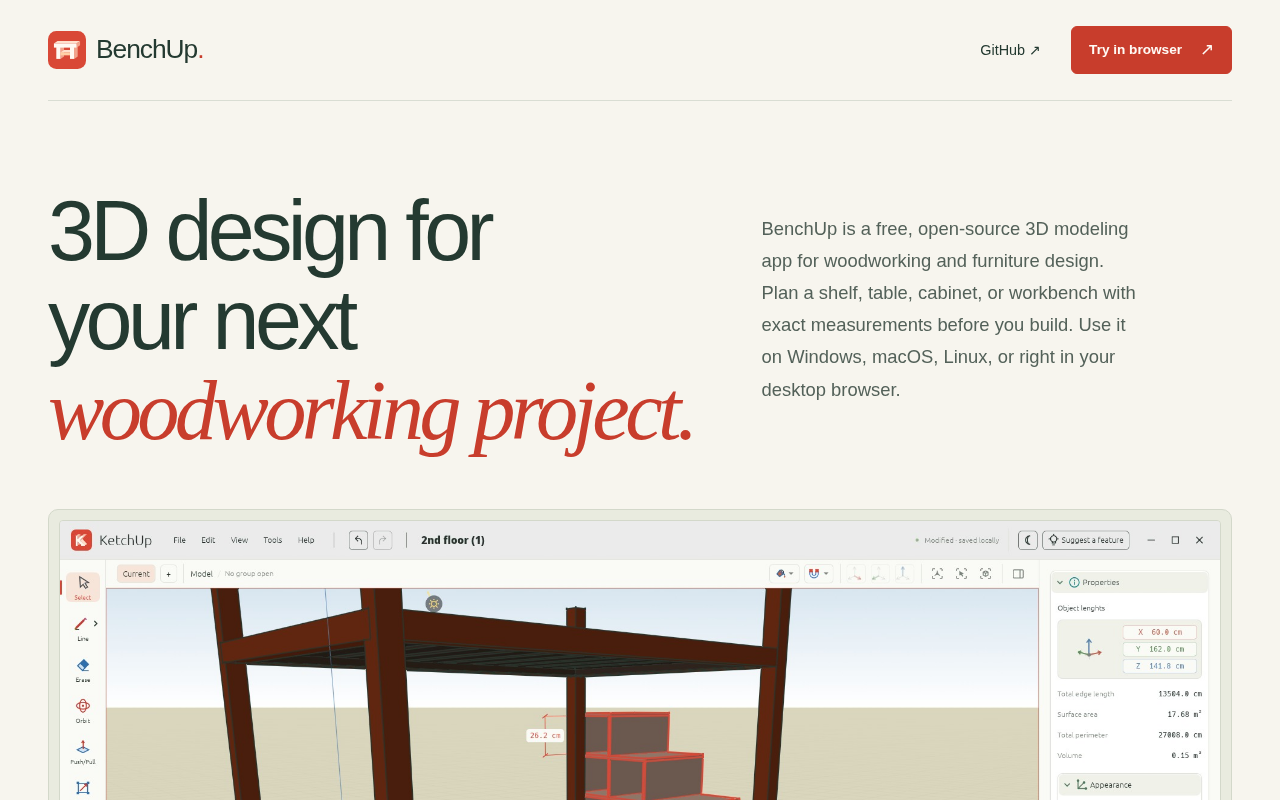
Open-source project KetchUp builds a browser-based SketchUp alternative with Rust and WebGPU
KetchUp is a fully open-source, browser-based 3D modeling tool built with Rust and WebGPU, regarded as a lightweight alternative to SketchUp. The article analyzes the key value of its technical choices: Rust's ownership model eliminates memory safety issues at compile time, and zero-cost abstraction supports a complex geometry kernel; WebGPU offers compute shaders and lower driver overhead compared with WebGL, allowing operations like mesh generation to be parallelized on the GPU with no local installation required. The project has gained over two hundred points in the tech community, reflecting market demand for controllable modeling tools. However, the article also notes that SketchUp's plugin ecosystem and workflow inertia are hard to shake in the short term; KetchUp's more realistic positioning is as a supplement for lightweight scenarios like conceptual iteration and teaching demos, and its feature details remain to be verified through hands-on experience.
A New Choice for Open-Source 3D Modeling: KetchUp Arrives
In the early stages of architectural design, interior renovation, and conceptual sketching, SketchUp has become the go-to tool for many thanks to its intuitive push-pull modeling approach. However, its desktop-only nature, licensing costs, and relatively closed ecosystem have long led some users to seek alternatives. KetchUp, which recently sparked discussion in the tech community, is one such attempt in this direction—a fully open-source SketchUp alternative built on Rust and WebGPU.
According to the project page, KetchUp is presented as a browser application, with its core rendering and geometry computations powered by the Rust language and the WebGPU graphics interface. This technical combination is noteworthy in itself: Rust's balance between memory safety and performance, combined with WebGPU's direct access to modern GPU capabilities, gives lightweight web-based 3D modeling the potential to approach native application quality. The project has gained over two hundred points and dozens of comments in the tech community, indicating that the combination of "open source + web-based + modern graphics stack" holds considerable appeal for both developers and design tool users.
Tech Stack Analysis: Why Rust and WebGPU Matter
The Engineering Foundation Rust Provides
Rust's value in this kind of project goes beyond simply "good performance." 3D modeling software must continuously process mesh data, topological relationships, and geometric transformations, and any out-of-bounds access or race condition can cause crashes or data corruption. Rust's ownership model eliminates many of these risks at compile time, while its zero-cost abstraction capabilities allow developers to organize complex geometry kernel code without sacrificing runtime efficiency. For an open-source project that needs long-term maintenance, this layer of safety is especially important.
Ownership Model and Zero-Cost Abstraction
Rust's ownership and borrow checking statically verify the legality of memory access at compile time, mechanically eliminating common defects such as dangling pointers, double frees, and data races. Zero-cost abstraction means that high-level constructs like iterators, generics, and traits compile down to machine code essentially equivalent to hand-written low-level code, without introducing runtime overhead. For code like a geometry kernel that must handle massive mesh data while remaining maintainable over the long term, this layer of protection can significantly reduce the risk of refactoring and parallelization. Combined with WebAssembly, Rust code can also run in the browser, giving the same geometry logic near-native execution efficiency on the web.
WebGPU Unlocks Browser-Side Graphics Capabilities
Compared with the earlier WebGL, WebGPU provides abstractions closer to modern graphics APIs, including compute shaders and lower driver overhead. This means that mesh generation, normal computation, and even some geometric operations can be handled in parallel by the GPU within the browser. For a tool like KetchUp that aims to deliver a smooth modeling experience on the web, WebGPU is an indispensable technical prerequisite. Putting the rendering pipeline in the browser also means users don't need to install local programs, with cross-platform consistency handled by the browser.
The Generational Gap Between WebGL and WebGPU
WebGL derives from OpenGL ES and was designed in an earlier era, with limited support for multithreaded rendering, compute shaders, and fine-grained memory management, as well as relatively high driver overhead. WebGPU, by contrast, was redesigned around the modern abstractions of Vulkan, Metal, and Direct3D 12, exposing explicit control over render pipelines, compute pipelines, and resource binding in the browser. It allows general-purpose computational tasks such as mesh generation and normal computation to be written as compute shaders and executed in parallel on the GPU, rather than taking the old detour of performing "pseudo-computation" through the render pipeline. For web-based 3D tools, this both reduces the CPU-side burden and brings browser applications closer to native program performance in complex scenes. Chrome and Edge already support it stably, with Firefox and Safari gradually following suit.
What It Means for the SketchUp Ecosystem
SketchUp's moat lies not only in its modeling interaction but also in its vast plugin ecosystem, asset library, and the inertia of industry workflows. It's unrealistic for an open-source alternative to shake these in the short term. KetchUp's more realistic positioning is as a supplement for lightweight scenarios: rapid conceptual iteration, teaching demonstrations, or basic modeling on devices where desktop software cannot be installed.
From an open-source perspective, the significance of such projects also lies in auditability and extensibility. Design teams can inspect how data is handled and whether private deployment is possible, while developers can extend functionality based on the existing code without waiting for a commercial software's feature roadmap. The level of discussion the project has generated in the tech community reflects, to some extent, that genuine market demand exists for "controllable modeling tools."
Current State and Realistic Expectations
It should be noted that currently available public information remains at the level of the project entry point and tech stack description; there is not yet sufficient first-hand data to evaluate details such as specific feature coverage, export format compatibility, and performance. For users interested in the project, the more pragmatic approach is to visit the project page directly to try it out and judge, in the context of their own workflows, whether it can fill gaps in existing tools.
Open-source 3D tools tend to follow a gradual path: first solving core modeling and rendering, then progressively filling in file interoperability and plugin capabilities. By choosing Rust and WebGPU as its starting point, KetchUp has at least offered a convincing answer in terms of technical direction. Whether it can move from tech community buzz to real design workflows depends on subsequent feature iteration and the depth of community participation.
Related articles

Seven Years of Evolution: How Far Has the Foldable Come From the First Generation?
From the first foldable to today's latest models, what has seven years changed? Shallower creases, higher brightness, thinner bodies, and smoother software migration—has the foldable crossed the chasm from enthusiasts to ordinary users? This article discusses the question based on a video comparison.

When Did Humans Start Eating Salt? A 10,000-Year History of Salt
When did humans start eating salt? From salt use at the dawn of agriculture 11,000 years ago to ancient seawater evaporation and rock salt mining, and on to the salt trade, salt taxes, and Gandhi's Salt March, this article traces salt's key role in human civilization.
Microsoft Paza Research: How African Language Speech Recognition Breaks Through Architecture and Data Bottlenecks
Microsoft's Paza research evaluates 53 speech models across 39 African languages, revealing architecture choice matters more than pre-training coverage, 200-300 hours is the practical data threshold, and language typology deeply influences recognition performance.