KIE API Hands-On: How Free LLM Endpoints Can Generate Games at Low Cost

Hands-on test: KIE API free quota plus Gemini builds an HTML5 game prototype using only 3 credits.
The article covers a developer's hands-on test of KIE API, an API marketplace aggregating Gemini, GPT, Codex, and image/video models with free credits upon registration. The author notes that image and video models consume high credits per call (one video model costs 45 input credits), quickly draining quotas, while text models are more affordable. In the test, the author used DeepSeek to generate a PRD and prompt, then called Gemini 3.7 Flash via the platform's Playground or the Kilo Code extension in VS Code to generate an HTML5 and PixiJS-based game similar to *Asteroid*, which ran properly after cleaning up the returned Markdown. The final cost was only 3 credits, far below the estimated 45. The author recommends prioritizing affordable models and avoiding costly output-side models like Astra and Fable, concluding that such aggregation platforms suit prototype validation rather than large-scale production calls.
In the search for usable APIs, one common pain point stands out: image and video generation models tend to burn through credits extremely fast, and it's easy to exhaust your quota before you know it, while text models are relatively affordable. A developer on YouTube shared a hands-on test of KIE API, demonstrating how to use the free quota on this aggregation platform together with models like Gemini to build a prototype of an HTML5 mini-game.
What Is KIE API
KIE API is an API marketplace that aggregates multiple models, bringing together the Gemini series, the GPT series, Codex, and others. According to the video, the platform doesn't just offer text models—scroll down and you'll find a full list of image and video models. After entering the API marketplace, users can browse all available models and choose for themselves.

The video's author notes that models like Gemini 3.7, 3.8, and Astra are all on the list. After selecting a specific model, you can see precise credit consumption information. For example, one video model is marked with an input credit cost of 45, meaning a single call isn't cheap. This also explains why the author recommends: image and video models easily drain your credits, so it's better to spend your limited quota on text generation.
API Marketplace / Aggregator refers to a middle-layer platform that wraps the interfaces of multiple model providers into a unified offering, exposing them through a single set of keys and a single billing system. For developers, its value lies in saving the hassle of registering accounts one by one, configuring separate keys, and managing multiple bills—one registration lets you compare and test across text, image, video, and other models. The trade-off is that the platform typically marks up prices above the upstream official rates and prices everything in a single virtual currency called "credits," which means real costs across different models can't be directly converted from official pricing. So when choosing models on an aggregator, treat "credit consumption" as a relative reference rather than an absolute monetary amount; actual charges are often settled separately by input tokens, output tokens, and number of calls, and the final bill may differ significantly from the listed quota.
Building a Game Prototype with the API
The author's goal for this hands-on test was to generate a game similar to Asteroid. The requirements he gave the model included: use an alternative name, don't rely on external assets, use built-in materials as much as possible, and adopt an HTML5 framework to shorten development time. He used DeepSeekAd to generate the PRD and prompt, then handed the prompt to Gemini 3.7 Flash on KIE API for execution.

There are two ways to connect: run directly in the platform's Playground, or call the API in VS Code through the Kilo Code extension. The latter requires obtaining an API key and the corresponding endpoint, which must be combined to make a request. The author demonstrates the complete process of copying the key from the platform and pasting it into the editor.
PRD (Product Requirements Document) is a document describing a product's goals, functional scope, interaction flows, and acceptance criteria. In AI-assisted development workflows, having the model produce a PRD first and then generating prompts from it is a "two-stage" approach: the first stage structures vague ideas into clear requirements, and the second translates requirements into instructions the model can execute. The benefit is reduced ambiguity in one-shot long prompts and more focused subsequent code generation; the cost is one extra model call.
PixiJS is a 2D rendering library built on WebGL (with a Canvas fallback), commonly used for browser-based games and interactive animations. It handles efficiently drawing sprites, textures, particles, and other elements to the canvas, but it doesn't provide a physics engine, collision detection, or audio management—developers still need to implement these themselves or pair it with other libraries. The "zero external assets" approach mentioned in the article relies precisely on PixiJS to handle rendering in the browser, then uses code to draw graphics procedurally and Web Audio to synthesize sound effects, avoiding the need to load external image and audio files.
Credit Consumption and Cost Control
Before running, you need to confirm your account balance. The video shows an account with 80 credits, while a single call is expected to consume 45 credits, so the author specifically emphasizes: always choose a model whose consumption is lower than your actual balance, otherwise the task can't be completed.

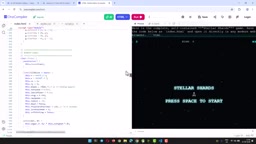
The model returned a complete HTML script and explained its "zero external assets" approach—using browser-native technologies like PixiJS to handle rendering. The author cleaned the explanatory text and Markdown markup out of the returned content, keeping only the executable HTML portion, and ran it in an online compiler.
API Key and Endpoint are the two basic elements for calling a hosted model service. The endpoint is the target address of the request (usually including the model identifier and service region), while the API key is the credential that identifies the caller and is used for authentication and billing, typically sent with the request in the Authorization header field. When connecting through an extension in an editor like VS Code (such as the Kilo Code mentioned in the article), both must be filled in: enter only the key with an endpoint pointing to the wrong model or region, and the request returns an authentication failure or model-not-found error; conversely, a missing key results in immediate rejection. Keys are sensitive information and should never be hardcoded into source code or committed to a version repository—inject them through environment variables or the editor's secret management features instead.
Test Results and Recommendations
The generated game runs directly in the browser, starts when you press the spacebar, and includes audio and other elements. The author describes it as "playable and addictive," and confirms the entire game is built on HTML5 and PixiJS, generated by Gemini 3.7.
One detail about the final cost: checking back on the billing page, this development session consumed only 3 credits rather than the estimated 45, and the account still has a balance. The API usage page also shows very low total spend. This shows that when using small models for small tasks, the actual cost can be far lower than the nominal quota.
The author's advice is clear: if you want to try for free, prioritize affordable models and avoid expensive ones like Astra and Fable that are costly on the output side (or even both input and output)—they'll quickly drain your credits while producing limited results. Start by checking your free quota on KIE API, then pick a model based on your balance—that's the key to controlling costs.
From a broader perspective, the value of these aggregation platforms lies in lowering the barrier to experimentation: developers don't have to register and pay for each model separately to quickly validate ideas. But quota limits also mean they're better suited to prototype validation and small projects rather than large-scale production calls.
Related articles

AI Can Read Neural Network Weights Directly: Do Models Already Exceed Expectations?
A Reddit developer experiment shows language models can directly read neural network weights and infer their function. Astra, Opus 5.5, and Muse Spark 1.3 all passed the test, sparking discussion on model generalization and training sources.

India's Microdrama Market Explodes: EloElo Secures $80M Investment from NBCUniversal
EloElo secures $80M from NBCUniversal to boost StoryTV, its microdrama platform with over 33M monthly active users, as India's microdrama market draws global capital.

Acoustic Detection of Multi-Rotor UAVs: Fusing Handcrafted Features with Pre-Trained Embeddings
Study reveals data leakage from random splits in UAV acoustic detection, proposes source-disjoint protocol with stacked ensemble of handcrafted features and YAMNet embeddings, achieving 95.29% accuracy for low-cost drone detection.