Kilo: The AI Fitness Coach Living Inside iMessage

Kilo embeds an AI fitness coach inside iMessage, replacing complex apps with proactive text-based coaching.
Kilo is an AI fitness coach that operates entirely within iMessage, representing a new wave of lightweight conversational AI apps. Rather than building a standalone app, it delivers personalized training plans, proactively pushes daily workouts via text, and continuously refines its recommendations based on user logs and check-ins. The choice of iMessage as the delivery channel is deliberate — high open rates and zero extra habit formation lower the friction of staying consistent. Currently in free private beta, its main limitations are its lock-in to the Apple ecosystem and the inherent constraints of text-only interfaces for complex data.
Fitting a Personal Trainer into a Text Message Thread
As fitness apps trend toward ever-increasing complexity, Kilo is taking the opposite approach — instead of asking you to download yet another feature-packed application, it sends your workout plan directly through iMessage. The product, which recently launched on Product Hunt, sums up its positioning in a single tagline: "Your agentic fitness coach in iMessage."
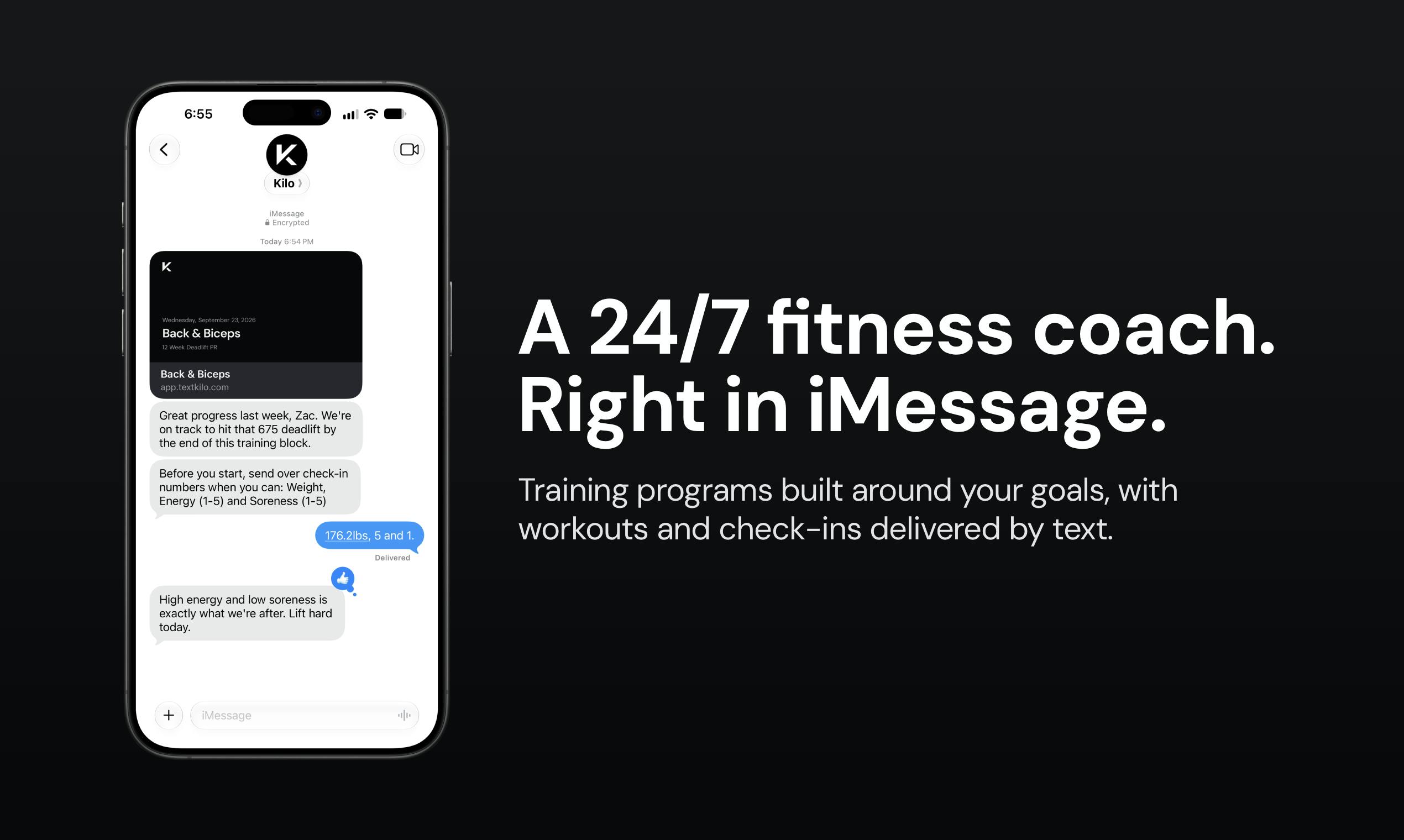
Kilo currently sits at #19 on Product Hunt with 63 upvotes and 3 comments. The buzz isn't explosive, but what it represents — a conversational product format — is a direction worth watching in the AI app space: hiding complex functionality behind the most natural interface imaginable, the humble text message.
What It Actually Does
According to the official description, Kilo's workflow breaks down into three steps:
Building a Training Plan
Kilo constructs a personalized training program for each user. This isn't a static spreadsheet — it's a living plan that adapts dynamically as you use it.
Proactively Pushing Workouts
The core experience is that it messages you first. Kilo sends your daily workout directly via text, eliminating the need to open an app and figure out what to do today. This "push" rather than "pull" model is precisely why it describes itself as "agentic" — it's not a passive tool waiting for commands, but a coach that actively follows up.
What does "Agentic" mean? It's one of the defining concepts in AI right now. It refers to AI systems that can autonomously set goals, plan steps, and proactively execute tasks — rather than simply responding to user input. Unlike the traditional chatbot "Q&A" model, agentic AI triggers actions without explicit prompts: sending you today's workout at a scheduled time, or nudging you with a reminder when you've missed two days in a row. This proactivity upgrades AI from "tool" to "agent," much closer to how a human coach actually behaves. When Kilo uses this term to describe itself, it's emphasizing that you don't need to manually trigger anything — it follows your progress on its own, just like a real coach would.
Adjusting Based on Feedback
Kilo uses your training logs and check-ins to recommend what comes next. In other words, the data you feed back after each session influences your future plan, creating a continuously iterating feedback loop. Workout tracking is built directly into the conversation — no jumping to third-party tools required.
Why iMessage?
Putting a fitness coach inside iMessage is Kilo's most interesting product decision.
Traditional fitness apps face a persistent challenge: users download them, open them a few times, then forget they exist — open rates steadily decline. Text messaging, on the other hand, is one of the highest open-rate, highest reach-rate channels on your phone. Nearly everyone checks it every single day. By moving the coaching experience into this high-frequency environment, Kilo is fundamentally reducing the friction that prevents people from sticking with exercise. You don't need to build a new habit of "opening some app" — you just reply to a message.
This format also gives the AI's proactivity a natural, legitimate home. A conversational partner that messages you at the right moment and asks how today's workout went feels far more like a real coach than a silent icon sitting on your home screen. For users who need external accountability to stay consistent, this sense of presence might be the key value proposition.
A Case Study in Conversational AI Products
Kilo isn't an isolated phenomenon. A growing number of AI applications are exploring the lightweight "skip the app, just have a conversation" approach — whether via SMS, WhatsApp, or other messaging platforms. The shared bet is this: when AI is smart enough, the interface should get out of the way. Ideally, users shouldn't even perceive it as "software."
That said, this path has real constraints. Depending on iMessage means being locked into the Apple ecosystem — Android users are left out for now. Conversational interfaces also struggle with complex data visualization: detailed exercise demonstrations, long-term progress charts, and similar content are inherently harder to communicate through text than through a graphical UI. How Kilo balances "simplicity" with "completeness" is the question it'll need to answer going forward.
The product logic behind "skip the app, just chat": Distribution channels are moats. In an app store environment of extreme saturation, the cost of acquiring users for a new app keeps rising, while messaging platforms like SMS, WhatsApp, and WeChat maintain near-100% daily active penetration. Building on these channels means borrowing the platform's existing user habits and high-frequency open behavior. Similar experiments in China include AI assistants within the WeChat Mini Program ecosystem; internationally, there are vertical products built on WhatsApp for medical consultations, language learning, and more. The shared challenge for all of them: conversational interfaces have inherently limited expressive capacity. When business logic gets complex, pure text interaction often falls short, requiring constant trade-offs between a lightweight entry point and functional depth.
Current Status and How to Try It
Kilo was built by developer Zac and is currently in a free private beta — interested users can apply to join. The product is categorized under Health & Fitness, Artificial Intelligence, and iMessage Apps, with a clear and focused positioning.
For anyone curious about the "AI agent + instant messaging" interaction paradigm, Kilo is an early-stage experiment worth following. Whether it can genuinely help users build lasting exercise habits will depend on the quality of its AI recommendations and the precision of its message timing — which, as it happens, are exactly the two things that determine whether "AI fitness coach" is a concept that actually holds up.
Related articles

5 Practical Ways Real Estate Agents Can Use AI to Boost Efficiency (2026 Edition)
How can real estate agents use AI to boost efficiency? Based on a YouTube walkthrough, this breaks down five methods — ChatGPT for listing descriptions, Canva for marketing materials, forms for open house leads, Zapier for automated follow-up, and seller meeting prep — and flags risk boundaries like fair housing laws, photo authenticity, and price verification.

Grok Bot vs ChatGPT Agent: Which AI Agent Is More Powerful?
How does Grok Bot differ from ChatGPT Agent? This comparison examines how they work: Grok Bot has a cloud computer and runs persistently inside tools to execute multi-step tasks automatically; ChatGPT Agent operates web pages in a browser and is more mature at general tasks. Includes selection advice.

Walmart Agent Gateway: AI Shops for You Automatically—Why Is Amazon Going the Opposite Way?
Walmart's Agent Gateway lets ChatGPT, Gemini and other AI assistants access its product catalog to search, compare and add to cart, with spending limits and per-purchase approval. Amazon blocks external AI agents—two retail giants, opposite paths. Currently US-only, India may follow.