Kimi K3.1 Pro Lands on Ollama Cloud: A 2.8T-Parameter Coding Model with Zero Data Retention

Kimi K3.1 Pro arrives on Ollama Cloud, callable with one command as a 2.8T-parameter ultra-large model.
Kimi K3.1 Pro is now officially available on Ollama Cloud, callable via a single command: `ollama run kimi-k3.1-pro:cloud`. The model uses a sparse architecture with 2.8T total parameters and 104B active parameters, officially positioned as a general foundation for agentic tasks such as coding, 3D creation, and financial research. The key point of this launch is not just another model being added, but that it solves two deployment obstacles at once: ultra-large models' dependence on local hardware and enterprise users' data compliance concerns. Ollama Cloud is hosted within the United States and promises full zero data retention, with inference requests not used for training or stored long-term. For teams already using Ollama, the upgrade path is nearly zero; for agent developers and compliance-sensitive industries, it offers new options for comparison and evaluation.
From Launch to Availability: Why Kimi K3.1 Pro Matters
Kimi K3.1 Pro is a large language model from Moonshot AI, and it was previously available on several platforms. Recently, the official Ollama account announced that the model is now officially available on Ollama Cloud, and users can call it directly with a single command:
ollama run kimi-k3.1-pro:cloud
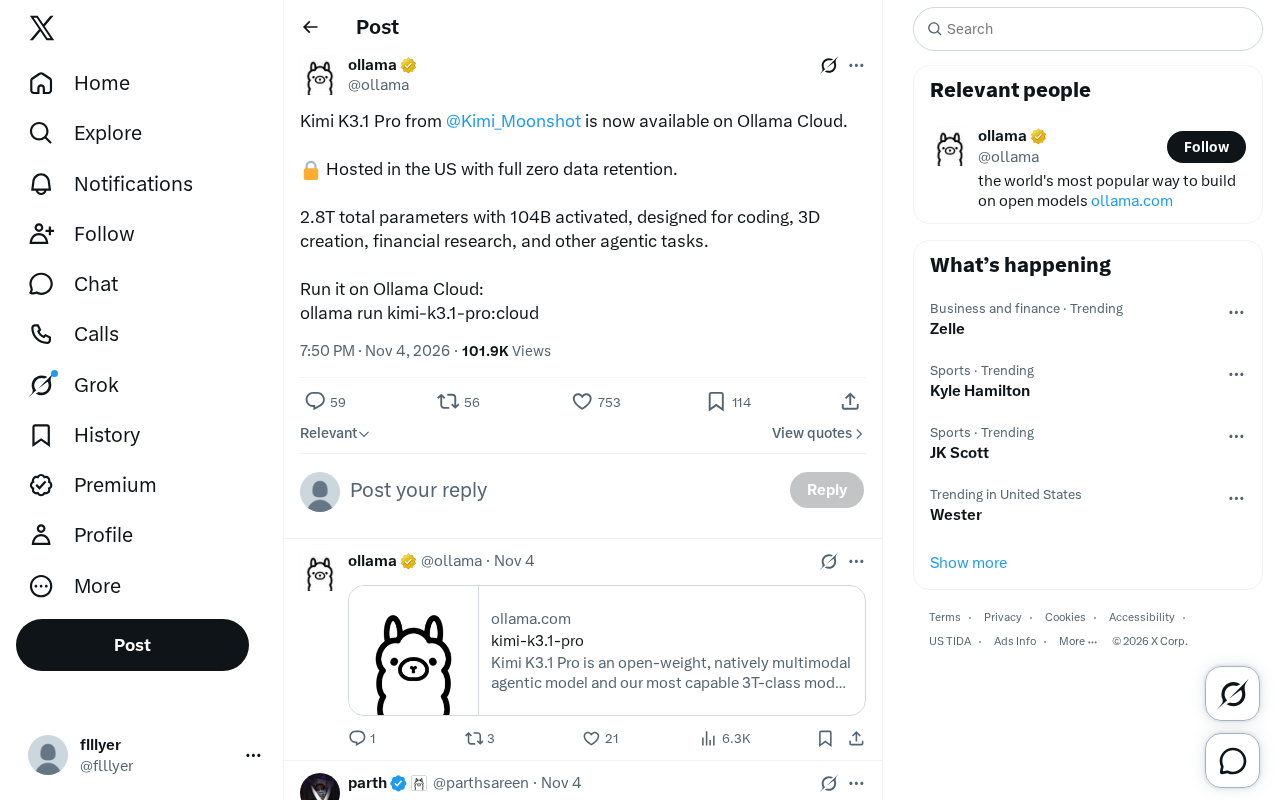
The key takeaway from this announcement goes beyond "yet another model is available"—it also solves two practical problems at once: the dependence of ultra-large models on local hardware, and enterprise users' concerns about data leaving their jurisdiction. Ollama Cloud is hosted within the United States and offers a full zero data retention commitment, meaning inference requests are not used for training or stored long-term.
Breaking Down the Specs: 2.8T Total Parameters and 104B Active
What the Sparse Architecture Actually Means
Kimi K3.1 Pro is specified at 2.8T total parameters with 104B active parameters. These numbers reveal the architectural direction: total parameter count determines the model's knowledge capacity and expressive power, while active parameter count determines the compute cost of a single inference pass. An active scale of 104B puts it in the top tier today, meaning it has enough "brainpower" for complex reasoning tasks without making every call so expensive that it can't be scaled.
This sparse design (similar to the MoE approach) has been the mainstream direction for large models in recent years: use a larger parameter pool to raise the capability ceiling, and use fewer active parameters to control inference cost. For developers, the real perceptible difference shows up in tasks like long-context code understanding and multi-step tool calling, not in simple Q&A.
MoE (Mixture of Experts) is an architecture that splits the feed-forward network into multiple "expert" sub-networks. During each forward pass, a router activates only a few experts based on the features of the input token, while the remaining experts do not participate in computation. This is exactly why there is such a large gap between "total parameters" and "active parameters": 2.8T is the sum of all experts' parameters, while 104B is the number of parameters that actually participate in computation for a single token.
The core trade-off of MoE lies in memory and compute. All expert parameters still need to reside in GPU memory or high-bandwidth storage, so deploying MoE requires memory capacity close to that of a dense large model; however, the FLOPs of a single inference pass are proportional only to the active parameters, making inference throughput and per-token cost significantly lower than a dense model with the same total parameter count. This is also why a model at the 2.8T scale must rely on cloud hosting—consumer-grade GPU memory simply cannot hold all the weights.
Task Positioning Oriented Toward Agents
Moonshot officially positions Kimi K3.1 Pro for coding, 3D creation, financial research, and other agentic tasks. What these scenarios have in common is that they require multi-turn planning, calls to external tools, and maintaining state consistency across long conversations.
Coding scenarios test cross-file understanding and instruction following; 3D creation involves spatial description and structured output; financial research requires extraction from long documents and numerical reasoning. Putting all three on the same model shows that Kimi K3.1 Pro is designed as a general-purpose agent foundation rather than a domain-specific model.
Agentic tasks refer to the model no longer doing only single-turn Q&A, but acting as an "executor" that autonomously completes multi-step goals: breaking down the task, deciding which tool to call, reading the tool's returned results, and adjusting the next step based on those results until the task is complete. Compared with ordinary conversation, this imposes three additional requirements on the model.
The first is long-horizon state retention—multi-turn tool calls quickly expand the context, and the model must still remember the initial goal and completed steps after tens of thousands of tokens. The second is structured output reliability—tool calls usually require strict JSON or function signature formats, and format errors directly interrupt the workflow. The third is error recovery—when a tool returns an exception, the model needs to recognize the failure and change strategy rather than mechanically retrying. Coding, 3D creation, and financial research are classified as agentic scenarios precisely because they all require the model to continuously plan over long contexts and reliably drive external tools.
Ollama Cloud Hosting: What Zero Data Retention Means
The two keywords Ollama emphasized this time are "US-hosted" and "full zero data retention." For teams integrating model APIs into production workflows, these two points directly affect procurement decisions.
Zero data retention generally means the provider does not persistently store users' prompts and outputs, nor use them for model training. This is especially critical for teams handling sensitive code, financial data, or unpublished research materials. It is worth noting that the execution details of the specific retention policy (such as log retention duration and how anomalous requests are handled) should be based on Ollama's official terms of service; the announcement itself only provides a statement of principles.
US hosting, meanwhile, addresses the compliance pathway: some enterprises have data residency requirements limited to specific jurisdictions, and in-jurisdiction inference can bypass the approval process for cross-border transfers.
Ollama is an open-source tool for running and managing large models locally, offering a unified CLI and REST API. Users pull models with ollama pull and start inference with ollama run, and models run on local CPU/GPU in quantized formats such as GGUF. Its value lies in condensing the cumbersome steps of "downloading weights, configuring the inference engine, and managing multiple model versions" into a single command, while letting different models share the same calling interface.
Ollama Cloud is the hosted extension of this toolchain: once a model name carries the :cloud tag, requests no longer go to the local inference process but are forwarded to the cloud inference cluster operated by Ollama. For callers, the CLI commands, API endpoints, and SDK invocation methods all remain unchanged—only the location of computation changes. This design allows "local small models + cloud ultra-large models" to be mixed under the same interface, which is precisely the technical basis for the near-zero integration cost discussed in this article.
How Integration Cost Changes Behind a Single Command
The value of the command ollama run kimi-k3.1-pro:cloud is that it compresses the cost of "integrating a 2.8T-parameter model" to nearly zero. Developers do not need to prepare GPU clusters, handle weight downloads and quantization, or build their own inference services. Ollama's long-standing focus on the local running experience is now extended through Cloud to ultra-large models that local hardware cannot run.
This layered strategy has a real impact on the ecosystem: lightweight models continue to run locally, heavy workloads go through Cloud, and the same CLI and API interfaces remain unchanged. Teams can use cloud large models to validate results during the prototyping stage, then decide which parts to move on-premises based on cost and latency requirements.
Data residency and cross-border data transfer are independent dimensions in compliance assessment and are not equivalent to "whether data is used for training." Even if a provider promises zero data retention, transmitting prompts containing personal information or regulated data to overseas servers may still trigger cross-border transfer compliance obligations—for example, the EU GDPR imposes adequacy decisions or standard contractual clauses on transfers of personal data to third countries, and some industry regulations also require data to be processed within specific jurisdictions.
Therefore, the practical significance of "US hosting" is that inference computation takes place within a specific jurisdiction, enabling enterprises with data residency requirements to confine the request path to a single jurisdiction and reduce the approval steps for cross-border transfers. Note, however, that factors such as network transmission paths, operational access permissions, and the locations of subsidiaries and subcontractors may still affect the final compliance determination. Procurement typically requires a comprehensive assessment combining the terms of service, DPA (data processing agreement), and one's own regulatory requirements, rather than drawing conclusions solely from the phrase "in-jurisdiction hosting."
Who Should Try It Now
Teams already using Ollama to manage local models are the direct beneficiaries of this launch—the upgrade path is nearly zero, requiring only pulling the cloud tag. Developers looking for a foundation model for agent applications should also add Kimi K3.1 Pro to their comparison list, especially for scenarios involving code generation and long-document analysis.
Financial and research teams sensitive to data compliance can treat the zero data retention commitment as one evaluation dimension, but they are also advised to check the specific definitions in the official terms to avoid treating marketing language as a compliance basis.
FAQ
Can Kimi K3.1 Pro run locally?
The 2.8T total parameter scale far exceeds consumer-grade hardware capabilities, and the path offered in the announcement is Ollama Cloud hosted inference.
Does zero data retention mean no information is recorded at all?
The announcement states full zero data retention; the specific scope of implementation should be checked against Ollama's terms of service and privacy policy.
What tasks is this model suited for?
It is officially positioned for coding, 3D creation, financial research, and other agentic tasks, with long context and multi-step tool calling as core characteristics.
Related articles

The Bottleneck of AI Programming Isn't Generation: Why Software Factories Collapse
After AI coding tools went mainstream, PR review quality dropped and incidents rose. The speaker argues the bottleneck isn't code generation but models' inability to sustain maintainability.
Gemini 4 Neon Hands-On: 10 Hours to Achieve What Opus Couldn't in Days, 20x Faster Warm Start
Google's surprise Gemini 4 Neon release made critic Theo change his tune: 10 hours to finish what Astra couldn't in ten days, 20x faster warm start, coherence beating Opus.

Gemini 4 Neon Hands-On: Which $20 AI Subscription Should You Choose?
Bilibili creator tests Gemini 4 Neon: composite intelligence index 61, beating Claude Opus 5.5, with API 25% cheaper. With a $20 budget, how to choose between Google AI Pro, Claude Pro, and ChatGPT Plus? Includes three must-know pitfalls and recommendations by user type.