Kimi K3.1 Pro Open-Source Model Matches GPT-6 Astra; China Releases AI Employment Policy

Domestic open-source models near the top, Anthropic launches a proactive agent, and AI employment policy is released.
This week's AI developments span three threads: Moonshot's open-source Kimi K3.1 Pro (~3T parameters) scores 65.7% on real-world coding tasks, surpassing GPT-6 Astra and trailing OPEX 5.5 by 0.7, while filtering attack-related data for safety; Anthropic's Claude Duet proactively monitors connected apps and reminds users, with a cloud computer for offline processing but requiring confirmation for key actions; and China's State Council issues an AI and employment document with 6 areas and 18 tasks, balancing new opportunities with mitigating job substitution.
Weekly AI Roundup: Domestic Open-Source Models Close In on GPT-6 Astra, AI Employment Policy Draws Attention
Over the past week, the AI field has been bustling with activity: Moonshot AI open-sourced Kimi K3.1 Pro with nearly 3 trillion parameters, delivering standout performance in real-world coding tasks; Anthropic launched Claude Duet, a proactive agent exploring a new form of personal agent; and China's State Council General Office released a dedicated document on AI and employment, seeking to balance technological progress with job security. Below is a review and analysis of this week's key developments.
A New Breakthrough in Domestic Open-Source Models: Kimi K3.1 Pro
Moonshot AI released the Kimi K3.1 Pro open-source model over the weekend, with a parameter count approaching 3 trillion. According to a video by a Bilibili creator, the model demonstrated impressive generation results in scenarios such as "making games and writing software."
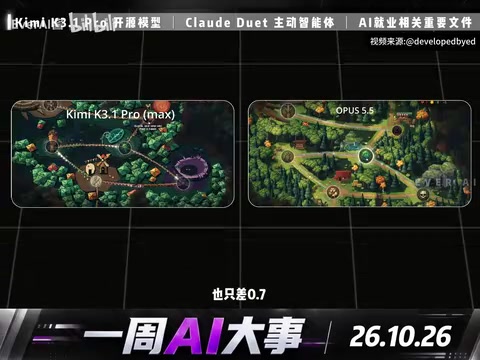
More noteworthy is its quantitative performance on coding tasks. In a real-world coding task test, Kimi K3.1 Pro scored 65.7%, surpassing GPT-6 Astra and trailing OPEX 5.5 by only 0.7 points. This result means that domestic open-source models have entered the competitive range of the international first tier in code generation and software construction capabilities.
Security Consideration: Proactively Removing Attack-Related Data
Kimi's training strategy this time has another distinctive feature: it proactively removed some cyberattack-related data to reduce the risk of the model being misused to attack systems, while preserving the integrity of everyday coding capabilities as much as possible. This approach reflects the developer's attempt to strike a balance between openness and security—while opening up the weights, it suppresses malicious use cases through data-level filtering.

The full model weights are planned to be released before November 4, allowing developers to deploy the model on their own devices. For teams needing localized, privacy-sensitive, or customized AI capabilities, this is an option worth watching.
Mixture-of-Experts Architecture and Activated Parameters: Kimi K3.1 Pro's claimed "nearly 3 trillion parameters" typically refers in the industry to the model's total parameter count, not the number actually involved in computation during each inference. Current ultra-large open-source models generally adopt a Mixture-of-Experts (MoE) architecture, activating only a small subset of experts during forward computation, so "total parameters" and "activated parameters" are two metrics that need to be distinguished. This explains a phenomenon: a model with a total parameter count approaching 3 trillion does not necessarily see inference costs grow by the same multiple, and deployment on consumer-grade or multi-GPU devices remains realistically possible. When evaluating such models, what deserves more attention is the scale of activated parameters, the number of experts, and the routing strategy, rather than just total parameters—a common pitfall when comparing the "size" of different models.
The Difference Between Open Weights and Open Source: The "full model weights planned to be released" mentioned in the article belongs to an open weights release, i.e., publishing the parameter files obtained after training, allowing others to download, deploy, and even fine-tune them, but usually without disclosing the training data, training code, and complete process. This differs from open-source software in the strict sense: users obtain a runnable, modifiable model but cannot fully reproduce its training process. The benefit of open weights is lowering the barrier to local deployment, suitable for privacy-sensitive or customization-needing scenarios; the cost is that the publisher has weaker control over downstream uses, and once the weights leak out they are hard to recall. Therefore, pre-filtering measures such as "removing attack-related data" often become one of the primary means by which open-weight publishers balance security and openness.
Anthropic Enters the Personal Agent Arena: Claude Duet
Anthropic this week launched Claude Duet, a proactive agent, formally entering the personal agent track. Unlike previous AIs that require users to actively initiate commands, Claude Duet, once authorized, periodically checks connected apps and proactively reminds users when it finds important emails or to-dos.

The agent has its own cloud computer and can continue processing tasks even when your device is turned off. However, for important operations such as sending messages and making payments, user confirmation is still required. This design enhances automation efficiency while preserving human control at key steps—a common compromise in trust mechanisms for current agent products.
From an industry trend perspective, personal agents are evolving from "passive response" to "proactive service." The launch of Claude Duet means Anthropic is no longer confined to supplying model APIs but is beginning to extend into the application layer, forming direct competition with existing agent products.
Agents' "Proactivity" and Tool Use: A so-called proactive agent refers to a system that, under user-preset authorization and trigger conditions, can autonomously initiate checks, make judgments, and execute actions. Its technical foundation is tool use / function calling and task planning capabilities: the model reads status by calling app interfaces such as email, calendar, and to-dos, then decides based on rules whether to remind or act on the user's behalf. Increased proactivity also brings new risk surfaces—misjudgments may trigger unnecessary actions, overly broad permissions may cause privacy exposure, and long-term background operation involves credential and data storage security. Therefore, "important operations require user confirmation" is not a simple product compromise but rather leaves irreversible or high-consequence actions in the human approval loop—a permission-tiering approach widely adopted in current agent design.
Domestic Policy: The Balancing Act Between AI and Employment
China's State Council General Office this week issued an important document on AI and employment, proposing 6 areas and 18 tasks, with particular mention of AI's impact on employment.
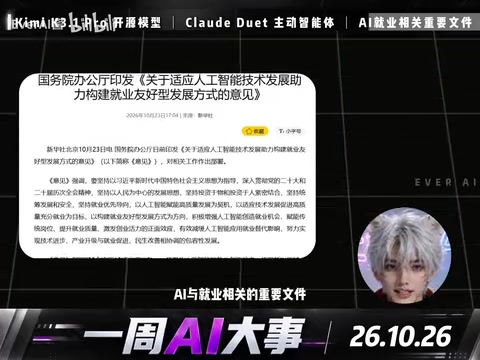
The document's dual tone is worth noting: on the one hand, it emphasizes using AI to create new opportunities; on the other, it explicitly calls for mitigating AI's substitution impact on roles such as clerical assistants, junior accountants, and manufacturing assembly lines. The document proposes promoting coordination between technological progress and employment livelihood, reducing job substitution shocks, and strengthening skills training.
This policy signal indicates that regulators have a clear understanding of AI's employment impact and are attempting preemptive intervention through policy tools. For enterprises, this means that while advancing AI automation, they need to pay more attention to employee skills transformation and job redesign; for workers, the importance of skills training and cross-domain capability building is further highlighted.
The "Task Substitution" Perspective on AI's Employment Impact: When assessing AI's impact on employment, economists typically distinguish between "job substitution" and "task substitution." A job often consists of multiple tasks, and AI is more likely to first substitute standardized, repetitive tasks (such as document organization, basic accounting, and repetitive assembly-line operations), with humans then taking on judgment, communication, and exception handling. This explains why the document names roles such as clerical assistants, junior accountants, and manufacturing assembly lines—they belong to types whose task structure is dominated by rule-based tasks. Corresponding policy tools are also oriented around the task level: skills training helps workers move to tasks less susceptible to substitution, while job redesign redefines human-machine division of labor, rather than simply using "whether a job disappears" as the criterion.
This Week's Observations
The three developments correspond to three dimensions of AI development: model capability (Kimi K3.1 Pro), product form (Claude Duet), and policy environment (the employment document). Domestic open-source models approaching the international top level on coding tasks shows that the open-source community is accelerating its catch-up; agent products shifting from passive tools to proactive services indicates that the interaction paradigm is migrating; and the introduction of the employment policy reminds us that the social costs of technology deployment need to be taken into account. Together, these three form a real picture of today's AI industry—fiercely competitive yet requiring careful balance.
One-line Summary
Domestic open-source models approach the top tier, Anthropic launches a proactive agent, and AI employment policy is released.
Paragraph Summary
Three main threads ran in parallel in the AI field this week. Moonshot AI open-sourced Kimi K3.1 Pro with nearly 3 trillion parameters, scoring 65.7% on a real-world coding task test—surpassing GPT-6 Astra and trailing OPEX 5.5 by only 0.7—and proactively removed cyberattack-related data during training to balance openness and security, with full weights planned for release before November 4. Anthropic launched the proactive agent Claude Duet, which can periodically check connected apps and proactively remind users of important matters, with a cloud computer enabling offline processing, though key operations such as sending messages and making payments still require user confirmation. China's State Council General Office released an AI and employment document proposing 6 areas and 18 tasks, emphasizing both using AI to create new opportunities and mitigating substitution shocks on roles such as clerical assistants, junior accountants, and assembly lines. The three correspond respectively to the dimensions of model capability, product form, and policy environment.
Related articles

LangGraph in Production: The Pain of Silent API Changes
Explores the challenge of silent external API changes affecting LangGraph agents in production, analyzes monitoring and testing limits, and proposes semantic validation and regression testing defenses.

Salesforce CRM Hands-On Test: Performance and Cost Deep Comparison of 5 AI Agents
Hands-on comparison of 5 AI agents in Salesforce CRM: Claude Opus leads at 87% accuracy, DeepSeek hits 82% at 1/75 the cost. Key findings on tool false positives, self-checking, and automatic field changes.

Conference Badge Turned Game Boy Color: A Gemini-Assisted Hardware Hack
The GitHub Universe conference badge was hacked into a device that runs Game Boy Color emulators. Steve Francia used Gemini to port NES and Game Boy emulators; this article analyzes AI's real role in hardware hacking and the evolution of conference badges.