Kimi K3 Hands-On: 3D Modeling & Game Development — Can an Open-Source Model Outperform Closed-Source Giants?

Open-source Kimi K3 outperforms Fable 5 and GPT Solve 5.6 in 3D modeling and game dev tests at a fraction of the cost.
A comprehensive hands-on test pits open-source Kimi K3 against closed-source Fable 5 and GPT Solve 5.6 across ten 3D modeling and game development challenges — from donut rendering and diamond shaders to Mario Kart clones and SimCity rebuilds. Kimi K3 emerges as the overall winner, delivering competitive or superior results at roughly one-quarter the price, challenging the assumption that complex creative tasks still require closed-source models.
An Open-Source Model Crashes the Top Tier
Who would have thought an open-source large language model could storm into the top tier this fast? Just a few weeks ago, the closed-source Fable 5 was so powerful it had to be rate-limited. Now, an open-source model from China — Kimi K3 — is going head-to-head with Fable 5 and GPT Solve 5.6.
What makes this even more remarkable is that Kimi K3 isn't just open-source — it also boasts the highest cost-efficiency among all top-tier models. According to the tester, it costs roughly a quarter of what Fable 5 charges, while delivering results that are arguably slightly better. This "cheap yet capable" combination made it an instant hit upon release, with demand surging so fast that providers needed extra time to scale up capacity. The impact of open-source models on the industry goes far beyond price competition. From a technical ecosystem perspective, open-source means developers can deploy, fine-tune, and customize models locally without worrying about API rate limits or data privacy concerns. Meta's LLaMA series first proved that open-source models could approach closed-source performance, followed by Mistral, Qwen, and others steadily closing the gap. What makes Kimi K3's breakthrough stand out is that it doesn't just match closed-source models on general benchmarks — it demonstrates competitiveness in complex scenarios like 3D modeling and game development that require long-chain reasoning and multi-tool coordination. This challenges the industry consensus that "complex tasks still require closed-source models."
This article is based on an in-depth hands-on test by a Bilibili creator, centered on one core question: How far can Kimi K3 go in the demanding domain of 3D modeling and game development? The entire test used CLI (Command Line Interface) tools, with Cloud, Kimi, and Codex working in parallel within the same folder, connected to Blender MCP, Godot MCP, and generative AI APIs and keys — all in the name of a fair comparison. MCP (Model Context Protocol) is an open protocol introduced by Anthropic in late 2024 that allows AI models to directly connect to external tools and data sources for two-way communication. In this test scenario, MCP enables AI models to directly manipulate the internal functions of Blender (a professional 3D modeling tool) and Godot (an open-source game engine), rather than merely generating code snippets for users to manually copy and execute. This "AI-direct-to-tool" paradigm drastically reduces the need for human intervention, making truly end-to-end automated creation possible.
Basic 3D Modeling Tests: Each Model Has Its Strengths
The test kicked off with the classic "donut" warm-up task, a reference to the famous tutorial creator Blender Guru — the channel name of Andrew Price, a YouTube 3D tutorial creator with millions of subscribers. His "Donut Tutorial" is the most iconic beginner project in the Blender community; virtually every Blender newcomer starts here. This seemingly simple donut actually covers multiple core 3D modeling skills: mesh modeling, subdivision surfaces, particle systems (for sprinkles), material and shader setup, lighting, and final rendering. Using it as a starting point for AI testing is quite clever — it's both an industry-recognized benchmark task and contains enough technical detail to differentiate model capabilities.
Interestingly, these AIs don't iterate like humans do. Instead, they write a large script to generate the entire scene in one shot, with only occasional minor adjustments to the final render.
The results showed that Cloud produced the highest-quality donut, creating each sprinkle as a separate object with well-composed lighting and camera setup. Kimi performed at roughly the same level as Cloud — an impressive showing. Codex, on the other hand, fell flat: its sprinkles looked stiff and unnatural, marking a clear failure.
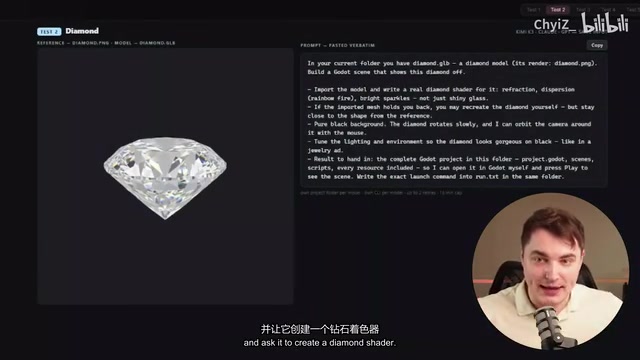
The second test — the diamond shader — ramped up the difficulty significantly, as the model had to create a refractive material that conforms to an existing mesh surface. A shader is a program in 3D graphics rendering that controls the visual appearance of an object's surface. Diamond shaders are considered especially challenging because the optical properties of real diamonds are extremely complex: they involve a high refractive index (approximately 2.42), dispersion effects (white light splitting into rainbow colors), total internal reflection, and multiple internal bounces. Achieving this effect in Blender requires precise configuration of the Principled BSDF node's IOR (Index of Refraction), Transmission, Roughness, and other parameters, and may require custom node groups to simulate dispersion.
This time, the tables turned — both Cloud and Kimi produced results that looked more like a "disco ball" than a diamond (typically caused by overusing specular reflections while neglecting physically correct internal refraction paths). ChatGPT (GPT Solve 5.6), however, delivered the best result, successfully achieving a sense of refraction and luxurious quality.
In the third test — the holographic character — the tester provided a GLB model and asked the AIs to convert it into a sci-fi capsule hologram effect. GLB is the binary-packed format of glTF (Graphics Library Transmission Format), defined by the Khronos Group and often called "the JPEG of 3D." It bundles mesh, materials, textures, animations, and all other data into a single file, and has become the de facto standard for cross-platform 3D asset exchange. Holographic effects in 3D rendering are typically achieved through a combination of Fresnel nodes, emissive materials, translucent shading, and scan-line animations, requiring the AI to simultaneously understand material systems and visual storytelling language.
Cloud Code's result was "ready for use in a game," with Kimi close behind using a slightly different pedestal approach — both passed the test. Codex attempted to add more flashy details but its top effect broke, resulting in another failure.
Spatial Understanding & Physics Simulation Comparison
In the geometry reconstruction test, the tester introduced a skill called "Image to 3GS," asking the models to procedurally reconstruct interactive geometry. This task demands genuine spatial understanding.

The results were dramatic: Cloud and Kimi both performed well, with interactive buttons and functioning switches. Meanwhile, ChatGPT — the diamond test champion — completely fell apart here, producing incorrect shapes and missing key components that prevented closure. This demonstrates that "spatial-visual understanding" and "material creativity" are two entirely different capability dimensions, and no single model dominates across the board.
The glass shattering simulation test required a rock to smash through glass, with fragments falling naturally to spell out "Kimi." Cloud achieved very high completion (almost "too perfect," looking somewhat unnatural). Kimi's fragments were smaller and more natural, though the rock kept rolling slightly — a minor flaw. ChatGPT performed poorly: the glass moved in the wrong direction, and all fragments piled into the text, resulting in a thoroughly unnatural outcome.
Animation Rigging Test: An Unexpected Highlight for Kimi K3
The animation retargeting test is particularly telling of AI's advancing programming capabilities. Mixamo is a free online service owned by Adobe that provides automatic character rigging and a massive motion-capture animation library. Animation Retargeting is the technique of mapping animation data from one skeletal system onto a character with a different bone structure — an extremely common need in game development, where developers typically want the same set of running and jumping animations to work on characters of different body types. The difficulty lies in different bone naming conventions, differing skeletal hierarchies, and scale mismatch issues.
A "Mixamo skeleton to Aquareg rigged character" retargeting task that required multiple prompts with Cloud Opus 4.8 two months ago was now completed by all three models with a single prompt. Cloud, Kimi, and ChatGPT all performed excellently, with ChatGPT once again showing its tendency toward "creative excess" by proactively adding a fancy pedestal.
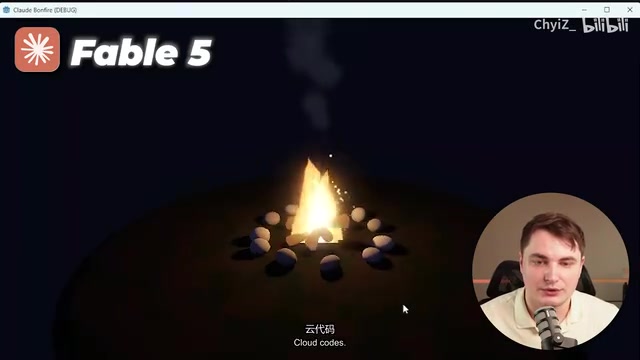
The real watershed came in the more complex "dragon entity mesh rigging" test, which required the AI to generate its own skeleton and create fluid animation. This involves "skin weights" — the degree to which each vertex is influenced by various bones. Poor weight distribution causes visual artifacts like mesh clipping and stretch deformation during animation playback. Cloud exhibited obvious weight issues with mesh anomalies during animation playback. Kimi, while imperfect (missing weights on ears and wings), was clearly better than Cloud. ChatGPT used a terrible approach to weight distribution and failed completely. Kimi K3 took the crown in this round.
Also noteworthy are the efficiency numbers: overall, Cloud Code was the fastest, Kimi fell in the middle, and Codex was inconsistent but had the longest average completion time.
The Ultimate Showdown: From Mario Kart Clone to City Simulation
The final "complete game" tests were where things got really tough. The first task was to build a Mario Kart clone with two levels and three cards, with all 3D models, environment objects, and textures generated via AI API calls throughout. Leading AI 3D generation services include Meshy, Tripo, Rodin, and others, which can generate textured 3D mesh models from text or image inputs. These are typically built on diffusion models or NeRF variants trained on massive 3D datasets and can produce usable 3D assets in seconds to minutes. Integrating these APIs into the game development pipeline means the AI coding assistant must not only write game logic code but also coordinate calls to external generation services, handle asset format conversion, and manage scene integration — placing high demands on the AI's multi-system coordination capabilities. All models ran in maximum reasoning/planning mode.
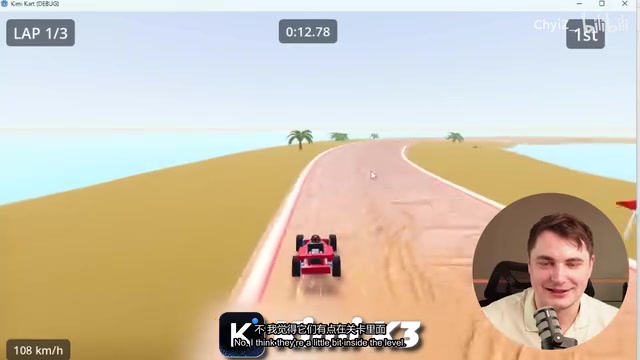
Interestingly, all three models forgot to generate a launch script, requiring manual intervention to run. The results stood in stark contrast:
- Fable 5 (Cloud): Took 1 hour and 10 minutes. The environment was decent but the kart models were terrible. Once a player got stuck, they were permanently stuck — virtually unplayable.
- GPT Solve 5.6 (ChatGPT): Objects lacked textures, controls were inverted, and there was no free movement — a terrible experience.
- Kimi K3: Featured genuine free movement and drifting capability. While it still needed significant polish, it was clearly the closest of the three to a "playable game."
The tenth test was rebuilding a SimCity-style game (inspired by subscriber Travis), with the tester running only Kimi overnight (approximately 4–5 hours). The result was surprisingly impressive: players could lay roads, build residential, industrial, and commercial zones, manage electricity, and construct schools, hospitals, and police stations. All AI-generated 3D building models snapped precisely to the grid. The tester admitted to "a wave of nostalgia," noting that this type of simulation management game is the genre most easily done well by AI.
Conclusion: The Significance of Open-Source Models Goes Far Beyond Performance
Across all ten rounds of testing, the conclusion is clear: in the comprehensive domain of 3D and game development, Kimi K3 clearly outperformed Fable 5 and GPT Solve 5.6. While none of the outputs could be called a "real game," reaching this point is already remarkably impressive.
More importantly, the broader industry implications are significant. The tester pointed out that the news of Fable 5 being rate-limited is "a bit concerning" — and this is precisely one of the reasons Kimi K3 has attracted so much attention. When a top-performing model also comes with open-source availability and one-quarter the price, it doesn't just offer another option for the ecosystem — it poses a genuine challenge to the closed-source monopoly. This disruption could accelerate pricing adjustments from closed-source vendors, boost R&D investment in the open-source community, and reshape the competitive landscape of the AI tools market. The open-source comeback may be just getting started.
Related articles

White House Invites OpenAI and Other Giants to Preview Voluntary AI Framework: Open-Source Language Becomes Key Battleground
Trump administration invites OpenAI, Anthropic, and Google to preview a voluntary AI framework, with open-source language emerging as the core lobbying battleground that could reshape industry competition.

AI Art Prompt Structure Breakdown: Creating a Desert Crystal Pyramid Scene
Breaking down a popular Reddit AI artwork to reveal the five core elements of structured prompts: subject, material, lighting, environment, and atmosphere for AI art scene creation.

$100 Million Deal: AI Gives 50,000 Ukrainian Kamikaze Drones Autonomous Target Lock
A U.S. company struck a $100M deal with Ukraine to deploy AI visual lock-on capabilities on 50,000 cheap kamikaze drones, enabling terminal autonomous guidance to defeat electronic warfare jamming.