Kimi K3 Released: 2.8 Trillion Parameter Open-Source Model Tops Global Coding Leaderboard

Kimi K3's 2.8T parameter MoE model tops global coding benchmarks at a fraction of competitors' costs.
Moonshot AI's Kimi K3, a 2.8 trillion parameter open-source model using Mixture of Experts architecture, has topped the global frontend coding arena with 1679 Elo points, beating Claude and GPT. Activating only 16 of 896 expert modules per task, K3 completes enterprise coding tasks at $0.94 versus Claude's $2.75, demonstrating how Chinese AI companies use architectural innovation to overcome chip sanctions. The model is fully open-source with free commercial use.
From Davos Laughter to Global Number One
At the Davos Forum in early 2025, Moonshot AI President Zhang Yutong made a statement that drew laughter from the foreign audience: Chinese startups have been acutely aware from day one that they don't have the luxury of throwing unlimited compute at problems, and it's precisely this resource constraint that forces teams to achieve extreme efficiency through fundamental research innovation. He put forward a now-famous assertion — Kimi used only about 1% of the compute resources of America's top labs to produce comparable models.
Nobody believed it at the time. But this claim wasn't an isolated case — in January 2025, DeepSeek released DeepSeek-R1, which similarly achieved near-frontier reasoning capabilities at extremely low cost, with training expenses reportedly just a fraction of OpenAI's equivalent models. These two companies represent a unique technical path forged by China's AI industry under chip sanctions: compensating for hardware disadvantages through algorithmic efficiency and architectural innovation. The theoretical basis lies in the fact that current large model training contains massive "redundant computation" — not all parameters are equally important for all tasks. Through more refined data filtering, more efficient training strategies (such as curriculum learning, progressive training), and smarter architectural design, it's theoretically possible to achieve comparable intelligence levels with fewer floating-point operations. The success of this approach is shaking Silicon Valley's faith in the "Scaling Law solves everything" doctrine.
Six months later, on July 17th, Kimi K3 was officially released, and the laughter stopped.
This is a 2.8 trillion parameter open-source model that topped the global frontend coding leaderboard on its launch day. For Chinese AI, long labeled as "unable to keep up," this isn't just catching up — it's more like blowing the ceiling off the entire track. This article will clarify three things: how sanctioned Chinese AI staged a comeback, what exactly makes K3 so strong, and the hurdles that still remain behind this triumphant narrative.
Kimi K3 Tops the Coding Arena: Victory Under Double-Blind Testing
The leaderboard K3 topped is called the "Frontend Code Arena" (LMArena coding track), regarded by programmers worldwide as the most hardcore "coding exam." Its most distinctive feature is double-blind testing: given the same coding problem, two models submit answers anonymously, judges vote for the better submission, and only after voting is it revealed whether they just praised a foreign model or a domestic Chinese one.
No brand filters, no bot manipulation — pure equality before code.
LMArena (formerly LMSYS Chatbot Arena) is a large model evaluation platform initiated by UC Berkeley's Sky Computing Lab. Its core methodology borrows from chess's Elo rating system. In each matchup, two anonymous models simultaneously receive the same prompt and generate responses, real users blind-evaluate and select the winner, and Elo scores are dynamically updated based on outcomes. This crowdsourced evaluation method based on human preferences is considered by academia to better reflect a model's true capabilities than traditional fixed benchmarks (such as HumanEval, MBPP, and other code evaluation sets), because it avoids the "teaching to the test" overfitting problem. As of 2025, the platform has accumulated millions of human votes and is one of the industry's most recognized manipulation-resistant third-party evaluations.
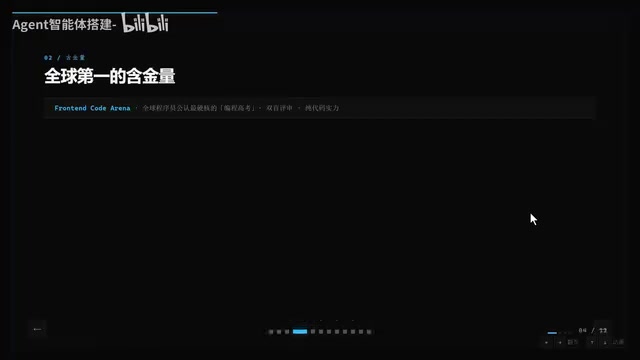
When the leaderboard updated, programmers worldwide were stunned:
- Kimi K3: 1679 points (Global #1, first model in history to break 1600)
- Claude Fable 5: 1631 points
- GPT-5.6: 1618 points
Across 7 coding sub-categories, K3 took first place in 6, falling slightly short only in game development. Even Elon Musk specifically commented under the related news with "Impressive." This kind of attention from the competitor camp is itself an endorsement of quality.
K3's Cost Advantage: What Really Keeps Silicon Valley Up at Night Is the Bill
If leaderboard rankings are just about prestige, what truly alarms overseas companies is the cost. Third-party organization Artificial Analysis calculated: for completing the same real enterprise-level coding task, the cost differences between models are staggering.
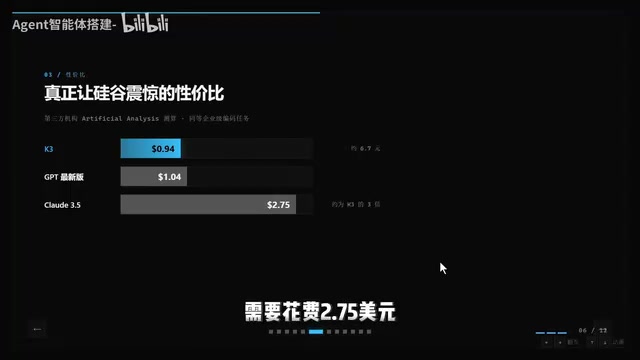
- Kimi K3: $0.94 (about 6-7 RMB, can't even buy a bubble tea)
- Latest GPT: $1.04
- Claude series: $2.75 (approximately 3x K3's cost)
In terms of comprehensive intelligence scores, K3 scored 57, while the top two scored 59 and 60 respectively — all in the same tier. In other words, others spent 3x the money to score 59, while you spent the price of a milk tea and scored 57. For business executives, this is barely a choice at all.
This leads to K3's core narrative: It's not that overseas models are unaffordable, but that Kimi offers better value for money.
Mixture of Experts (MoE) Architecture: How to Train 2.8 Trillion Parameters Without High-End Chips
Many people ask: aren't we short on high-end chips? How can we still train such a large model? This is precisely K3's most brilliant aspect.
The Specific Context of Chip Sanctions
Since October 2022, the U.S. Department of Commerce's Bureau of Industry and Security (BIS) has issued multiple rounds of chip export controls targeting China, with core restriction metrics including chip compute density (measured in TOPS) and interconnect bandwidth. NVIDIA's A100, H100, H200, and other data center GPUs all fall within the ban's scope, and the subsequently released "China-special" H20 was further restricted in early 2025. This means Chinese AI companies face two major hardware challenges: first, inability to obtain the most advanced process training chips; second, even if some high-end GPUs are acquired through existing inventory purchases, their cluster scale is far smaller than that of top American labs. According to public estimates, OpenAI and Google routinely use clusters of tens of thousands of H100-class GPUs to train frontier models, while Chinese companies may have only one-tenth or even less of equivalent compute available. It's precisely in this context that MoE and other efficient architectures became a "must-have" rather than a "nice-to-have" for Chinese AI companies.
Sparse Activation with Mixture of Experts
While others compete on who has more GPUs and bigger data centers, K3 chose to "live frugally and wisely." 2.8 trillion parameters sounds scary, but it uses a Mixture of Experts (MoE) framework — although the model contains 896 expert modules internally, only 16 relevant ones are activated for each task.
It's like visiting a top hospital — they won't have all 896 doctors consult on your case. You see the specialist for your specific condition, and efficiency goes through the roof. This "sparse activation" makes massive parameter counts compatible with manageable compute.
From a technical perspective, the Mixture of Experts (MoE) architecture can be traced back to Jacobs et al.'s 1991 paper, but it truly shone in the large model era starting with Google's Switch Transformer (2021). MoE's core idea is: a model's total parameter count can be very large (representing knowledge capacity), but only a small fraction of parameters is activated during each inference (representing computational cost). In implementation, each layer of the model contains multiple "expert" sub-networks and a "router" (gate network), which assigns tokens to the most relevant experts based on input content. K3's activation of only 16 out of 896 experts means its actual inference computation is roughly equivalent to a dense model of several tens of billions of parameters, while its knowledge capacity is at the 2.8 trillion level. This is the key to "bypassing compute bottlenecks through architectural innovation."
Two Key Technical Breakthroughs
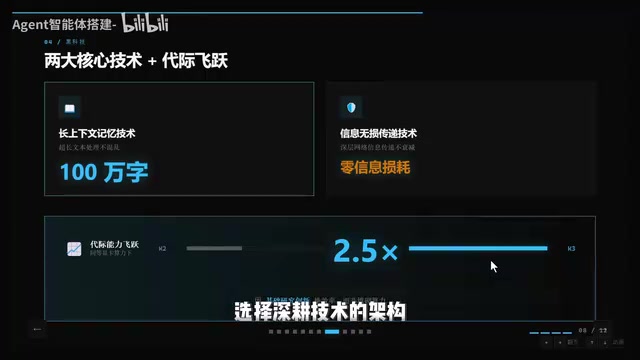
Beyond MoE, K3 has two other highlights. One handles "memory," allowing the model to read through million-word documents in one go without getting confused; the other handles "message passing," keeping information intact as it travels through hundreds of neural network layers (long-range information preservation).
These two technologies address core challenges in the large model field. Regarding "memory," traditional Transformer self-attention has O(n²) computational complexity — doubling context length quadruples computation — which limited early models' context windows to thousands or tens of thousands of tokens. In recent years, the industry has broken through this limitation using RoPE positional encoding extrapolation and interpolation methods, sparse attention mechanisms (such as sliding window attention), and hierarchical compressed memory. Regarding "message passing," when information passes through hundreds of Transformer layers, key information captured in early layers can easily be "diluted" or "forgotten" in deeper networks, typically requiring improved residual connection structures, cross-layer attention, or information highway mechanisms. These two technologies are particularly crucial for coding tasks, as large codebases often involve cross-file dependencies spanning tens of thousands of lines, requiring the model to precisely locate and correlate scattered information across ultra-long contexts.
The final calculation shows that with the same GPU compute, K3's capability reaches 2.5x that of its predecessor K2. Zhang Yutong's philosophy of "trading innovation for efficiency" is far from empty talk. While many companies in the industry single-mindedly expand their compute reserves, Kimi chose to dig deep into architecture, striving to maximize the value of every unit of compute.
Full Open-Source with Free Commercial Use: The Most Aggressive Move
Before July 27th, K3 achieved full weight open-source with free commercial use. This means whether you're a large corporation, small startup, or individual developer, you can take this globally top-3 model home, deploy it on your own servers, without answering to anyone or paying a cent in licensing fees.
When the news broke, overseas developer forums exploded. People calculated: AI capabilities that previously required millions of dollars to build can now run on a consumer-grade GPU. The strategic significance of open-source lies in completely rewriting the barrier to accessing AI capabilities.
Large model open-source has become an important strategic dimension in industry competition. Meta's LLaMA series pioneered "big company open-source," with the strategic intent of: building a developer ecosystem by freely releasing model capabilities, undermining competitors' business moats, and anchoring industry standards to their own architecture. For Kimi, the logic behind open-sourcing K3 may be more multifaceted: first, accelerating model iteration through massive developer usage feedback; second, establishing global technical brand recognition; third, forcing a business model shift from "selling models" to "selling services" — when the model itself is free, value-added services around fine-tuning, deployment, and industry solutions become the real profit source. Full weight open-source means anyone can perform secondary training and commercial deployment, which is fundamentally different from "pseudo open-source" that only exposes API access.
Behind the Triumph: Three Hurdles Kimi K3 Still Needs to Clear
Excitement aside, we need to be realistic. There are still three hurdles on this path.
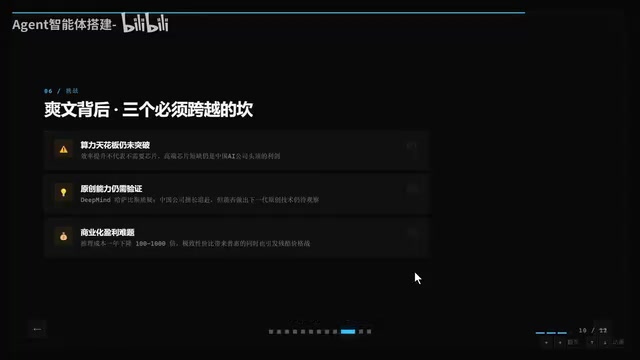
First, the compute ceiling has been delayed, not bypassed. No matter how efficient you are, you still need GPUs — "even the cleverest housewife can't cook without rice." High-end chips remain a sword hanging over every Chinese AI company's head. While MoE architecture reduces inference costs, the training phase still requires loading all 2.8 trillion parameters into memory for gradient updates, with enormous total hardware demands. As model scale continues to climb, the compute gap will only become more apparent.
Second, skepticism about original innovation isn't entirely unfounded. Google DeepMind CEO Demis Hassabis once said that Chinese companies are indeed good at catching up, but whether they can produce next-generation original technology still requires time to verify. Although this statement was somewhat "disproven" by K3 just six months later, it also reminds us: no matter how efficient you are at following, there comes a day when you must be the trailblazer. True technical leadership isn't just about "doing it cheaper" — it's about defining the next paradigm, just as the Transformer architecture itself was born at Google Brain, not from any follower.
Third, making money is what ultimately matters. Cheap API services are nice, but too cheap means no profit. Zhang Yutong himself has admitted that Chinese AI can't rely on cost-effectiveness forever; in the long run, they must command pricing power and rule-setting authority. Currently, China's entire large model industry is trapped in a "price war" quagmire, with API pricing dropping repeatedly and commercialization prospects looking bleak. Open-source models directly abandon revenue from the model itself — if value-added services and ecosystem monetization can't keep up, the "free" strategy will ultimately be unsustainable.
History Keeps Repeating: From Blockade to Breakthrough
Looking back, this script of "being sanctioned, being forced to develop breakthrough technology, and actually producing a superior solution" is far from unfamiliar. Android used its free open-source architecture to grab the lion's share of the market right from Apple's grasp; when China was marginalized from joining Europe's Galileo navigation program, it turned around and quietly built the BeiDou system, now used by over 100 countries worldwide.
Sanctions are always a double-edged sword — they can choke you, but they can also force you to learn a way of living that depends on no one. From DeepSeek to Kimi, this cohort of Chinese AI companies is demonstrating what it means to "find life in a desperate situation."
Now the question is before us: on one side is the "brute force aesthetics" of throwing money at compute, on the other is the "efficiency revolution" of extreme optimization — who will break through the door to AGI first? This is perhaps the most fascinating divergence point to watch in today's AI industry.
Key Takeaways
Related articles
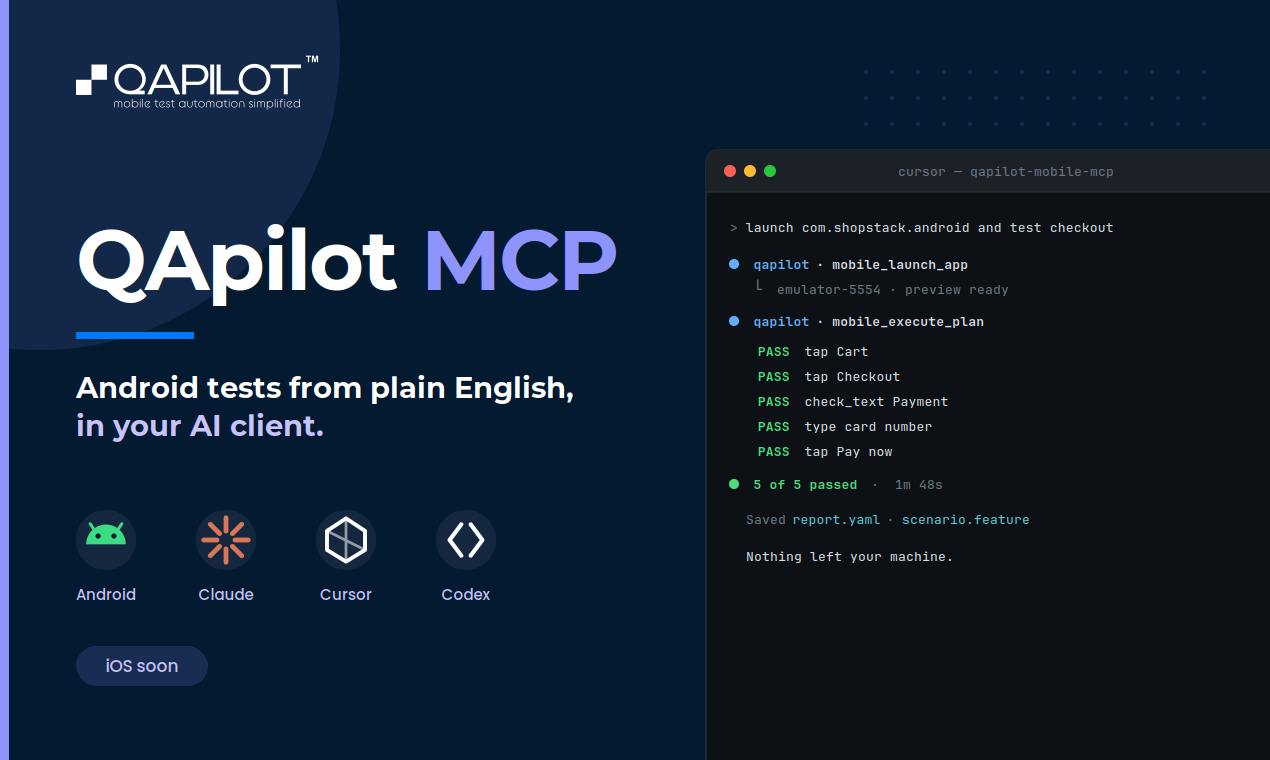
QApilot MCP: Test Android Apps in Natural Language Inside Your AI Coding Assistant
QApilot MCP lets developers test Android apps in natural language inside Claude, Cursor, and Codex — no Appium code needed. Auto-generates reusable Gherkin test cases.
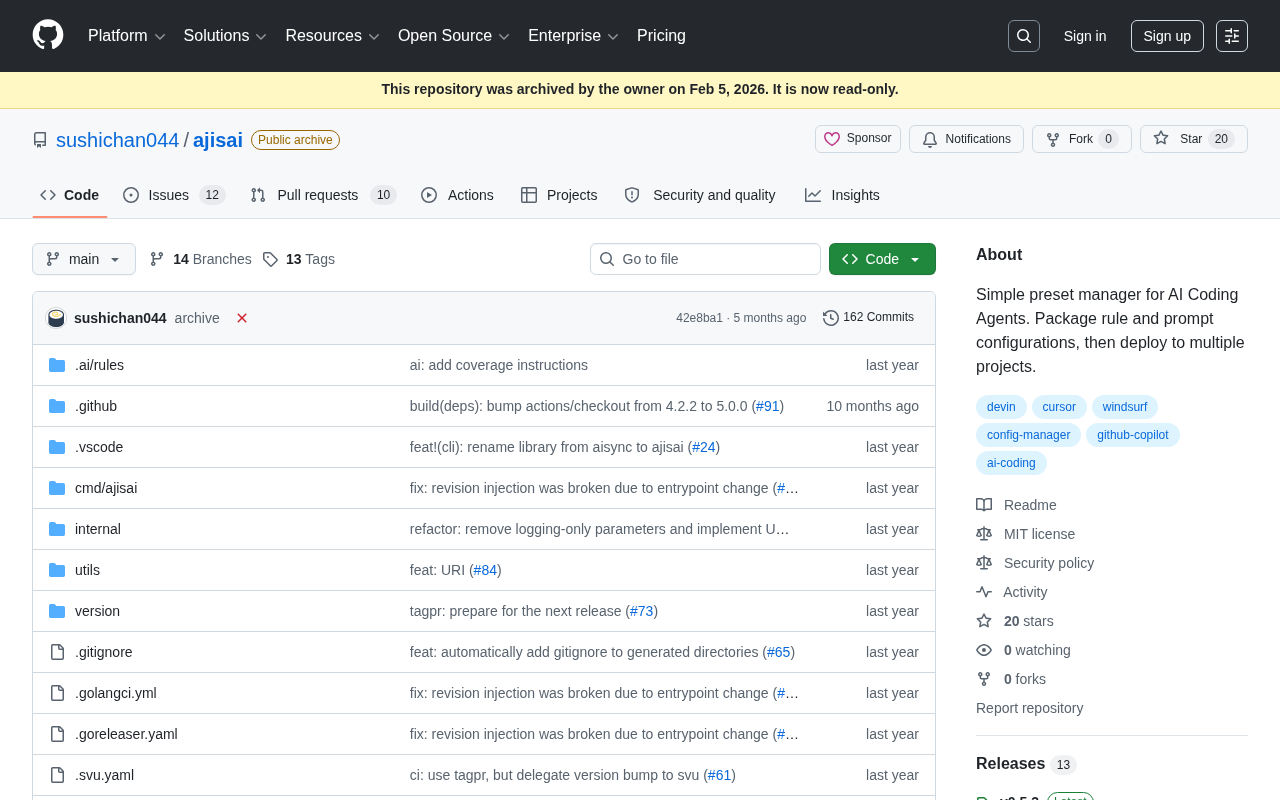
ajisai: A Preset Management Tool for Unifying Rules and Prompts Across AI Coding Assistants
ajisai is a Go-based preset manager for AI coding assistants like Cursor and Claude Code. Package rules and prompts once, deploy everywhere. Early-stage but promising.
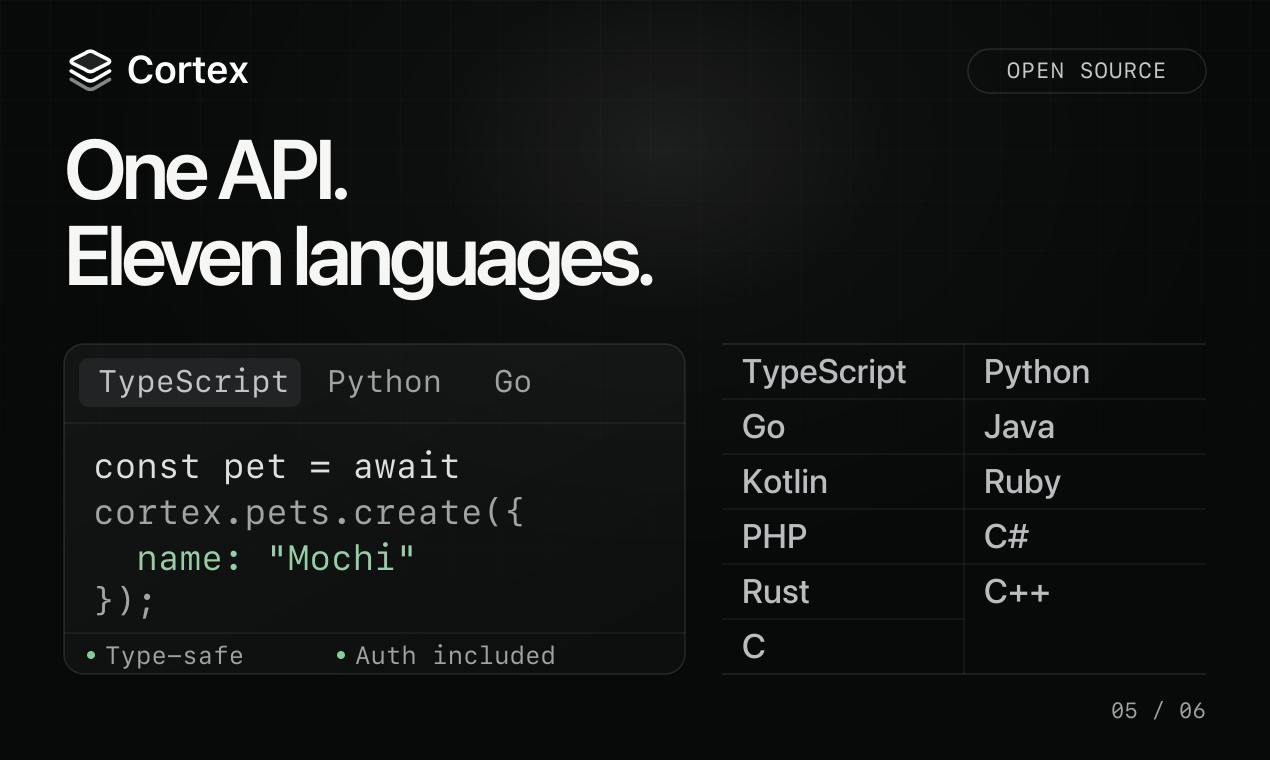
Cortex: Convert API Specs into Docs, SDKs, and MCP Servers in One Click
Cortex is an open-source tool that converts OpenAPI, GraphQL, gRPC and more into interactive docs, typed SDKs in 11 languages, and MCP servers for AI agents.