Kinotic: An All-in-One Platform for AI App Development and Cloud Deployment

Kinotic unifies organization management, entity modeling, CI/CD, observability, and multi-tenant isolation into one AI development platform.
Kinotic is an all-in-one platform for AI application development aimed at solving efficiency bottlenecks caused by toolchain fragmentation. It centrally manages projects, entities, users, and interfaces under an organization, supports one-time GitHub linking and bring-your-own identity providers. Development is entity-driven: define an entity once to auto-generate data layers, search, and APIs, with MCP connecting AI coding tools like Cursor. Each code push triggers a unified pipeline for build, deployment, and SBOM generation, with replayable deployment steps for auditing. Observability spans organization-to-application metrics and enables jumping from failed requests to exact traces. A multi-tenant architecture ensures data isolation across organizations with full audit trails.
Kinotic: An All-in-One Platform for AI App Development and Cloud Deployment
In the field of AI application development, toolchain fragmentation has long been an efficiency bottleneck. From code hosting and CI/CD to observability, developers often have to switch between multiple platforms. Kinotic attempts to change this by integrating organization management, the application development lifecycle, deployment and delivery, and infrastructure monitoring into a single platform. Based on its official demo content, this article breaks down its core capabilities and design philosophy.
Organization and Project Management: A Unified Entry Point
Kinotic uses the Organization as its top-level unit, displaying all applications within an organization in one place. Projects, entities, users, and UI interfaces are visible at a glance, reducing the cognitive burden of managing multiple projects. It supports a one-time link with GitHub, after which all repository deployments are completed automatically through that link, simplifying the integration between version control and deployment.
For identity management, Kinotic allows users to bring their own identity provider, such as Okta, IntraID, and others, giving enterprises flexibility to integrate with their existing identity systems.

Application Capabilities: Entity-Driven Development
A notable feature of Kinotic is its "one application, multiple projects" architecture. Developers only need to define an entity once, and the platform automatically generates the data layer, search functionality, and APIs. This declarative development model reduces repetitive code and lets developers focus more on business logic.
Search functionality works directly against real-time data with no additional configuration. Schema generation and visualization are also automated, helping developers understand data structures. In addition, the platform provides Machine Identities for devices and integrations, and supports connecting to AI tools such as Cursor and Cloud Code via MCP (Model Context Protocol). This means AI coding assistants can interact directly with the platform to obtain context or perform operations, opening up new possibilities for AI-assisted development.
MCP (Model Context Protocol) is a standardized protocol proposed and open-sourced by Anthropic, designed to establish a unified connection between large language models (LLMs) and external data sources and tools. Before MCP emerged, if an AI coding assistant wanted to access data or perform operations on a specific platform, it typically required developing a separate plugin or integration for that platform, resulting in severe ecosystem fragmentation. MCP defines a client-server architecture: AI applications act as clients, while platforms act as servers exposing Resources, Tools, and Prompts. Kinotic's support for MCP means that AI tools such as Cursor and Cloud Code can read entity definitions, trigger deployments, or query logs within the platform according to a unified protocol, without needing separate adaptation for each AI tool. This standardized integration extends AI-assisted development from "code completion" to "platform operation automation," and is a key concept for understanding Kinotic's positioning as an AI-native development platform.
Deployment and Delivery: Pipeline as Code
Kinotic standardizes the deployment process: every code push triggers a unified pipeline that completes build, deployment, and SBOM (Software Bill of Materials) generation. Automatic SBOM generation helps meet software supply chain security requirements.
Deployments run in isolated microservices, logs are output in real time, and every deployment step is recorded and replayable. This means the complete software build materials for any deployment are retained, facilitating auditing and issue reproduction. This "replayable" deployment mechanism is especially valuable when debugging complex issues.
SBOM (Software Bill of Materials) is a machine-readable inventory that itemizes all components, libraries, and their versions and dependencies contained in a software product, similar to a bill of materials in manufacturing. The value of SBOM lies in improving software supply chain transparency: when an open-source component is found to have a security vulnerability (such as the Log4j incident), enterprises can quickly check whether their software is affected instead of manually investigating project by project. Regulatory requirements such as U.S. Executive Order EO 14028 and the EU Cyber Resilience Act have pushed SBOM to become a compliance item for software delivery. Kinotic automatically generates an SBOM in the pipeline for every code push, meaning supply chain security information is produced in sync with build artifacts without additional manual steps or third-party tools, lowering the barrier to meeting compliance requirements.
Observability: From Metrics to Distributed Tracing
For observability, Kinotic provides service metrics at every level from organization to application. When a request fails, developers can jump directly to the exact trace for that request to quickly pinpoint the root cause.
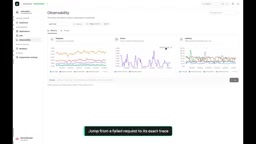
The System Console lets users operate the entire platform from a single interface, viewing the compute capacity, resource allocation, and logs of each worker node. Any failure displays the exact error message, and all changes have a complete audit trail. This centralized operations view reduces the complexity of managing distributed systems.

Distributed Tracing is a core method for locating performance bottlenecks and root causes of failures in microservices architectures. A single user request often spans multiple microservices. Distributed tracing assigns a globally unique Trace ID to each request and passes it between services, linking scattered logs and latency data into a complete call chain. Developers can intuitively see which service and which stage of the request took the longest or threw an exception. Kinotic's emphasis on "jumping directly from a failed request to its exact trace" leverages this capability: in the traditional approach, developers first notice a rise in error rates on a monitoring dashboard, then search the logging system by timestamp, and finally manually piece together the call relationships; direct jumping compresses this troubleshooting path into a single click, significantly shortening mean time to repair (MTTR).
Security and Infrastructure: Multi-Tenant Isolation
Kinotic uses a multi-tenant architecture, where each organization is isolated from others on the platform to ensure data security. The platform claims to "build faster, run anywhere," emphasizing development efficiency and deployment flexibility.
Conclusion
Kinotic's core philosophy is to integrate all the pieces needed for AI application development—project organization, entity modeling, CI/CD, observability, and security isolation—into a single platform. Through automated schema generation, MCP integration, replayable deployments, and fine-grained observability, it aims to reduce friction in developers' toolchains. For teams seeking an integrated development experience, Kinotic offers a noteworthy option. Its actual performance still needs to be validated in real projects, but its design direction aligns with the current demand for efficiency and security in AI application development.
Related articles

Anthropic IPO Explained: Fuel for the AI Boom or the Spark for a Bubble?
Anthropic files for an IPO under ticker ANT. Breaking down the prospectus: 80% of revenue from usage-based pricing, $72B of an $80.7B net loss being non-cash charges, 900% net revenue retention, and how past IPOs like SpaceX performed on day one and over three years — answering the AI bubble question.

Will AI Kill the Research Paper? Mathematicians Offer a New Answer
Mathematicians on the Lex Fridman podcast discuss whether AI will kill research papers—from journal review pressure to Lean formal verification, GitHub open source fatigue to Mathlib's crowdsourcing model, exploring the evolution of academic contributions and the future of mathematical knowledge verification.

Enterprise LLM Development: From RAG to Multi-Agent in Practice
A course breakdown of enterprise LLM application development: from prompt engineering and RAG to multi-agent engineering practice and FDE project delivery, helping developers understand why Agent technology is a key focus for enterprise deployment and learn systematically to avoid detours.