Kling 4.0: A Fast, Affordable AI Video Model Built for High-Frequency Creators

Kling 4.0 uses keyframe control and built-in audio lip sync to turn AI video generation into a predictable pipeline.
Kling 4.0 is an AI video generation model for high-frequency creators, focused on giving users control so video generation becomes a predictable process rather than random retries. It supports up to 10 keyframes, 15 reference assets, and 8000-token prompts for 30-second clips, with built-in stereo audio and 10+ language lip sync. Creative Recreation swaps products or characters in existing videos, Flash mode offers faster, cheaper drafts, and MCP/CLI access enables agent-based automated workflows.
Kling 4.0: A Fast, Affordable AI Video Model Built for High-Frequency Creators
Ranking 20th on Product Hunt with 69 upvotes, Kling 4.0 clearly targets a niche but fast-growing audience: creators, marketers, and studios that need to produce video at high frequency without being tormented by randomness. Its core proposition is straightforward—give control back to users and turn video generation from a "gacha draw" into a predictable production process.
From "Prompt Praying" to "Lock the Story First"
Most AI video tools today work by taking a prompt and retrying over and over until a usable clip appears. Kling 4.0 tries to change that logic: users lock in the narrative structure first, then let the model execute. Specifically, it supports up to 10 keyframes, 15 reference assets, and an 8,000-token prompt to generate a 30-second clip in a single pass. This means creators can define shot rhythm and visual anchors before generation, rather than leaving the outcome to probability.
This "story first, generation second" approach is especially meaningful for teams that need to produce content in bulk. Marketing teams can quickly swap scenes or characters based on the same keyframe structure, maintaining visual consistency across a video series without having to start from scratch every time.
Keyframes are control anchors in video generation: the creator specifies the composition, subject pose, or scene elements of a frame at a given point in time, and the model fills in the transitions in between. Traditional text-to-video only gives a text description and lets the model improvise, producing random results; keyframes act as mandatory "checkpoints" the model must pass through, significantly reducing the chance of drifting off course. The more keyframes, the greater the narrative controllability—but the higher the upfront design cost. Kling 4.0 allows up to 10 keyframes, meaning a 30-second clip has a visual anchor roughly every 3 seconds on average—enough to support simple shot changes and action progression, though complex camera movements still require detailed prompts.
Reference assets are used to lock in consistency of characters, products, or style. For example, uploading multiple angles of the same person lets the model keep facial features stable across different shots and avoid "face changes every frame." The cap of 15 reference assets is fairly practical for serialized content (such as a brand spokesperson appearing on camera).
Built-in Audio and Multilingual Lip Sync
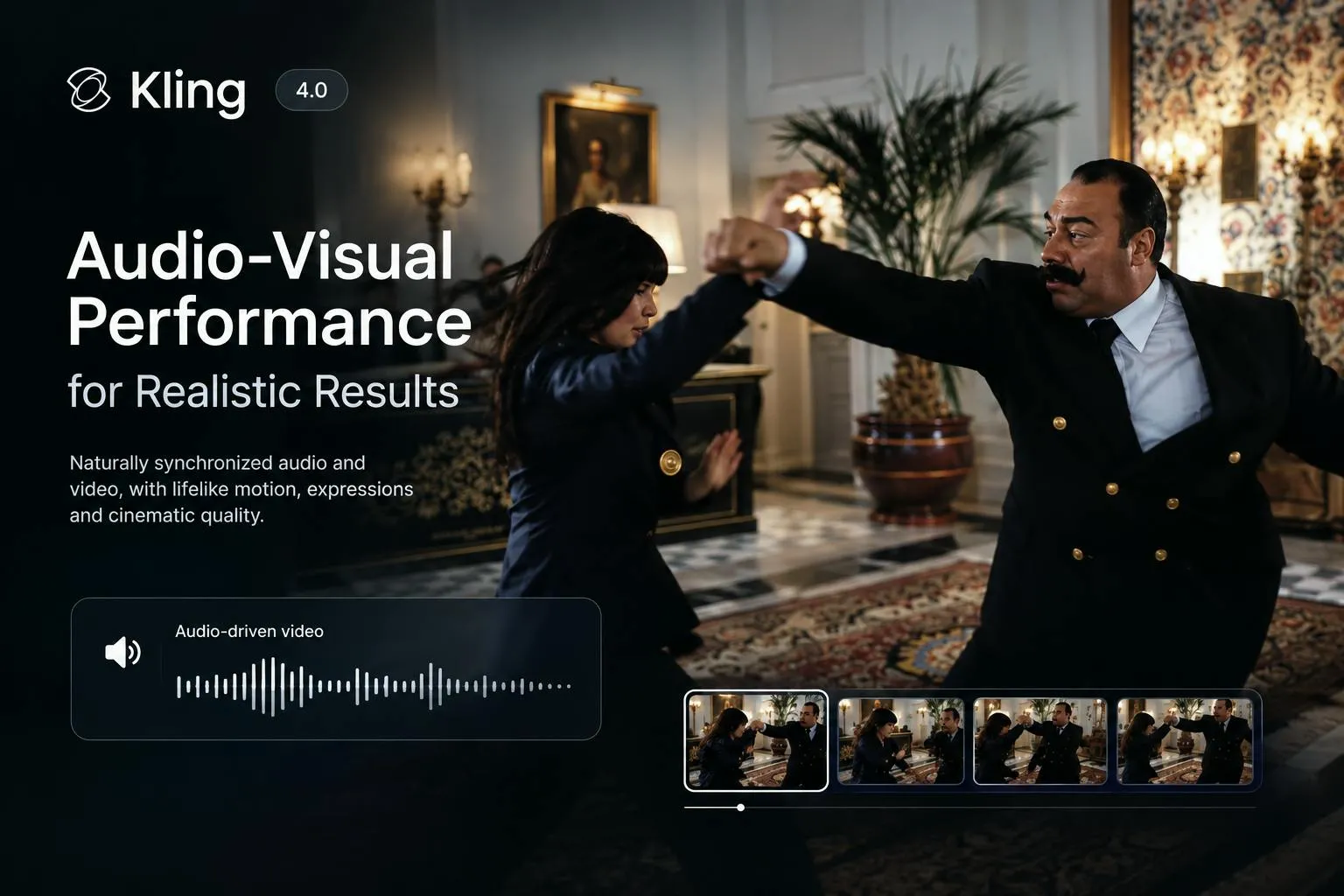
Kling 4.0 builds stereo audio and lip sync directly into the model, supporting more than 10 languages. For short videos and marketing content, audio is often one of the most time-consuming parts of the post-production pipeline—generating voiceover separately, aligning lip movements, and then compositing each step can introduce rework. Building these capabilities in reduces the cost of switching between tools.
However, the actual quality of multilingual lip sync (especially for non-English languages) is not demonstrated in detail on the Product Hunt page, and judging it requires hands-on testing. For teams targeting global markets, this is an area worth verifying carefully during onboarding.
Lip sync refers to the technology that precisely aligns a person's mouth movements in a video with spoken audio. The traditional workflow requires recording voiceover first, then running a separate lip-alignment tool, and finally compositing back into the video—switching between tools easily causes audio-video desync. Building lip sync into the video generation model means audio and visuals are generated jointly in a single inference pass, which in theory yields higher alignment accuracy and less rework. The key difficulty in multilingual support is that different languages have vastly different phoneme sets and speech rhythms; lip-shape mapping for non-English languages (such as Chinese and Japanese) often requires additional training data, and real-world results vary widely—which is why the article recommends prioritizing verification during onboarding.
Creative Recreation and Flash Mode: Two Paths to Efficiency
Kling 4.0 includes two feature designs worth noting. The first is Creative Recreation, which can replace products or characters in an existing video. For e-commerce and brands, this offers a low-cost way to reuse content: a single video asset can be quickly adapted to different SKUs or different markets by swapping the product.
The second is Kling 4.0 Flash, positioned as a faster, cheaper draft mode. This aligns with the rhythm of professional creative workflows—use a low-cost mode to settle on a creative direction first, then use the full model to produce the final version. For high-frequency creators, controlling costs at the draft stage often affects overall output efficiency more than the quality of the final render.
MCP and CLI Access: Built for Agent Workflows
Kling 4.0 offers MCP and CLI access, allowing it to plug directly into agent workflows. This design reveals that its target users aren't just creators working manually, but also teams building automated content pipelines. Invoking video generation via the command line or the MCP protocol means video production can be embedded into existing automated workflows—for example, batch-generating product showcase videos or regularly producing social media assets.
From a product positioning standpoint, Kling 4.0 makes a clear trade-off between "control" and "throughput": it doesn't chase the longest single-generation duration or the highest image quality, but instead combines 30-second single-pass generation, multi-keyframe control, and a low-cost draft mode into a pipeline suited to high-frequency output. Whether this trade-off holds up depends on the balance between actual generation quality and price—and neither figure is fully disclosed on the Product Hunt page.
MCP (Model Context Protocol) is an open protocol proposed by Anthropic and increasingly adopted across the industry, designed to let AI models call external tools and data sources in a standardized way. For a video generation product, offering an MCP interface means agents (such as Claude, Cursor, etc.) can autonomously call Kling 4.0 to complete the chain of "write script → generate keyframes → render video" without manual, step-by-step operation in a web UI. CLI (command-line interface) targets engineering teams, making it easy to embed video generation into CI/CD or batch scripts. Together, Kling 4.0 effectively positions itself as a programmable node in the content pipeline rather than an isolated manual tool—consistent with its "high-frequency output" product proposition.
Trade-offs Worth Noting
The most informative line in Kling 4.0's product description is "control, not lucky retries." It acknowledges a real pain point in current AI video generation: the time wasted on randomness. But greater control also means users need to invest more upfront work in designing keyframes and reference assets. For users chasing fast turnaround, this may actually raise the bar; for teams that need stable output, this is precisely where the value lies.
Another point to watch is the practicality of 30-second single-pass generation. Mainstream short-video content typically runs between 15 and 60 seconds, and 30 seconds covers a considerable portion of those scenarios—but longer narrative content still requires stitching. Kling 4.0 clearly prioritizes "high frequency" over "feature-length," a clear positioning that won't suit everyone.
One-line Summary
With keyframe control and built-in audio lip sync, Kling 4.0 turns AI video generation from a gacha draw into a predictable pipeline.
Paragraph Summary
Kling 4.0 is an AI video generation model built for high-frequency video creators, with a core proposition of giving control back to users and turning video generation from random retries into a predictable production process. It supports up to 10 keyframes, 15 reference assets, and an 8000-token prompt to generate a 30-second clip in a single pass, emphasizing locking in the narrative structure before letting the model execute. The product has built-in stereo audio and lip sync for more than 10 languages, reducing post-production dubbing and alignment costs; Creative Recreation can replace products or characters in existing videos, and Flash mode provides faster, cheaper draft output. In addition, MCP and CLI access let it embed into agent-based automated content workflows. The article notes that the product makes a clear trade-off between control and throughput, positioning itself for high-frequency short-video scenarios, but actual generation quality and pricing have not been fully disclosed and require hands-on verification.
Related articles

WebMCP Security Guide: Three Hints That Make AI Agents Safer
The Chrome team demonstrates three security hints for WebMCP tools: readOnlyHint eliminates invalid confirmation dialogs, consequentialHint forces human confirmation for high-risk operations, and untrustedContentHint defends against indirect prompt injection—improving AI agent security with one or two lines of code.

Why Turbulence Is the Hardest Problem in Fluid Mechanics — and How AI Could Crack It
Why is turbulence the hardest problem in fluid mechanics? This article, based on a Lex Fridman podcast conversation, explores turbulence's multi-scale nature, comparisons with classical thermodynamics, and how AI might simplify turbulence description by discovering coordinate transformations — examining the intersection of vortex formation with mathematics and physics.

R.L. Stine Google Talk: How the Master of Horror Ignites Kids' Passion for Reading
At a Google talk, R.L. Stine shares his accidental pivot from comedy to horror, his principles for children's horror, how phones impact storytelling, and how Goosebumps motivates kids to read.