KnowWork Goes Open Source: An Enterprise Private-Deployment Agent Platform Built on DeepSeek Harness

KnowWork is an open-source enterprise agent platform built on DeepSeek Harness, featuring private deployment, sandbox isolation, and end-to-end auditing.
KnowWork targets the three hard constraints enterprises face when using agents—data cannot leave the intranet, permissions must be isolated, and operations must be auditable. Built on DeepSeek Harness and open-sourced under the Apache license, it deploys with one command, and its images are hosted on Alibaba Cloud for direct pulls within China. All commands run in session-level sandbox containers isolated from the host machine. Policy Q&A cites the source of every conclusion, and execution is fully reviewable; multi-step tasks first produce a to-do list, proactively ask at key points, and support continuation. It delivers real files (Word/HTML/PPT) with online preview, and tool calls, parameters, and token consumption are all reviewable, with department-level knowledge base authorization and audit logs.
Enterprises want to use agents, but data cannot leave the intranet, permissions must be isolated, and every step must be auditable—these three hard constraints rule out many general-purpose agent platforms outright. KnowWork targets exactly this gap: it is built on DeepSeek Harness, open-sourced under the Apache license, deployed with a single command, and its images are hosted on Alibaba Cloud so they can be pulled directly within China.
Deployment and Runtime Environment
KnowWork keeps the barrier to entry very low. According to a demo video on Bilibili, deployment requires just one command, and the image is hosted on an Alibaba Cloud domestic node, so pull speeds are unaffected by cross-border networks. It works right after installation—no need to configure an additional model gateway or set up a vector database.
More importantly, there is runtime isolation. All commands run in the session's own sandbox container and cannot touch the host machine itself. This means that when the agent executes code, reads and writes files, or calls tools, the risk is confined to the boundary of a single session rather than exposing the entire server.
Sandbox Container is a lightweight isolated runtime environment, typically implemented based on container technology (such as Docker). In agent scenarios, a sandbox allocates an independent file system, network, and process space for each session, so that code, commands, and file operations executed by the agent are confined inside the container and cannot directly access host resources. Even if the agent mistakenly executes a dangerous command or suffers a prompt injection attack, the impact is limited to that sandbox instance, and the container is destroyed once the session ends. Compared with virtual machines, sandbox containers start faster and have lower resource overhead, making them suitable for agent sessions that need to be created and destroyed frequently.
Policy Q&A: Every Conclusion Cites Its Source
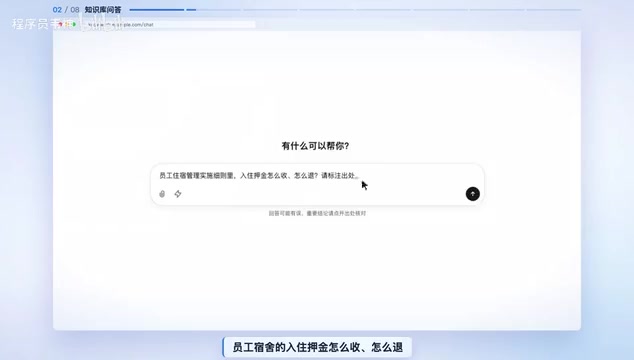
The video opens with a concrete scenario: how the employee dormitory check-in deposit is collected and refunded. Such questions may seem trivial, but they are actually the scenarios that most test an enterprise knowledge base—answers are scattered across policy documents, historical notices, and departmental rules, and a wrong answer means both employees and HR have to redo their work.
KnowWork's approach is to connect the enterprise knowledge base to the agent, annotate the source of every conclusion in its answers, and let users click the number to see the original text of the rule. The execution process can be expanded at any time to see which documents were retrieved and which snippets were matched—all fully visible.
Retrieval-Augmented Generation (RAG) is a technical paradigm in which a large model first retrieves relevant document snippets from an enterprise knowledge base before answering, and then generates an answer based on those snippets. KnowWork's policy Q&A is a typical RAG application: after a user asks a question, the system performs semantic retrieval across policy documents, notices, and detailed rules, finds the relevant passages, and then feeds the snippets together with the question into the model to generate an answer. Because answers have clear document sources, the system can require the model to annotate citation numbers in its output, achieving "every conclusion is traceable." The core value of RAG lies in mitigating the hallucination problem of large models and enabling updates to the enterprise knowledge base to be reflected immediately in answers without retraining the model.
Multi-Step Tasks: Make a To-Do List First, Then Act
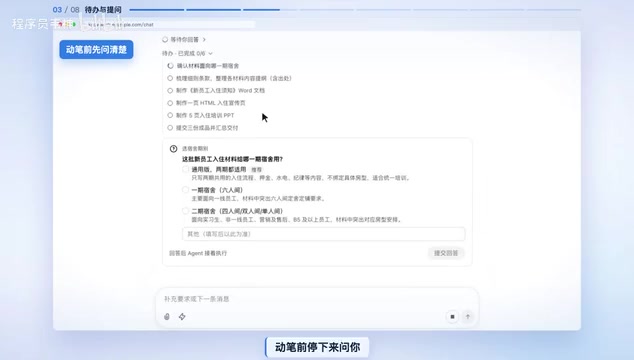
Beyond single-turn Q&A, the way KnowWork handles complete tasks deserves separate mention. In the demo, it is given a task: create a set of onboarding materials for new employees. It does not start writing directly; instead, it first lists a to-do checklist, stops before writing to ask, "Which dormitory period is this batch of materials for?" and continues after the person makes a selection.
The to-do items are advanced one by one, checking off each item as it is completed. If the first pass is not finished, there is no need to start over—add a requirement, and it will continue along the same to-do list rather than tearing everything up and starting again. This process of "plan first, execute later, and allow continuation" is closer to real office scenarios than one-shot generation.
Task Planning and Todo Lists are core mechanisms for agents handling complex multi-step tasks. Unlike single-turn Q&A, complex tasks need to be decomposed into ordered substeps, and the agent first outputs a structured to-do list before executing item by item. This "plan first, execute later" model has two benefits: first, users can review and correct the direction before execution, preventing the agent from wasting large amounts of tokens on the wrong path; second, the to-do list serves as persistent task state and supports continuation after interruption—when users add new requirements, the agent can continue along the original list instead of generating from scratch. Proactively asking the user at key points (such as "Which dormitory period is this batch of materials for?") introduces human confirmation into planning and reduces the risk of irreversible errors.
Deliverables and Observability
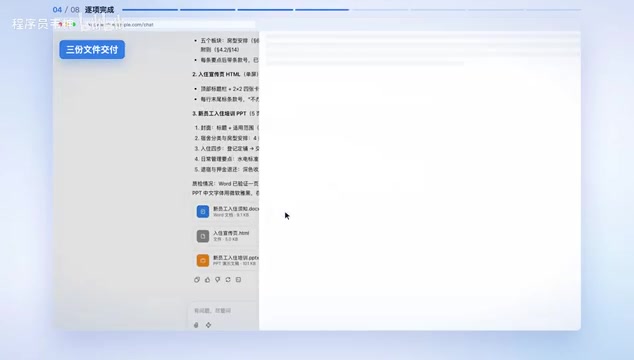
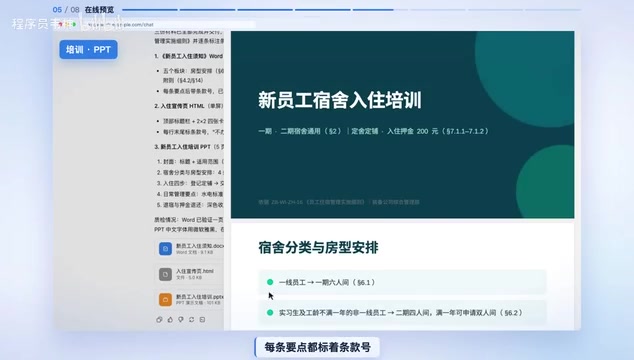
What is ultimately delivered is real files, not text in a chat box. The demo includes three types of outputs: a Word check-in guide, an HTML promotional page, and a midnight training PPT. Click to preview them online and view all four content blocks on one screen. Each key point in the PPT is labeled with a control number for later verification.
Every round can be reviewed step by step: which tools were called, what parameters were passed, and how many tokens were spent—all recorded. In the backend, administrators can create departments, authorize knowledge bases by department, and centrally view skill operation status, operation records for the entire space, and audit logs. For enterprises that need compliance traceability, these capabilities are often more important than the model itself.
Open Source and Trial
KnowWork is built on DeepSeekAd Harness, open-sourced under the Apache license, and available for trial on DeepHub. The Apache license allows commercial use and secondary modification, making it a friendly starting point for internal enterprise platforms.
In terms of positioning, KnowWork does not compete on general-purpose conversational ability; instead, it stakes its chips on three things: private deployment, permission isolation, and audit traceability. These three are exactly the parts enterprises find hardest to compromise on when evaluating agent platforms. Open source means enterprises can review the code themselves and control data flows themselves, which is more tangible than any SaaS promise.
For technical teams looking for an internal agent foundation, KnowWork is worth spending half an hour running through the demo scenario—especially that detail of "asking a question before acting," which reveals the product designer's depth of understanding of office workflows.
Apache License 2.0 is a permissive open-source license released by the Apache Software Foundation that allows users to freely use, modify, and distribute the software, including for commercial purposes and closed-source redistribution. Unlike the GPL license commonly used by enterprises, Apache 2.0 does not require derivative works to be open-sourced, so enterprises can develop derivative works based on KnowWork and integrate them into internal platforms without having to disclose the modified code. The license also includes explicit patent grant clauses, reducing the risk of patent litigation. For enterprises that need private deployment and independent code auditing, Apache 2.0 means they can review data flows themselves and control model invocation chains, which is more controllable than relying on a SaaS vendor's compliance promises.
One-line Summary
KnowWork is an open-source enterprise agent platform built on DeepSeek Harness, focused on private deployment, sandbox isolation, and end-to-end auditing.
Paragraph Summary
KnowWork targets the three hard constraints enterprises face when using agents—data cannot leave the intranet, permissions must be isolated, and operations must be auditable. Built on DeepSeek Harness and open-sourced under the Apache license, it can be deployed with one command, and its images are hosted on Alibaba Cloud for direct pulls within China. All commands run in session-level sandbox containers isolated from the host machine. Policy Q&A cites the source of every conclusion, and the execution process can be expanded for review; multi-step tasks first produce a to-do list, proactively ask at key points, and support continuation along the same to-do list. It ultimately delivers real files (Word/HTML/PPT) with online preview, and tool calls, parameters, and token consumption can all be reviewed end to end. Administrators can authorize knowledge bases at the department level and view audit logs.
Related articles

The Truth Behind Titanic's Sinking: Key Decisions and Communication Failures in the National Geographic Documentary
National Geographic's The Unsinkable Ship uses survivor testimony to reconstruct Titanic's fatal decisions—from the missing MSG telegram prefix and the broken boiler-room-to-bridge link to how 'unsinkable' thinking delayed damage control and evacuation.

74M-Parameter Open-Source Model Partially Outperforms Jev AI in Testing
Fastino AI's Glider 2.5 models, with just 74M–300M parameters, reportedly outperform Jev AI in some guardrail benchmarks per YouTube testing, run on consumer hardware, and even play Doom. We analyze small models' competitiveness and deployment value on specific tasks.

Gemini 4 Argon Hands-On: Aggressive Pricing, 3D Capabilities Need Coaching
Gemini 4 Argon hands-on: limited-time $2/$10 pricing, million-token output, strong 3D and reverse-engineering work, but weak front-end aesthetics and zero-shot ability need coaching.