Korean Invoice OCR Model: Deep Learning + Image Preprocessing Achieves 87% F1 Score

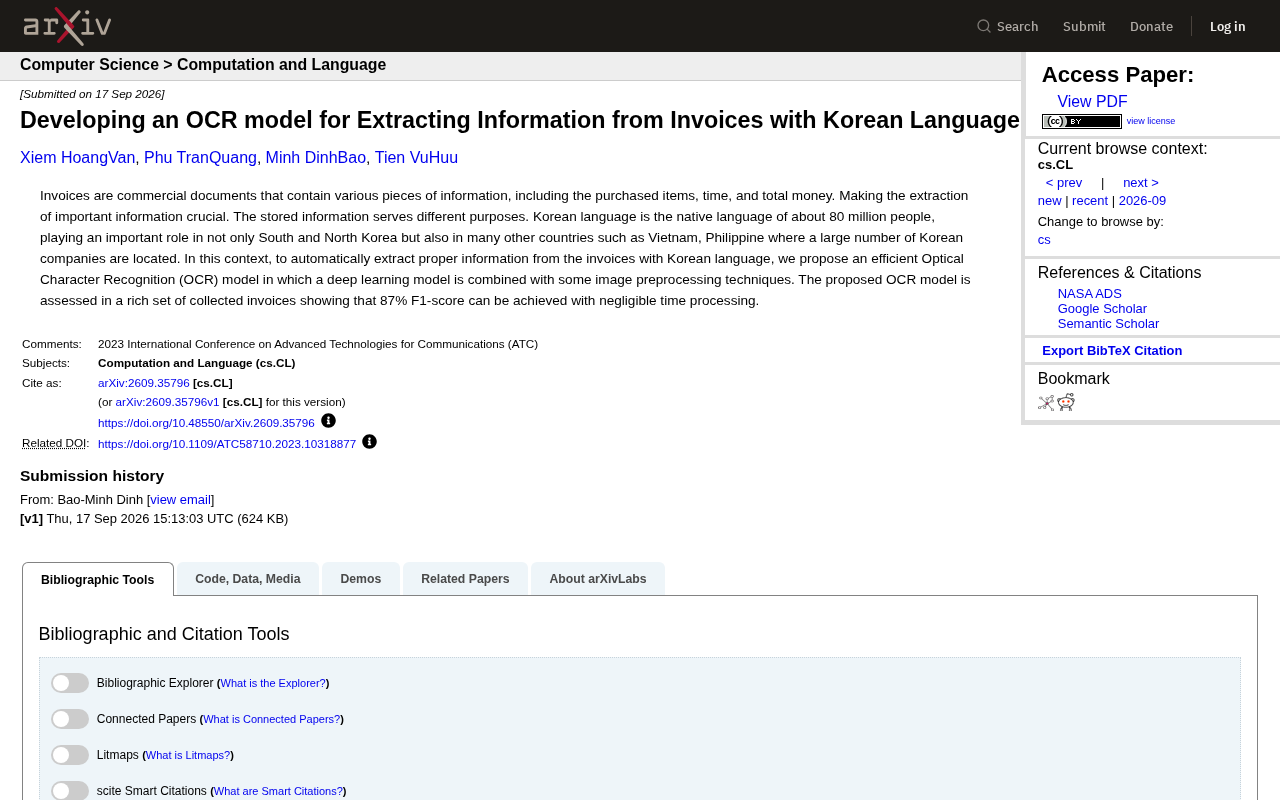
Korean invoice OCR model combines image preprocessing and deep learning to achieve 87% F1 on real-world data.
This arXiv paper addresses the vertical task of automated Korean invoice information extraction, proposing a combined approach of image preprocessing and deep learning. The block-based structure of Korean Hangul — where initial consonants, vowels, and final consonants are assembled within a single square unit — poses greater segmentation and feature extraction challenges than Latin scripts. The research team evaluated the model on a real-world invoice dataset, achieving an 87% F1 score with negligible inference time, establishing baseline feasibility for large-scale commercial deployment. The paper also notes that demand for Korean invoice processing has grown alongside Korean enterprises' expansion into Southeast Asian markets such as Vietnam and the Philippines.
The Real-World Need for Korean Invoice Information Extraction
Invoices are indispensable records in commercial transactions, capturing key information such as purchased items, transaction dates, and total amounts. Automatically extracting structured data from paper or image-based invoices is foundational to enterprise financial automation, expense auditing, and data archiving. Manual data entry is not only time-consuming but also error-prone, making optical character recognition (OCR) technology the long-standing core solution in this domain.
What makes this research noteworthy is its focus on the Korean language context. According to the arXiv paper, Korean is the native language of approximately 80 million people and is widely used not only on the Korean Peninsula but also in countries like Vietnam and the Philippines, where Korean-invested enterprises are heavily concentrated. In other words, automating Korean invoice processing is not a niche problem confined to the peninsula — it is a genuine engineering challenge that has emerged alongside Korean companies' global expansion.
Approach: Combining Deep Learning with Image Preprocessing
The solution proposed in this paper does not rely purely on an end-to-end deep learning network. Instead, it adopts a combined approach of deep learning models paired with image preprocessing techniques — a design that is both common and pragmatic in real-world OCR engineering.
Why Image Preprocessing Matters
Invoice images captured in real-world settings often vary significantly in quality. Issues such as uneven lighting, skew, noise, stamp occlusion, and inconsistent scan resolution can all directly impact recognition accuracy. By applying preprocessing steps — such as denoising, binarization, skew correction, and contrast enhancement — before feeding images into the deep learning model, input quality can be substantially improved, reducing the cognitive burden placed on the model.
The Unique Challenges of Korean OCR
The Korean writing system (Hangul) is composed of syllable blocks, where each character is formed by combining an initial consonant (초성), a vowel (중성), and an optional final consonant (종성) within a single square unit. This structure is fundamentally different from the linear arrangement of Latin alphabets — Korean characters have complex internal structures and dense visual forms, placing higher demands on character segmentation and feature extraction in OCR models. Combining deep learning with targeted image processing is precisely intended to address the unique recognition difficulty posed by this writing system.
Hangul (한글), created under the direction of King Sejong of the Joseon Dynasty in the 15th century, is designed so that consonant letters (자음) and vowel letters (모음) are assembled into syllable blocks within a single square unit. For example, "한" is composed of three elements: the initial consonant ㅎ, the vowel ㅏ, and the final consonant ㄴ. This differs from Chinese character forms or the letter-by-letter linear arrangement of Latin scripts. For OCR systems, the challenge lies in the fact that at low resolutions, fine strokes within syllable blocks can easily merge or break apart. The model must simultaneously perform "block localization" and "phoneme decomposition" to reconstruct the correct syllable encoding. Furthermore, Korean business documents frequently mix numerals, Chinese characters (한자), and Latin letters, making multi-script recognition an additional challenge and a key reason why general-purpose OCR engines tend to perform inconsistently on Korean text.
Experimental Results and Engineering Value
The research team evaluated the model on a rich dataset of real-world invoices. The results show that the OCR model achieves an F1 score of 87%, with negligible processing time.
From a metrics standpoint, an 87% F1 score in real commercial document scenarios represents a practically usable level of performance — it balances recognition precision and recall, meaning the model neither produces excessive false positives nor misses too much target information. The "negligible processing time" aspect is particularly important for real-world deployment: financial systems typically need to process large volumes of invoices in batch, and inference speed directly determines the practical feasibility of any solution.
A Measured Perspective on These Results
It is worth noting that, as a preliminary arXiv paper, the research still provides limited information. The abstract does not detail the specific deep learning architecture used, dataset size, field-level extraction performance, or horizontal comparisons with existing mainstream OCR solutions (such as commercial OCR APIs or open-source engines). Whether the 87% F1 score applies to full-text character recognition or key field extraction also needs to be confirmed in the complete paper.
The F1 score is the most commonly used comprehensive evaluation metric in information extraction tasks, defined as the harmonic mean of Precision and Recall: F1 = 2 × (P × R) / (P + R). Precision measures the proportion of the model's outputs that are correctly identified, while Recall measures the proportion of all true targets that are successfully identified. These two metrics often involve a trade-off — overly conservative models have low recall, while overly aggressive ones suffer in precision. The F1 score's use of the harmonic mean makes it more sensitive to extreme values at either end, more fairly reflecting a model's overall performance in real business scenarios. In document information extraction tasks, the F1 score is typically calculated at the field or entity level — using correctly extracted key fields (such as invoice number, amount, and date) as the unit of measurement rather than individual characters. Therefore, the actual meaning of the 87% figure depends on the paper's explicit specification of the evaluation granularity.
Implications for Enterprises and Developers
This work reflects a broader trend: general-purpose OCR models often struggle to directly meet the business requirements of specific languages and document types. Customized optimization for vertical scenarios — including language adaptation, document layout understanding, and image preprocessing — is the key path to improving practical accuracy.
For enterprises operating in Southeast Asia and other regions that need to process large volumes of Korean business documents, this research offers a useful technical reference. For developers, the layered "preprocessing + deep learning" design remains a sound paradigm for building robust OCR systems, especially in real-world environments where data quality is unpredictable.
As multilingual Document AI continues to advance, specialized optimization for less-resourced languages and complex writing systems is likely to become an important battleground in the next phase of OCR technology development.
Related articles

Random Pruning of the DPO Computation Graph: 1.4x Training Speedup and Lower Peak Memory
DPO training too slow and memory-hungry? This paper proposes a random pruning framework for the DPO computation graph, sampling independently across position, sequence, and branch dimensions; branch pruning achieves a 1.426x step-time speedup and cuts training time by about 30%, with in-depth attribution of memory and time gains.

Why Does JEPA Underperform MLM in Longitudinal EHR Representation Learning?
New study compares JEPA and MLM for longitudinal EHR representation learning on MIMIC-IV: three JEPA variants train stably without collapse but underperform MLM; target size, not heterogeneity, drives prediction error.

Transfer Learning + Visible Light Communication: A New Approach to Energy-Efficient Indoor Positioning
A study proposes a transfer learning-based visible light communication indoor positioning method, achieving 47% accuracy improvement on the BOSCH factory dataset, 67.5% model efficiency under high noise, and introducing the ME composite metric for energy-efficient positioning in energy-constrained industrial IoT scenarios.