kosa8: A Reversible Secure Sandbox for AI Agents
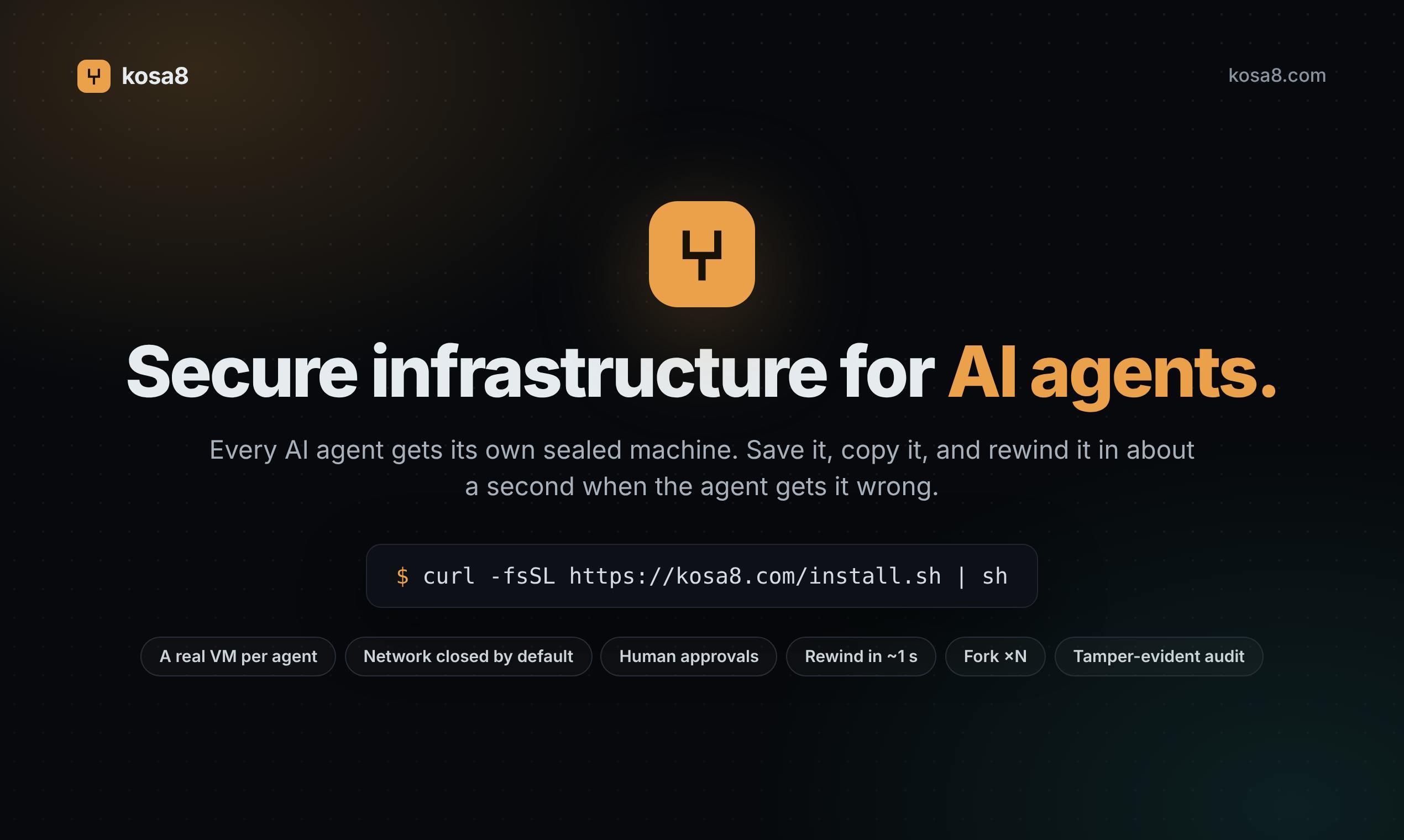
kosa8 places AI coding agents in isolated VMs with ~1-second snapshot rollback and environment forking.
kosa8 is an isolated execution tool for AI coding agents, running Claude Code, Codex, and similar agents in dedicated virtual machines to prevent direct operation on host files and system configurations. It creates checkpoints of the entire runtime environment before high-risk operations, with ~1-second rollback that restores running process state. It also supports forking multiple sandboxes from one checkpoint for parallel testing and running local AI models inside the sandbox. kosa8 provides a unified dashboard and positions itself as "agent infrastructure," balancing isolation and flexibility. It is still early-stage; rollback details, resource overhead, and code synchronization remain to be verified.
AI coding agents are becoming everyday tools for developers, but letting them operate directly on your computer always carries risk. A single wrong command can delete files, and one runaway dependency install can pollute your system environment. kosa8, which debuted on Product Hunt, tries to resolve this tension: it runs agents like Claude Code and Codex inside isolated virtual machines, takes snapshots of the entire runtime environment before high-risk operations, and can roll back in about one second if something goes wrong—restoring even running processes.
Isolated Execution: Giving Agents Their Own "Dedicated Computer"
The core idea behind kosa8 is environment isolation. Rather than relying on container-level permission controls, it assigns agents their own dedicated virtual machines. This means that no matter what an agent does inside, the impact is confined to the sandbox—files, credentials, and system configurations on the host machine remain untouched.
For developers accustomed to using Claude Code or Codex, the immediate benefit of this isolation is reduced mental burden. You no longer need to double-check paths before approving each command, nor worry that some script will accidentally modify global configuration. According to the product page, users can also finely restrict the scope of resources accessible within the sandbox, further narrowing the attack surface.
Beyond the security boundary, kosa8 also supports running local AI models inside the sandbox. This is practically significant for scenarios that involve sensitive data and where users prefer not to send content to cloud APIs.
The difference in isolation strength between containers and virtual machines is key background for understanding kosa8's design trade-offs. Containers (such as Docker) share the host kernel and use namespaces and cgroups for resource and view isolation. They start quickly and have low overhead, but if a kernel vulnerability is exploited, escape risk is real; moreover, containers typically run as root, so misoperations can still reach mounted host directories. Virtual machines rely on a hypervisor to emulate a complete computer at the hardware or kernel level. The guest operating system has its own kernel, forming a stronger boundary with the host: even if the guest kernel is compromised, an attacker must still break through another layer—the hypervisor—to reach the host. The cost is that each VM must load a complete operating system, making memory and startup overhead significantly higher than containers—which is also why kosa8 faces greater resource pressure when running multiple forked environments. In recent years, lightweight virtualization (such as Firecracker microVMs) has sought to strike a balance between the two, reducing startup time to the hundreds of milliseconds while retaining hardware-level isolation. kosa8's choice of virtual machines over containers essentially places the security boundary above flexibility.
Snapshots and Rollback: Making "Undo" Infrastructure
If isolation is the line of defense, the checkpoint mechanism is the safety net. kosa8 allows checkpoints of the entire runtime environment before risky operations, with rollback taking about one second—and it restores more than just filesystem state: running processes are restored as well.
This detail is worth noting. Most snapshot solutions can only restore disk data; process state is lost, and after rollback the agent must restart and reload context. By including processes in the recovery scope, kosa8 interrupts agent workflows less and comes closer to a "time reversal" experience.
Another useful feature is environment forking. Developers can derive multiple sandboxes from the same checkpoint and test different implementation paths in parallel. For example, one agent can try approach A while another tries approach B in an independent copy, without interference, and results can be compared afterward. This turns trial and error from serial into parallel, markedly improving efficiency for exploratory tasks.
Restoring process state in snapshots is difficult because a process is not just bytes in memory; it also includes kernel-maintained open file descriptors, network connections, signal-handling state, and interaction context with external devices. When only the disk filesystem is restored, the original processes no longer exist after rollback, and the agent must restart and rebuild context—previously accumulated conversation history and intermediate results may be lost. To restore processes as well, common technical approaches include: first, checkpoint/restore of the entire VM's memory and CPU registers at the hypervisor layer—CRIU (Checkpoint and Restore in Userspace) is a typical example that can freeze and rebuild a task tree at the process level, though compatibility across kernel versions and network connections is challenging; second, using VM memory snapshot capabilities, where the host side saves a complete memory image at once and loads it wholesale on restore. The latter is transparent to the guest and offers better consistency, but snapshot size is large and restore time grows with memory. If kosa8's claimed ~1-second rollback is accurate, it likely employs optimizations such as incremental memory snapshots or copy-on-write, though the exact mechanism is not disclosed on the product page.
Unified Dashboard and Product Positioning
kosa8 provides a single dashboard to manage all sandboxes, including creation, monitoring, rollback, and forking. The product received 13 upvotes and 6 comments on Product Hunt, ranking 16th for the day, and is categorized under developer tools, artificial intelligence, and security.
In terms of positioning, kosa8 targets the niche need of "agent infrastructure." Current solutions on the market fall roughly into two categories: cloud-hosted agent platforms, which offer good isolation but limited flexibility; and direct local execution, which is flexible but leaves risk to the user. kosa8 enters at the local virtualization layer, seeking to balance isolation with compatibility for local models.
"Agent infrastructure" can be understood as a runtime support layer between underlying compute and upper-layer applications. It focuses on how agents are securely launched, constrained, observed, and restored—not on how smart the agents themselves are. This layer typically includes several capabilities: execution environment provisioning (creation and destruction of sandboxes and VMs), permission and resource boundaries (reachable scope of networks, filesystems, and credentials), state management (checkpoints, rollback, forking), observability (logs, command auditing, cost tracking), and lifecycle orchestration. An adjacent concept is the "agent framework" (such as LangGraph or AutoGen), which handles task decomposition, tool invocation, and multi-agent collaboration logic, running on top of the infrastructure. The current market situation is that cloud-hosted platforms bundle the above capabilities but lock in the ecosystem, while direct local execution hands these responsibilities back to developers. kosa8's choice to enter at the local virtualization layer means it is not tied to a specific model or framework and can in theory serve Claude Code, Codex, and local open-source models alike—the basis of its compatibility claim.
Several Questions Worth Watching
How the product's core promise—1-second rollback including process state—is implemented technically is not detailed on the page, and actual performance remains to be verified. VM resource overhead is also a factor to consider in real use, especially when developers run multiple forked environments simultaneously.
In addition, the sandbox limits interaction between agents and the host machine, but may also introduce workflow friction: how to synchronize code between the isolated environment and real project directories is an engineering question such tools must answer.
kosa8 is currently at an early stage, with few comments, and its feature completeness and stability still need validation from more users. But the thinking it represents is clear: as AI agents take on more and more actual execution work, providing them with isolated, reversible runtime environments is shifting from a "nice to have" into part of the infrastructure.
Code synchronization between isolated environments and real project directories is a typical engineering challenge for such sandbox tools. The available options each involve trade-offs: first, mapping host directories into the VM via shared folders or bind mounts, which feels close to local development but effectively opens a writable channel through the isolation wall—an agent's accidental deletion or malicious write would directly affect real code; second, one-way or on-demand synchronization, such as read-only mounts plus explicit pushes, which is secure but adds steps; third, a Git-based workflow, where the agent clones the repository inside the sandbox and commits on a branch, which the developer reviews and merges—offering the most thorough isolation at the cost of repeated overhead such as build caches and dependency installation. A common compromise is to use Git as the primary synchronization channel, supplemented by shared mounts for specific cache directories, with mandatory human review of diffs before merging. Which approach to choose depends on the team's prioritization of "isolation strength" versus "iteration speed."
One-line Summary
kosa8 runs AI coding agents in isolated virtual machines, with ~1-second snapshot rollback and environment forking.
Paragraph Summary
kosa8 is an isolated execution tool for AI coding agents, running agents like Claude Code and Codex in dedicated virtual machines to prevent them from directly operating on host files and system configurations. Its core mechanism creates checkpoints of the entire runtime environment before high-risk operations, with rollback in about one second that can restore running process state, reducing disruption to agent workflows. The product also supports forking multiple sandboxes from the same checkpoint to test different approaches in parallel, and allows running local AI models inside the sandbox for sensitive data. kosa8 provides a unified dashboard to manage all environments and positions itself as "agent infrastructure," seeking to balance the isolation of cloud-hosted platforms with the flexibility of direct local execution. The product is still at an early stage, and rollback implementation details, VM resource overhead, and code synchronization approaches remain to be verified.
Related articles
AWS Launches Official Agent Toolkit: Letting AI Agents Directly Build and Manage AWS Applications
AWS launches the official Agent Toolkit, letting AI coding agents directly build and manage AWS apps across CDK, CloudFormation, Serverless, Bedrock Agents, and DevSecOps.
Does Agentic AI Need Its Own "Second Foundation"? A Three-Loop Architecture Explored
Inspired by Asimov's Foundation series, a multi-agent AI architecture hypothesis proposes execute, verify, and adapt control loops to reduce correlated errors and improve trust in AI results.
Rewriting a Commercial Engine in Jai: The Trade-off Between Performance and Productivity
Exploring the engineering practice of rewriting a commercial game engine in Jai: compile-time metaprogramming and data-oriented design advantages, plus ecosystem maturity and learning curve challenges.