Krea 2 Identity Edit Lora Hidden Technique: Precise Image Control Through Text Annotations

Text annotations on input images can serve as spatial prompts in Krea 2 Identity Edit Lora for precise object placement.
A Reddit community discovery reveals that Krea 2 Identity Edit Lora can interpret text annotations written directly on input images as spatial prompts, rendering corresponding objects at marked positions. This emergent multimodal behavior bypasses traditional control methods like ControlNet, offering creators an intuitive, zero-learning-cost approach to precise image composition control.
An Unexpected Discovery: Text Annotations as a Precision Control Tool
In the world of AI image generation and editing, helping models accurately understand creators' intentions has always been a core challenge the community explores. Recently, a Reddit user shared a fascinating discovery about Krea 2 Identity Edit Lora: by adding text annotations directly onto the input image to mark specific objects, the Lora treats these annotations as part of the prompt and renders the corresponding content at the exact positions you specify.
This discovery reveals a kind of "multimodal fusion" behavior in how Krea 2 Identity Edit Lora processes input images — the model doesn't just read the visual content of the image, but also parses any text appearing within it and incorporates that information into its generation logic. This provides an unprecedented means of precise control for AI image editing.
This feature was created by community developer conradlocke, and the original post author expressed special thanks to them.
Why Text Annotation Control Deserves Attention
Pain Points of Traditional AI Image Control
In conventional image editing workflows, creators who want to control exactly where an object appears in an image typically rely on these approaches:
- Text prompt spatial descriptions: For example, "place a red apple in the upper left corner" — but natural language is inherently vague about spatial positions, and models frequently misinterpret these descriptions.
- Inpainting / mask editing: Manually defining regions before generating — tedious and requiring some skill.
- ControlNet-style structural control: Requires additional reference images or pose maps, with a relatively high barrier to entry. ControlNet was proposed by Lvmin Zhang at Stanford University in 2023 as a neural network architecture for adding spatial conditional control to pretrained diffusion models. It works by copying the encoder portion of the base model and adding zero convolution layers, enabling the model to accept additional conditional inputs such as edge maps, depth maps, pose skeletons, and semantic segmentation maps for precise spatial structure control in generated images. While ControlNet dramatically improved controllability, its workflow is relatively complex: users need to prepare or extract the appropriate type of condition map, select the matching ControlNet model, and adjust parameters like control strength. Additionally, technologies like IP-Adapter and T2I-Adapter provide different dimensions of control capability, but all come with a learning curve.
The key characteristic of Krea 2 Identity Edit Lora essentially turns "in-image annotations" into spatial anchors — you write a text label at a specific position in your input image, and the model renders the corresponding object right at that location. This is an extremely intuitive interaction method that dramatically lowers the difficulty of precise image control. Compared to solutions like ControlNet that require preparing additional condition maps and adjusting multiple parameters, directly writing annotations on images has virtually zero learning cost — and this is precisely why it has attracted widespread attention.
Enhanced Control Precision Through Image-Text Fusion
The greatest value of this approach lies in "what you label is what you get." Compared to pure text prompts like "place X next to Y" — which depend on the model's spatial reasoning ability — annotating positions directly on the canvas hands spatial information to the model as visual coordinates, bypassing the inherent limitations of natural language for spatial description.
For scenarios requiring fine layout, multi-object arrangement (such as product compositions, scene synthesis, character positioning, etc.), this control method significantly reduces the cost of iterative adjustments.
Krea 2 Identity Edit Lora: Positioning and Technical Background
What is Identity Edit?
Krea has attracted considerable attention in the AI creative generation space in recent years. Founded in 2022, Krea positions itself as an AI image generation and editing platform for creative professionals. Unlike Midjourney's focus on prompt-driven artistic creation or ComfyUI's emphasis on node-based workflow orchestration, Krea emphasizes real-time interaction. Its signature feature is the Real-time Canvas — users can sketch or drag reference images onto the canvas, and the model responds with generated images in real time. Krea 2 is its second-generation product line, with significant improvements in both image generation quality and editing controllability. The platform also embraces the open-source community, allowing users to load community LoRAs. This "platform + community" collaboration model enables community contributions like Identity Edit Lora to quickly reach a broader user base.
Identity Edit typically refers to editing and recombining images while maintaining the identity characteristics of the subject (such as facial features of a person or the appearance of a specific object).
LoRA (Low-Rank Adaptation) is a lightweight model fine-tuning technique that can inject specific capabilities or styles into a base model without retraining the entire large model. Proposed by Microsoft Research in 2021, its core insight is that the weight matrix changes during fine-tuning of large pretrained models actually have a low "intrinsic rank." Therefore, instead of updating the entire weight matrix W, the update can be decomposed into a product of two low-rank matrices A and B (ΔW = A×B), where the parameters of A and B are far smaller than the original matrix. This means that for a base model of tens of GB, the LoRA fine-tuning file might only be tens of MB or even a few MB, yet can inject entirely new styles, character consistency, or specific capabilities. In the Stable Diffusion ecosystem, LoRA has become the community's most mainstream model customization method — users can stack multiple LoRAs like "plugins," flexibly combining different capabilities. Identity Edit Lora grants the base model the ability to "maintain identity consistency + flexible editing" through this approach.
Possible Mechanism Behind Model Recognition of Text Annotations
From a technical perspective, this "text annotation as prompt" behavior most likely stems from the underlying model's powerful vision-language alignment capability. Vision-language alignment is one of the core technologies in multimodal AI, with its development traceable back to the CLIP (Contrastive Language-Image Pretraining) model. Released by OpenAI in 2021, CLIP used contrastive learning to train a unified visual-language representation space on 400 million image-text pairs. This approach profoundly influenced the architectural design of diffusion models — models like Stable Diffusion use CLIP text encoders to convert prompts into conditioning vectors that guide image generation. The deep coupling between text encoders and image understanding modules in modern diffusion models means that when input images contain clearly readable text, the model's visual encoder "reads" this text and integrates its semantic information into the generation conditions.
As model scale increases and training data includes large volumes of text-containing images (such as advertisements, posters, screenshots), visual encoders have gradually developed OCR-level (Optical Character Recognition) text understanding capabilities. This ability isn't the result of intentional training but rather a natural emergence when data scale and model capacity reach a certain threshold.
In other words, this may not be a deliberately designed feature of the Lora, but rather an "emergent" manifestation of the model's powerful multimodal understanding capabilities. "Emergence" is a widely discussed phenomenon in large-scale AI models, referring to the model spontaneously acquiring abilities beyond its training objectives. Google's research team systematically described this phenomenon in a 2022 paper: when model parameters or training data volume crosses a certain critical point, certain capabilities "suddenly" appear rather than growing linearly. In the diffusion model domain, text rendering capability is a classic emergence case — early Stable Diffusion could barely render text correctly in generated images, but with newer generation models like SDXL and Flux, text generation quality improved dramatically. The ability discussed here — "reading text in images and using it as generation conditions" — represents the reverse application of this capability, which can be seen as the model's image-text understanding ability extending from the "output side" to the "input side."
Creators discovered and leveraged this through practice, which is precisely the charm of open-source community exploration: use cases not necessarily covered in official documentation are often unearthed by users during actual operations.
Practical Implications for AI Creators' Workflows
Lower Barrier to Precise Image Control
For everyday creators, this means there's no need to master complex ControlNet parameters or masking techniques — simply "write annotations" on the reference image to achieve targeted guidance of generation results. This approach requires virtually no additional technical learning, truly delivering a "what you see is what you get" experience.
Community-Driven AI Tool Innovation Paradigm
This discovery once again confirms the vitality of the open-source AI tool ecosystem: a Lora contributed by community developer conradlocke has its true capability boundaries expanded collectively by its users. Feature developers provide tools, community users discover unexpected uses through practice, and these findings spread rapidly through platforms like Reddit — this positive cycle of "development — discovery — sharing" is a key driving force behind the rapid iteration of today's AI creative tools.
Use Boundaries That Deserve Rational Assessment
It's worth noting that this article is based on a single community source. The stability of specific results, and the applicability range across different types of objects and scenarios, still requires verification by more users. Whether text annotations can be accurately parsed in all cases, and whether the annotation text itself might remain as artifacts in the generated results, are questions that need to be tested repeatedly in actual use.
Conclusion
This hidden "text annotation as image control" technique in Krea 2 Identity Edit Lora demonstrates the increasingly powerful image-text fusion understanding capabilities of contemporary AI image models. It not only provides creators with an intuitive, low-barrier means of precise control, but also reaffirms that in the world of AI creative tools, a tool's true potential often requires community exploration to be fully unlocked.
For creators who enjoy experimenting with AI image generation, it's worth trying it yourself — write a few text annotations on your input image and see what surprises Krea 2 Identity Edit Lora delivers.
Related articles
Automattic Executives Signed Reciprocal Severance Agreements During Mullenweg's Brief Ouster
Automattic's CFO and General Counsel signed reciprocal severance agreements during Matt Mullenweg's brief ouster, covering one year's salary and accelerated equity vesting, raising corporate governance concerns.
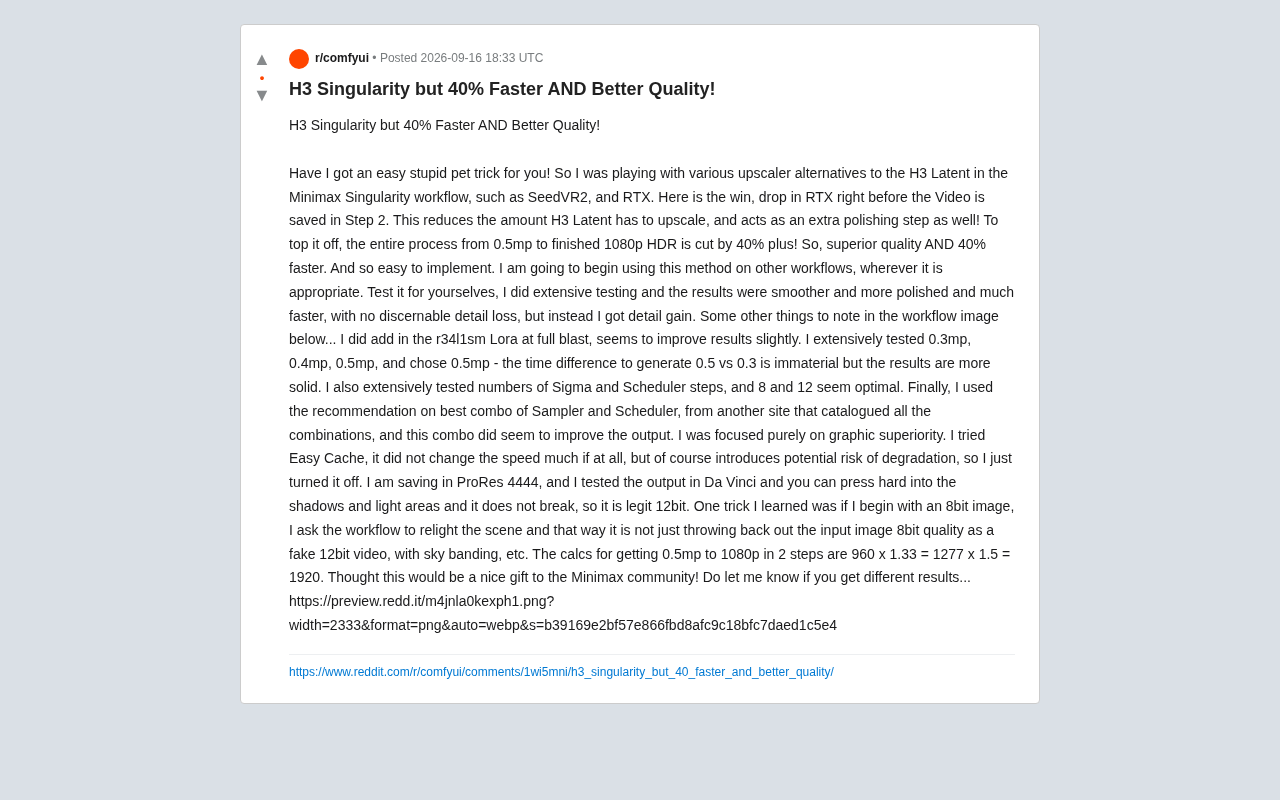
H3 Singularity Optimization: 40% Speed Boost With Better Image Quality
A Reddit user's Minimax Singularity workflow tip: insert an RTX upsampler before H3 Latent for 40%+ speed gains and better quality. Covers parameters, 12-bit output, and more.
Glyph: A Multi-Strategy Agent System for Automated Enterprise Data Catalog Annotation
Glyph is a multi-strategy LLM agent system for enterprise data catalogs that automates column description generation and sensitivity ontology tagging, grounding outputs in pipeline source code to improve accuracy.