Krea2 Character LoRA Training Guide: How to Accurately Reproduce Face and Body
Character LoRA success hinges on dataset quality, feature disentanglement, and base model compatibility — methodology beats any specific tutorial.
This article addresses a recurring question in AI image generation communities: how to train a character LoRA for newer models like Krea2 that reliably reproduces both facial features and body type. It offers a methodology-first framework built around three pillars: dataset quality (20–40 diverse images covering multiple angles and full-body shots), captioning strategy (describe what you don't want baked in, leave character traits undescribed), and base model compatibility (reference the latest configs on Hugging Face and tools like Kohya_ss rather than outdated tutorials). Overfitting and unstable body proportions are the most common failure modes. In a field where tools evolve faster than tutorials, understanding core principles is more durable than following any specific guide.
A Question That Keeps Coming Up
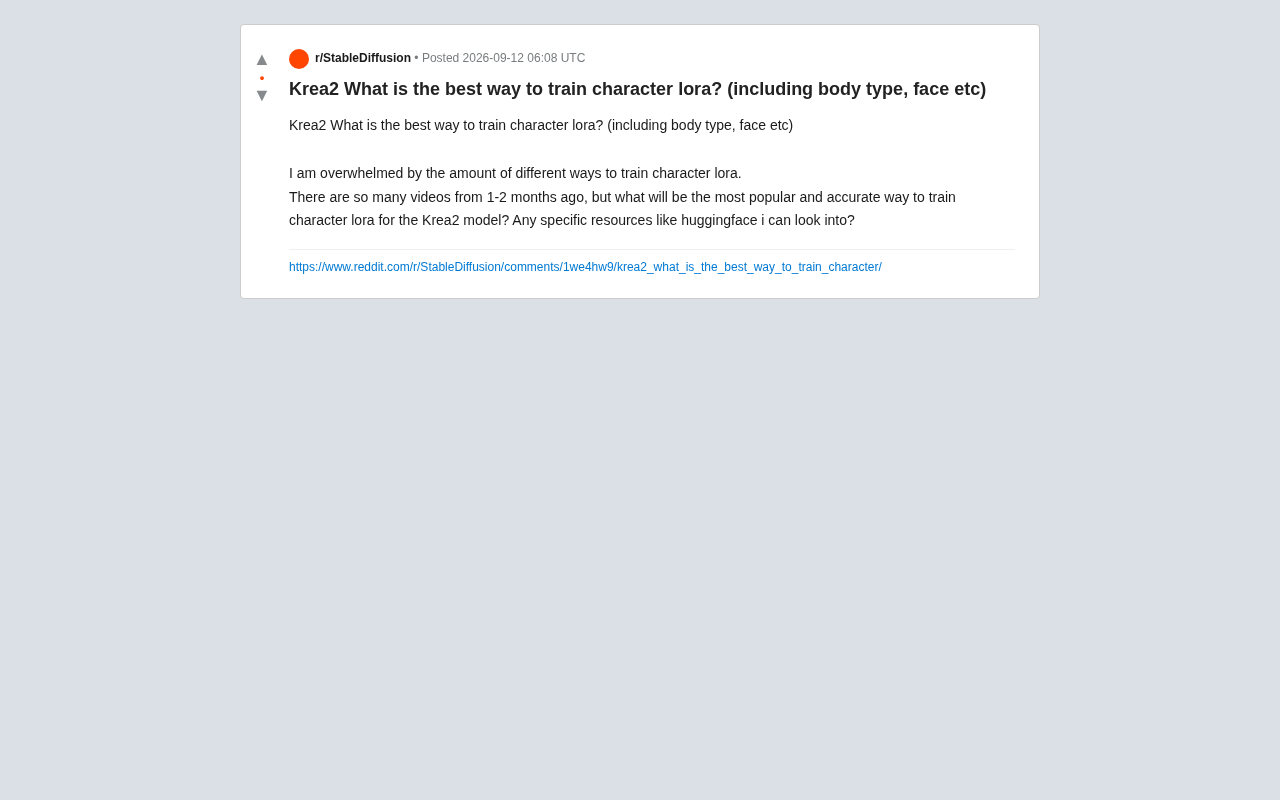
In Reddit's AI image generation community, one creator voiced a frustration shared by many: when it comes to the Krea2 model, is there an optimal path for training character LoRA (Low-Rank Adaptation)? He admitted being overwhelmed by the sheer volume of contradictory tutorials online — "There are so many videos from a month or two ago, but which method is actually the most popular and most accurate?"
The question sounds simple, but it cuts to the heart of a core pain point in AI character customization: tools evolve far faster than best practices can be documented. A tutorial from just a month or two ago may already be partially obsolete due to base model updates or training script upgrades. This article attempts to lay out the underlying logic of character LoRA training and help creators build a methodology that won't go stale.
Why Character LoRA Training Is So Tricky
The goal of a character LoRA is to get a model to consistently generate the same fictional character — not just the face, but also the body type, hairstyle, overall presence, and the full set of visual traits. This is significantly harder than training a style LoRA, because faces and body proportions are areas where the human visual system is extremely sensitive. Even a small deviation creates an uncanny "close but not quite right" illusion.
The challenges cluster around three main areas. First, dataset quality — whether a character's features can be reliably reproduced depends heavily on the diversity and consistency of the training material. Second, feature disentanglement — getting the model to distinguish between "this is an intrinsic character trait" and "this is just the background or pose in a particular image." Third, base model compatibility — different foundation models (like Krea2) respond to LoRA training in very different ways, and plugging in parameters tuned for another model often produces poor results.
The Dataset Is Everything
Regardless of which training script you use, a high-quality dataset is the single most important factor in whether a character LoRA succeeds or fails. For a use case that requires reproducing both facial features and body type, it's worth being intentional about coverage from the very start of dataset preparation.
Image Count and Composition
Generally speaking, 20 to 40 carefully selected images are sufficient to train a usable character LoRA. What matters is not quantity but coverage:
- Close-up facial shots: Multiple angles (front, side, three-quarter), different expressions — these help the model learn facial structure
- Half-body and full-body shots: These are essential for capturing body type; be sure to include standing, sitting, and other poses that convey body proportions
- Varied lighting and backgrounds: This prevents the model from accidentally learning a specific background as part of the character's identity
If you only feed the model close-ups and skip full-body images, it will struggle to learn a stable body type. Conversely, relying only on distant full-body shots will result in blurry facial detail.
Captioning Strategy
How you caption your images directly affects feature disentanglement. The common approach is to assign the character a unique trigger word, then use captions to describe the elements you do not want baked in — such as background, clothing, and pose — while leaving the character's intrinsic traits undescribed or minimally described. This way, the model will attribute "the stable features that weren't described" to the trigger word.
Specific Recommendations for Krea2
For the Krea2 model mentioned in the original post, one thing worth clarifying upfront: the right training approach depends heavily on Krea2's underlying architecture. Since community feedback suggests that relevant tutorials are updated extremely quickly, rather than blindly following a specific video, it's better to focus your energy on finding official or community-recommended configurations for that base model.
Useful places to look include:
- Hugging Face: Search for LoRA training examples using the same architecture as your target model; check publicly shared training parameters (learning rate, network dim, training steps, etc.) from other users
- Major training tools: Such as Kohya_ss and ai-toolkit — these typically roll out adapted configurations for new models quickly
- Recent community forum posts: Prioritize recent discussions that explicitly mention the model version, rather than generic older tutorials
A practical approach: run a baseline using the community's validated default parameters first, then fine-tune based on whether you're seeing overfitting or underfitting. Avoid copying parameters that were tuned for a completely different model.
Hard-Won Tips to Avoid Common Pitfalls
Overfitting is the most common problem. When training runs too long or the learning rate is too high, the LoRA will "memorize" the training images, leading to stiff outputs that don't respond well to new prompts. Symptoms include the character always striking the same pose or wearing the same outfit. The fix is to reduce training steps, lower the learning rate, or increase dataset diversity.
Body type is harder to stabilize than face. The face has a relatively fixed structure, while body shape varies dramatically with pose and clothing. If you find the body type drifting inconsistently, add more full-body images to the dataset that clearly show body proportions, and avoid over-describing physique details in your captions.
Don't chase the "one optimal method." The anxiety expressed by the original poster is completely understandable — everyone wants to find the single correct answer. But in the fast-moving world of AI, a solid methodology is worth far more than any specific tutorial. Mastering the three core skills — dataset preparation, captioning logic, and parameter tuning — will serve you far better than memorizing every step of an already-outdated video.
Final Thoughts
Training a character LoRA that accurately reproduces both face and body is, at its core, a systems problem involving data quality, feature disentanglement, and base model compatibility. When facing newer models like Krea2, the most reliable path isn't to rush out and find the most "popular" method — it's to first understand the underlying principles, then experiment starting from the latest configurations on Hugging Face and in mainstream training tools. Once you understand what the parameters actually mean, no model update or tutorial refresh will ever leave you feeling lost.
Related articles

Asana AI Product Lead Shares AI Agent Best Practices
Asana's AI product lead shares AI Agent best practices, covering responsibility boundaries, human-in-the-loop design, data model anchoring, and evaluation iteration methods for product teams deploying Agents.

Japanese Internet Giant GMO Hit by Hacker Leak: Cloud Service Vulnerability Exposes Customer Data
GMO Internet confirms cloud service hack, customer data possibly exposed. The company is verifying the leaked data, highlighting cloud security and supply chain attack risks.

Apple Adds AI Assistant to Pages, Keynote, Numbers
Apple introduces an AI assistant to Keynote, Pages, and Numbers, powered by Apple and OpenAI models, capable of understanding document context, designing animated slides in Keynote, and drafting and restructuring documents in Pages, escalating AI competition in productivity suites.