Asana AI Product Lead Shares AI Agent Best Practices

Asana's practice reveals: AI Agent deployment hinges on product engineering, not model capabilities.
Based on insights from Asana's AI product lead, the article outlines enterprise AI Agent deployment practices. Core view: Agents should be embedded into existing work management workflows rather than treated as standalone tools, understanding task context and triggering actions at appropriate points. Design follows three principles: clear responsibility boundaries, human-in-the-loop by default, and anchoring to structured data models. Evaluation should focus on real-workflow completion rates, human intervention frequency, and suggestion adoption rates, using failure cases as the primary iteration signal to form continuous monitoring and feedback loops. Implications for product teams: Agent design must stay tied to workflows, permissions and security must be considered upfront, and capability boundaries must be clearly communicated to users. Overall, Agent deployment is more a product engineering problem than a model capability problem.
AI Agent Deployment Through the Lens of Asana's Practice: Principles and Insights
As AI Agents move from concept to enterprise workflows, how to design, deploy, and manage them has become a core issue for product teams. In a recent discussion, Asana's AI product lead shared the company's internal practices, which offer valuable reference for teams exploring AI Agent deployment.
From Work Management Platform to Agent Orchestration Layer
Asana's core business is helping teams coordinate work, and the introduction of AI Agents is changing how this process is automated. According to the product lead, Asana does not treat Agents as standalone tools but embeds them into existing work management workflows. Agents need to understand task context, access project data, and trigger actions at the appropriate points. This approach means the value of Agents lies not in replacing human decision-making but in reducing coordination costs and automatically handling repetitive steps.
This perspective contrasts with the current industry discussion around "Agent-as-a-Service." Many teams view Agents as independently callable APIs, but in real enterprise collaboration scenarios, Agents need to integrate with existing permission systems, data models, and process standards to function reliably.
Core Principles for Designing Agents
The product lead mentioned several recurring design principles. Although no specific quantitative metrics were given, the directional judgment is worth noting.
Define clear responsibility boundaries for Agents. Unlike general-purpose assistants, Agents in work scenarios need to be confined to clear areas of responsibility. The vaguer the responsibility, the more likely an Agent is to behave unpredictably in edge cases. Asana's approach is to define specific task types and operable objects for Agents rather than granting them broad "understand everything" capabilities.
Human-in-the-loop is the default configuration. At critical operation points, Agents should request human confirmation or provide a rollback-capable operation record. In product design, this principle manifests as approval flows, operation logs, and undo mechanisms—rather than assuming the Agent is always correct.
Anchor to the data model. An Agent's reasoning quality depends heavily on the structuredness and accessibility of the underlying data. If project management data itself is chaotic, the Agent's output will also be unreliable. Therefore, before deploying an Agent, sorting out the data model and permission boundaries is the more pragmatic sequence.
Human-in-the-Loop is an interaction paradigm in AI system design that refers to retaining human intervention, review, or decision-making steps within automated workflows. In AI Agent scenarios, it typically takes three forms: pre-confirmation (requesting approval before the Agent executes), process supervision (humans can take over at any time while the Agent runs), and post-hoc traceability (retaining complete operation logs for review and rollback). The opposite extreme is the "fully automated closed loop," where the Agent independently completes the entire perceive—decide—execute cycle. The core value of human-in-the-loop is not to deny Agent capabilities but to reserve control over irreversible or high-risk operations for humans, thereby controlling failure costs while systems are still immature. In enterprise management software, approval flows, change records, and undo mechanisms are the most common engineering manifestations of this principle.
Data Model here broadly refers to the structured definition describing business entities and their relationships, constraints, and permissions—for example, fields such as projects, tasks, assignees, due dates, and status transitions, along with their associated rules. For AI Agents, the data model is essentially the "skeleton" through which they understand the working world: the reasoning and actions produced by the model must ultimately map onto these entities and fields to be executed. If the data model has redundancy, inconsistent naming, or missing key relationships, the Agent will struggle to accurately determine context and is prone to producing suggestions that seem reasonable but cannot be implemented. Therefore, "anchoring to the data model" means first ensuring that business data itself is clearly structured, semantically consistent, and has well-defined access permissions, and then letting the Agent reason based on this stable representation. This determines deployment outcomes more than simply improving model capabilities.
Practical Approaches to Evaluation and Iteration
Regarding how to measure Agent performance, the product lead shared Asana's direction: focusing on completion rates in real workflows, frequency of human intervention, and user adoption of Agent suggestions. These metrics are not pursued for their absolute values but are used as iteration signals.
One noteworthy point is that Agent failure cases often provide more information than success cases. Recording the error trigger conditions, misjudgment scenarios, and user correction behaviors of Agents in real workflows is the primary basis for optimizing Agent behavior. This differs from the traditional software testing approach that relies on predefined test cases—Agent evaluation is closer to continuous monitoring and feedback loops.
The difference between Agent evaluation and traditional software testing deserves separate explanation. Traditional software testing relies on pre-written test cases with clear inputs and expected outputs, where pass rates can be determined in one go; Agent behavior, however, is generated by models in open contexts with virtually infinite input spaces, making exhaustive test cases impractical. Therefore, the industry tends to combine online and offline evaluation: the offline side uses annotated task sets to measure completion quality, while the online side continuously monitors runtime metrics such as completion rate, human takeover rate, and suggestion adoption rate. Meanwhile, error analysis has become a core method—attributing each Agent failure trajectory to identify whether it stems from missing context, incorrect tool calls, or boundary judgment errors, then making targeted fixes to prompts, tools, or data to form a "monitor—attribute—fix" loop.
Implications for Product Teams
Several points from Asana's sharing can be directly helpful to product teams.
First, Agent product design should not be divorced from the workflow itself. Packaging Agents as standalone feature entry points often leads to low usage rates; embedding them into users' existing operation paths makes them more likely to be adopted.
Second, permissions and security need to be considered upfront. Agents access project data and execute operations on behalf of users, which means the permission model must be incorporated in the early stages of Agent design rather than patched in afterward.
Finally, the capability boundaries of Agents should be clearly communicated to users. Users need to know what the Agent can do, what it cannot do, and when human intervention is required. This expectation management directly affects trust building.
Asana's practice shows that AI Agent deployment in enterprises is more a product engineering problem than a model capability problem. Integrating Agents into existing workflows, defining clear boundaries, and establishing feedback mechanisms—these seemingly straightforward practices are precisely the key to whether Agents can truly be put to use.
One-line Summary
Asana's practice reveals: the key to AI Agent deployment lies in product engineering, not model capabilities.
Paragraph Summary
Based on insights from Asana's AI product lead, this article outlines practical experience in deploying AI Agents in enterprises. The core view is that Agents should not be standalone tools but should be embedded into existing work management workflows, understanding task context and triggering actions at appropriate points. Design should follow three principles: clear responsibility boundaries, human-in-the-loop as the default configuration, and anchoring to structured data models. For evaluation, focus on completion rates in real workflows, frequency of human intervention, and suggestion adoption rates, and treat failure cases as the primary iteration signal to form continuous monitoring and feedback loops. Implications for product teams include: Agent design cannot be divorced from workflows, permissions and security must be considered upfront, and capability boundaries must be clearly communicated to users. Overall, Agent deployment is more a product engineering problem than a model capability problem.
Related articles
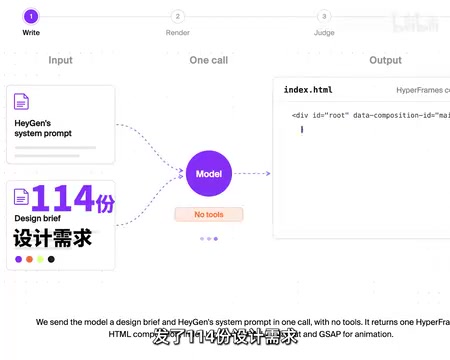
27-Model Code-to-Video Test: Claude Opus 5.5 Takes the Crown, But the Real Value King Is Someone Else
Artificial Analysis' Code2Video Benchmark has 27 models write HTML videos from pure code: Claude Opus 5.5 tops at 1536, while GPT 6.1 ranks fourth at ~1/10 the cost.

Writing Code with Claude Code Means Passing a Network Admin Exam First: The Pain of Configuring AI Programming Tools
Claude Code's real barrier isn't coding ability but account, network, and regional configuration. Why AI programming tools are painful to set up — and how developers should choose pragmatically.
Jev in Practice: A Decision Model That Replaces Token-by-Token Decoding with a Single Prefill
Breaking down Jev's inference paradigm: skip token-by-token decoding and use a single prefill forward pass to output choices, ordinal scores, and booleans. Comparing encoder and decoder paths, multi-question mask design, duplicate token pitfalls, and RLCD with GRPO for probability calibration training.