KREV AI: Automating Ecommerce Brand Operations with an AI Team

KREV AI 2.0 uses six named AI agents to cover the entire ecommerce operations chain, upgrading from a single-point tool to an AI operations team.
KREV AI 2.0 debuted on Product Hunt with six named AI agents (Scout, Luna, Kai, Chloe, Rue, Toshi, Max) covering competitor ad monitoring, content generation, media buying, social media publishing, email marketing, storefront editing, and search optimization, positioned as an AI team that runs your ecommerce brand. The article sees this as a paradigm shift from single-point tools to multi-agent collaboration, with value in reducing cross-tool switching, but challenges in agent coordination, decision interpretability, and brand consistency. It received 78 votes, 3 comments, and ranked #11 on Product Hunt. Ideal for SMB sellers; mature brands should be cautious.
Six AI Agents Form a "Virtual Operations Team"
Ecommerce operations are evolving from a "numbers game" to an "AI team." KREV AI 2.0, newly launched on Product Hunt, proposes a bold vision: use six specialized AI agents to cover the entire chain—from competitor ad monitoring and content generation to media buying, social media publishing, email marketing, storefront editing, and search optimization—letting an AI team "run your ecommerce brand for you." Is it a marketing gimmick, or the next stop for ecommerce automation?
Six AI Agents Form a "Virtual Operations Team"
The core design of KREV AI is to break ecommerce operations into six distinct functions, each assigned a named AI agent:
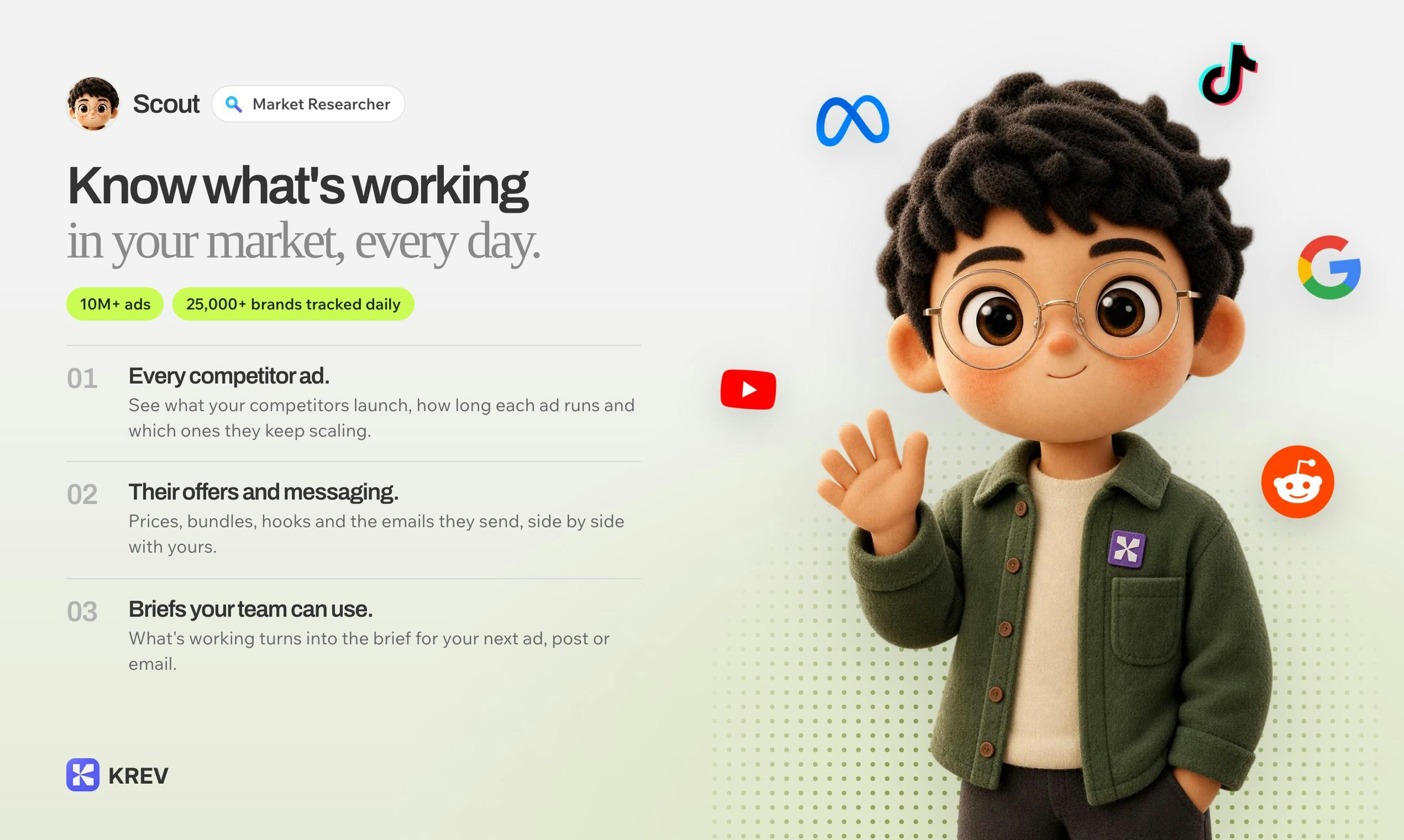
- Scout: Tracks over 10 million competitor ads, providing intelligence input for product selection and campaign strategy;
- Luna: Generates "real-looking" content, addressing the pain point of AI assets feeling stiff and lacking authenticity;
- Kai: Handles media buying—the execution and optimization of ad campaigns;
- Chloe: Captures social media trends and publishes content, playing the role of "trend chaser";
- Rue: Sends emails, taking over the email marketing function;
- Toshi: Edits and optimizes store pages—essentially storefront design and maintenance;
- Max: Responsible for "making you discoverable," i.e., optimization for search and discovery.
The official positioning is "An AI team that runs your ecommerce brand." Judging from the agent naming and division of labor, KREV attempts to let different agents make autonomous decisions within their domains, rather than cramming all tasks into a single general-purpose LLM. This "multi-agent division of labor" approach aligns with the current trend of AI applications evolving from Copilot to Agent: users no longer issue step-by-step instructions, but instead set goals and let the agent team collaborate to accomplish them.
Multi-Agent System is an important direction in the evolution of AI applications. Unlike a single general-purpose LLM handling all tasks, a multi-agent system has multiple AI agents with specific roles and tool permissions working together; each agent can focus on its own domain, invoke dedicated tools, and exchange information with other agents when necessary. The advantage of this architecture lies in the specialization and maintainability that division of labor brings, but it also introduces new challenges: communication protocols between agents, task allocation and conflict resolution, consistency of global objectives, and interpretability of overall behavior. KREV's division of ecommerce operations into six agents is essentially an attempt to replace human scheduling with a multi-agent architecture, and its success depends largely on the design of inter-agent coordination mechanisms rather than the capability ceiling of any single agent.
From Tool to Team: A Paradigm Shift in Ecommerce AI
Over the past few years, most AI tools in ecommerce have remained at the level of single-point efficiency gains—generating product descriptions, creating images, writing ad copy, optimizing email subject lines. Each tool needs to be manually connected, and the operator remains the "scheduling center" of the entire process. KREV's differentiation lies in handing over the scheduling itself to AI: Scout's intelligence can flow to front-end content and campaigns, Chloe's trend judgments can influence social media content, and Rue and Toshi handle conversion and landing pages.
The value of this model lies in reducing the friction of switching between tools. For small and medium-sized ecommerce brands, simultaneously maintaining ad monitoring, content production, media buying, email marketing, and store operations often requires generalists or a small team; if an AI agent team can truly collaborate, it would compress the functions of "operations director + media buying + content + email + site building" into a single product.
But this is also the biggest doubt facing KREV: the quality of collaboration between agents, the interpretability of decisions, and the consistency of brand tone are all far harder to get right than single-point tools. Luna's emphasis on "content that looks real" precisely indicates that AI content still falls short on authenticity, and once brand content loses authenticity, long-term trust is damaged.
The difference between Copilot and Agent is key to understanding this paradigm shift. In Copilot mode, AI serves as an auxiliary tool; users give instructions and review output at every step, with humans always in the loop. In Agent mode, users set goals and the AI autonomously plans steps, invokes tools, and executes tasks, with humans relegated to a supervisory role. The evolution from Copilot to Agent means that AI's responsibility expands from "executing single-step tasks" to "managing multi-step processes." KREV's claim of "an AI team running your brand" is a typical Agent model, but it also means brands need to cede more control. Current Agent technology is still immature in reliability, error recovery, and cost control for long-process tasks, so the balance between "full autonomy" and "human review as a fallback" is the core issue determining whether such products can be adopted.
Media Buying is a specialized function in digital advertising, referring to the entire process by which advertisers or agencies purchase ad placements, allocate budgets, formulate bidding strategies, and optimize campaign performance across various media platforms. Traditional media buying relies on media buyers manually adjusting bids and audience targeting based on data, while programmatic advertising and AI-driven campaigns attempt to automate this process. The Kai agent in KREV handles exactly this function. The difficulty of media buying lies in: different platforms have different algorithmic logic, budget allocation requires cross-channel trade-offs, attribution is complex, and campaign errors directly consume real money. Therefore, whether an AI agent can be competent at media buying depends not only on model capability but also on whether it has access to real-time data and operational permissions across platforms.
Product Hunt Traction and Early Signals
KREV AI received 78 votes and 3 comments on Product Hunt, ranking #11, launched by Modi Sulak. This result indicates it reached the top of the day's leaderboard, but the low comment count means real user feedback and in-depth discussion have yet to fully unfold. For a product claiming to "run the entire ecommerce brand," the gap between early traction and actual reputation needs time to be verified.
From a product strategy perspective, KREV chose anthropomorphic names (Scout, Luna, Kai, etc.) to lower comprehension costs, letting users understand AI agents as if they were "building a team"—a smart product narrative. But naming cannot replace results; what users ultimately care about is: whether Scout's 10 million tracked ads can translate into actionable insights, whether Kai's campaigns can control costs, and whether Max's search optimization can bring actual traffic.
Who Should Use KREV, and Who Should Wait
KREV's ideal users are small and medium-sized ecommerce sellers who lack a complete operations team but want to maintain a certain brand tone. They typically don't have dedicated media buyers or email marketing staff, and AI agents can turn these functions from "no one does it" to "someone manages it."
Caution is warranted for companies with mature brands and strict compliance requirements for content and advertising. Multi-agent autonomous decision-making means brands need to trust AI's statements and campaign behavior on public channels, which still requires human review as a fallback at this stage. In addition, KREV's website and Product Hunt page have not yet shown the specific mechanisms of agent collaboration or pricing details; potential users should pay attention to actual workflow demonstrations and trial feedback rather than being directly persuaded by the "AI team" concept.
Competition in ecommerce AI has shifted from "who can generate better copy" to "who can take over more of the operations chain." KREV AI is betting on the latter, and whether it succeeds depends on whether the six agents truly collaborate like a team rather than six chatbots each fighting its own battle.
One-line Summary
KREV AI 2.0 uses six named AI agents with divided roles to cover the entire ecommerce operations chain, attempting to upgrade from a single-point tool to an AI operations team.
Paragraph Summary
KREV AI 2.0 debuted on Product Hunt, proposing six named AI agents (Scout, Luna, Kai, Chloe, Rue, Toshi, Max) to cover competitor ad monitoring, content generation, media buying, social media publishing, email marketing, storefront editing, and search optimization, positioned as "an AI team that runs your ecommerce brand." The article argues this represents a paradigm shift in ecommerce AI from single-point efficiency tools to multi-agent collaboration, with value in reducing cross-tool switching and manual scheduling, but the biggest challenges lie in agent collaboration quality, decision interpretability, and brand tone consistency. It received 78 votes, 3 comments, and ranked #11 on Product Hunt—reaching the top of the leaderboard but with limited in-depth feedback. Ideal users are small and medium-sized sellers lacking a complete operations team; mature brand enterprises should approach multi-agent autonomous decisions with caution.
Related articles

AI Writes Your Code—Do You Still Need to Learn Git? Five Reasons
AI coding agents handle Git operations automatically—is it still necessary to learn Git? Five reasons: team communication, reviewing agent PRs, monitoring code changes, fallback when AI goes down, and the joy of learning—plus how the focus of learning Git is shifting in the agent era.

Anthropic Reportedly Prices IPO at $83 Per Share, Valuing Company at $1.5 Trillion
Anthropic reportedly prices IPO at $83 per share, above the expected range, with a fully diluted valuation of $1.5 trillion. This article analyzes the signal significance of the pricing and its impact on the AI industry's financing environment.

Open-Source Code Hosting Platform Codeberg Suffers Outage, Sparking Debate in Developer Community
Open-source code hosting platform Codeberg.org suffered an outage, sparking Hacker News debate over nonprofit platform stability and open-source infrastructure dependency risks.