Kripke Challenges "Meaning Is Use": Rethinking LLM Evaluation

Kripkean rule-following challenges undermine "meaning is use" and call for NLP evaluation to shift toward abstraction and recursion.
Drawing on Kripke's Wittgenstein, the article argues that large language models' reliance on "meaning is use" faces a rule-following problem: finite usage cannot uniquely determine future rules, so perfect in-distribution performance does not guarantee conceptual mastery. It reframes OOD generalization and criticizes fixed-case and local-robustness evaluation as insufficient, proposing to assess abstraction and recursion while offering an experimental paradigm.
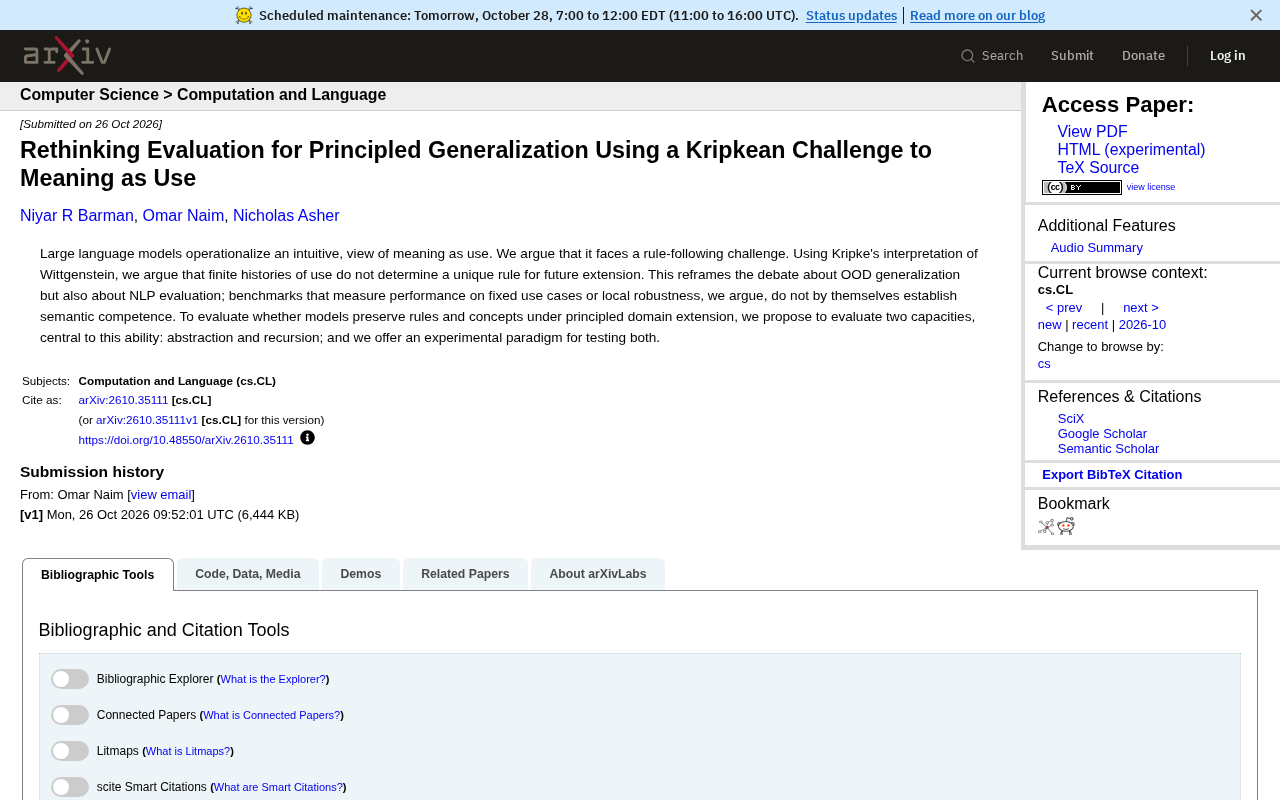
Large language models are often understood through the intuitive view that "meaning is use": the meaning of a word is determined by its pattern of use in a corpus. However, a recent paper draws on Kripke's reading of Wittgenstein to argue that this view faces a "rule-following" problem—a finite history of use cannot uniquely determine the rule for future extension. This challenge not only reframes the discussion of out-of-distribution (OOD) generalization but also raises fundamental questions about current NLP evaluation paradigms.
The Intuition and the Fracture of "Meaning Is Use"
The paper begins by noting that large language models, at the operational level, practice an intuitive "meaning is use" view: models learn patterns of word and concept usage from massive text and generate responses accordingly. This view has been highly successful in engineering, but it implicitly assumes that patterns of use are sufficient to determine meaning.
Drawing on Kripke's reading of Wittgenstein, the authors identify a fundamental fracture in this assumption: any finite history of use can be explained by infinitely many rules, and these rules differ in how they extend to future usage. In other words, past usage cannot uniquely pin down the correct future usage. For language models, this means that even if a model performs perfectly within the training distribution, there is no guarantee that it has grasped the correct rules or concepts.
Kripke's reading of Wittgenstein is the key background for understanding the paper's argument. In Philosophical Investigations, Wittgenstein raises the "rule-following" paradox: any finite sequence of behavior can be explained by infinitely many rules, so there is no "fact" that determines how we should continue in the future. In Wittgenstein on Rules and Private Language, Kripke radicalizes this paradox into what is called "Kripkean skepticism": if past usage can always be accommodated by different rules, then there is no objective basis for following a rule "correctly," and meaning itself seems to become indeterminate. Kripke's "skeptical solution" appeals to communal agreement rather than individual inner facts. The paper borrows this framework to argue that the "patterns of use" a language model induces from a finite corpus cannot uniquely pin down its future semantic extension. Thus "meaning is use" faces uncertainty in principle, not merely a problem of insufficient data coverage.
How the Rule-Following Problem Reframes the OOD Generalization Debate
Traditional discussions of OOD generalization usually focus on performance degradation under distribution shift and attempt to close the gap through better regularization, data augmentation, or architecture design. But the paper argues that the Kripkean challenge pushes the problem to a deeper level: whether the model is extending rules in a principled way, rather than merely fitting local patterns.
If a finite history cannot determine a unique rule, then a model's success or failure in OOD settings cannot simply be attributed to "insufficient generalization ability"; it may instead involve uncertainty in rule selection. This requires evaluation methods to shift from "performance on fixed test cases" to "whether rules and concepts remain consistent under principled domain extension."
Out-of-distribution (OOD) generalization is a standard concept in machine learning, referring to model performance when the training and test distributions differ. Traditional research usually attributes OOD failure to statistical mismatch caused by distribution shift and has developed methods such as domain generalization, invariant risk minimization, and data augmentation. However, these methods assume there is a "correct" generalization rule to be learned. The Kripkean challenge points out that finite training data may correspond to infinitely many rules that fit the data equally well but extrapolate differently. Therefore, OOD success depends not only on statistical generalization ability but also on which rule the model "chooses." This perspective elevates OOD evaluation from a question of performance metrics to a question of semantic determinacy: we need to judge whether the model maintains rule consistency under principled extension, rather than merely comparing accuracy gaps between in-distribution and out-of-distribution data.
Limitations of Existing Benchmarks: Fixed Test Cases and Local Robustness
The paper explicitly criticizes two common practices in current NLP evaluation: measuring model performance on fixed test cases and testing local robustness. The authors argue that neither type of evaluation is sufficient on its own to establish semantic competence.
High scores on fixed test cases may merely reflect memorization or interpolation of specific usage patterns, while local robustness tests usually perturb only the surface form of inputs and do not touch rule-level extension. Neither can answer a key question: when the domain is extended in a principled way, does the model still follow the same rules and concepts?
Local robustness testing usually refers to applying small perturbations to inputs (such as character substitutions, synonym replacements, or sentence rewrites) and observing whether model outputs remain stable. Such tests can reveal a model's sensitivity to surface changes, but the perturbations are confined to the input space and do not involve rule-level extension. For example, a model may be stable across all spelling variants yet fail to apply the same concept in a principled way to an entirely new domain. The paper therefore distinguishes "surface robustness" from "rule consistency": the former can be improved through data augmentation, while the latter requires the model to preserve conceptual structure when the domain is extended. This distinction has direct implications for benchmark design—perturbation tests alone cannot verify semantic competence; experimental paradigms that probe rule extension need to be designed.
Proposing Evaluation of Two Core Capabilities: Abstraction and Recursion
To address these challenges, the paper proposes evaluating two capabilities that are crucial for principled extension: abstraction and recursion. Abstraction enables a model to extract rules from concrete cases, while recursion enables rules to be applied iteratively to new situations.
The authors also provide an experimental paradigm for testing both capabilities simultaneously. Although the abstract does not disclose the specific experimental details, the proposal of this framework itself points in a direction: evaluation should not stop at input-output matching but should probe whether the model maintains consistency at the rule level.
Abstraction has different emphases in cognitive science and machine learning. In the context of the paper, abstraction refers to the ability to extract reusable rules from concrete cases—that is, the process of ignoring surface differences and preserving structural invariants. Recursion refers to the ability to iteratively apply extracted rules to new situations, including applying rules to their own outputs or to nested structures. Together they constitute the core of "principled extension": abstraction provides the rule, and recursion ensures that the rule can be extended repeatedly. This framework echoes the "rules versus similarity" debate in psycholinguistics—if a model relies only on similarity-based interpolation, it will fail in new domains that require recursive extension; if it possesses abstraction and recursion, it can remain consistent at the rule level. The experimental paradigm proposed by the paper attempts precisely to separate these two capabilities, thereby determining whether the model is "using rules" or "fitting patterns."
Implications for NLP Evaluation Practice
The value of this work lies in translating the philosophical discussion of rule-following into an actionable evaluation agenda. For researchers building and evaluating language models, it prompts us to re-examine the underlying assumptions of benchmark design: a model that performs excellently on a fixed test set may not possess semantic competence; genuine principled generalization requires the model to preserve the invariance of rules and concepts when the domain is extended.
Of course, the evaluation paradigm for abstraction and recursion is still at the proposal stage, and its practical feasibility and discriminative power await validation in future experiments. But the questions raised by the paper are sharp enough—if "meaning is use" cannot support judgments of semantic competence, then NLP evaluation needs a new theoretical foundation.
One-line Summary
Kripkean rule-following challenges undermine "meaning is use" and call for NLP evaluation to shift toward abstraction and recursion capabilities.
Paragraph Summary
Drawing on Kripke's reading of Wittgenstein, the article argues that the "meaning is use" view relied on by large language models faces a rule-following problem: a finite history of use cannot uniquely determine future rules of extension, so even a model that performs perfectly in-distribution is not guaranteed to have grasped the correct concepts. This challenge reframes the OOD generalization debate, shifting focus from statistical performance gaps to whether a model maintains rule consistency under principled domain extension. The authors criticize existing NLP evaluation for relying on fixed test-case performance and local robustness tests, arguing that neither is sufficient to establish semantic competence, and propose evaluating two core capabilities—abstraction and recursion—along with an experimental paradigm. Although the paradigm remains to be validated, the paper turns philosophical discussion into an actionable evaluation agenda and suggests that benchmark design needs to re-examine its underlying assumptions.
Related articles

DeepSeek Open-Sources DeepInfer: What Is an Inference Framework Actually For?
DeepSeek open-sources its inference framework DeepInfer under Apache 2.0, supporting DeepSeek V4.1 Flash offline inference. This article explains its request scheduling, FlashMLA/DeepGEMM compute optimization, DSPark speculative verification acceleration, and what it means for developers and ordinary users.

Open-Source AI Learning Agent: A Full Workflow Experience from Topology Graphs to Exam Generation
Explore an open-source AI learning agent: built on DeepSeek API, it constructs knowledge systems via topology graphs, with automatic document generation, notes, super documents, and exams. Learn about its Agent workflow and design highlights.

DeepSeek Whale Girl Open-Source MV Meme: AI Industry Coded Slang About Pivoting to Closed Source
Bilibili's DeepSeek Whale Girl rap MV uses fictional memes to tease the AI open-source vs. closed-source debate, with lyrics full of industry slang. This article explains the meme culture, the Whale Girl symbol, and the open/closed tension.