Ladybird Browser Ships First Alpha: How AI Coding Agents Are Reshaping the Browser Engine Landscape
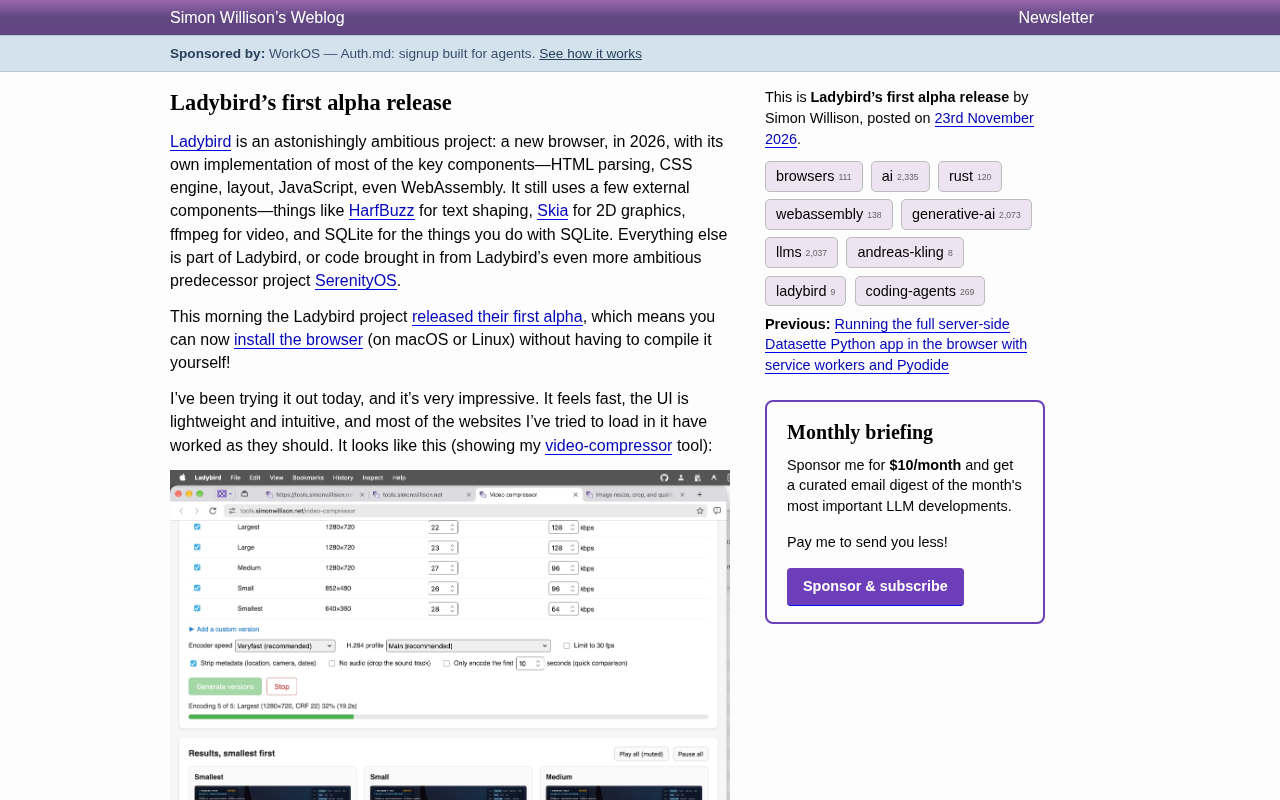
Ladybird releases its first Alpha, with its in-house engine using AI agents to boost WPT pass counts.
The Ladybird browser engine has released its first Alpha, installable directly on macOS and Linux. It implements HTML parsing, a CSS engine, layout, JavaScript, and WebAssembly almost from scratch, relying only on a few external libraries like HarfBuzz, Skia, ffmpeg, and SQLite. Simon Willison found it fast and lightweight, with most sites loading, though modern Web APIs like Service Worker remain incomplete. The project heavily uses AI coding agents such as Claude Code and Codex; October commits surged, WPT passing items rose from about 2.12 million to 2.18 million in five days, part of LibJS was ported to Rust, and the Cranelift WASM engine was adopted. The team makes no security promises in the Alpha stage and advises against logging into sensitive accounts.
An Ambitious Browser Project Takes a Key Step Forward
In 2026, a brand-new browser engine is quietly rising. The Ladybird project has just released its first Alpha version, and macOS and Linux users can now download and install it directly without compiling it themselves. The project's ambition is striking: it has implemented core components almost from scratch—HTML parsing, a CSS engine, layout, JavaScript, and even WebAssembly—keeping only a handful of external dependencies such as HarfBuzz for text shaping, Skia for 2D graphics, ffmpeg for video decoding, and SQLite. The rest of the code either belongs to Ladybird itself or is inherited from its more ambitious predecessor project, SerenityOS.
Well-known developer Simon Willison called it "impressive" after trying it out—the browser feels fast, the interface is lightweight and intuitive, and most websites load normally. He tested it with his own WebAssembly-based video compression tool: ffmpeg compiled to WASM ran smoothly, and the Pyodide REPL (Python compiled to WebAssembly) also worked.
SerenityOS is an open-source operating system project launched by Andreas Kling in 2018, aiming to build a Unix-like desktop system from scratch, with the core philosophy of "no external dependencies, write all the code yourself." Ladybird was originally just a browser component within SerenityOS and was later split off as the project grew. Because it inherits SerenityOS's "build everything yourself" philosophy, Ladybird has its own implementations of an HTML parser, a CSS engine, and the JavaScript engine LibJS, rather than reusing Chromium's Blink or Mozilla's Gecko like most browsers do. This approach is costly, but it also means the project is not constrained by the licensing and architectural decisions of an upstream engine and can be redesigned for modern hardware and security models.
HarfBuzz is an open-source text shaping engine responsible for converting Unicode character sequences into glyph sequences with correct positioning, handling complex typographic rules such as Arabic cursive joining, Indic syllable reordering, kerning, and ligatures; Skia is Google's open-source 2D graphics library responsible for rasterization, path drawing, and text rendering, and both Chrome and Android are built on it. Ladybird keeps these two as external dependencies because text shaping and low-level graphics rasterization are highly mature, highly standardized infrastructure where the benefits of in-house development are limited and the risks are enormous—a deliberate trade-off that contrasts with its strategy of building its own parser and layout engine.
Multi-Process Architecture and Web Compatibility: Progress and Shortcomings Side by Side
Ladybird uses an isolation mechanism with a separate process per tab, consistent with the security model of mainstream browsers (Chrome technically uses a per-site process strategy). Willison showed the process tree after opening multiple tabs: the main process, the Hub, multiple WebContent processes, RequestServer, Compositor, and others each performing their own roles.
But the Alpha version still has obvious shortcomings. When Willison tried to run Datasette Lite—an application that relies on a complex combination of Service Worker and Web Worker—he encountered an error: undefined is not a function (evaluated from 'navigator.serviceWorker.startMessages'). He filed an issue and found a corresponding FIXME comment in the source code. This shows that some modern Web APIs are not yet fully implemented, and compatibility for progressive web apps that rely on Service Workers will still take time to polish.
Service Worker is a script thread that runs in the browser background, independent of the page, acting as a network proxy that can intercept requests, enable offline caching, and support push notifications—it is the core of Progressive Web Apps (PWAs); Web Worker allows JavaScript to run on a background thread to avoid blocking the main thread. The two are often used together; for example, pure front-end applications like Datasette Lite need Service Worker to provide offline resources and request interception. The navigator.serviceWorker.startMessages in Ladybird's error belongs to the Service Worker messaging API, and its absence indicates that this module has not yet been fully implemented. For browsers, such APIs involve inter-process communication, persistent storage, and security sandboxing, making them far more complex to implement than ordinary DOM interfaces, so they are typically the last parts filled in by new engines.
web-platform-tests (WPT) is a cross-browser conformance test suite led by the W3C, containing millions of subtests covering HTML, CSS, DOM, Web API, and other specifications. All major browser vendors use its pass rate to measure standards compatibility. WPT is characterized by extremely fine-grained test items that correspond one-to-one with specification clauses, making it particularly suitable as a target list for automated fixes—which is exactly the basis for Ladybird's use of AI agents to "grind through problems" in bulk.
The "October Surge" Driven by AI Coding Agents
This year the Ladybird project has leaned heavily on AI coding agents to advance development. On February 23, 2026, Andreas Kling published "Ladybird adopts Rust, with help from AI," describing how the team used Claude Code and Codex to port part of the LibJS JavaScript engine's code from C++ to 25,000 lines of Rust in two weeks.
The GitHub contribution graph clearly shows this trend: commits were steady in the first half of 2026, began climbing in July, and peaked in late October. This "October surge" corresponds to the landing of a series of major improvements: moving style and layout to a separate thread, a new JavaScript JIT, replacing the old C++ implementation with the Cranelift WebAssembly engine for a 7x gain on the JetStream 3 WASM benchmark, and adding 75,650 newly passing subtests on the roughly 2.25 million-subtest web-platform-tests suite—surpassing Safari.
According to Ladybird's October 2026 monthly report, most of the gains were concentrated within five days—growing from about 2.12 million passing subtests on October 22 to about 2.18 million on October 27. The team pointed AI coding agents at WPT and asked them to fill in missing features, and a large number of small fixes accumulated into significant progress, with the /css directory gaining about 30,000 items and /editing about 10,000.
Cranelift is a compiler backend in the Rust ecosystem, originally developed for the Wasmtime runtime, that can quickly compile WebAssembly bytecode into machine code, emphasizing compilation speed over extreme optimization. Ladybird used it to replace its own C++ WASM interpreter/compiler implementation, achieving a 7x gain on the WASM subtest of JetStream 3, indicating that the original implementation was closer to interpreted execution than true just-in-time compilation. JetStream 3 is a browser benchmark suite maintained by the WebKit team, covering JavaScript and WebAssembly workloads, and is often used for side-by-side comparison of engine performance.
JIT (just-in-time compilation) refers to dynamically compiling JavaScript source code or bytecode into machine code at runtime, and is key to JavaScript performance in modern browsers. A newly written JIT usually first implements a baseline compiler to ensure correctness, then layers an optimizing compiler on top, so a JIT launch is often accompanied by extensive regression testing and compatibility fixes—which explains why it appeared in the same time window as the jump in WPT pass rates.
Security Considerations: Not Yet Suitable for Logging Into Sensitive Accounts
In the release announcement, Andreas Kling admitted: "This is an Alpha version. Some websites won't work, and it will crash sometimes. Please tell us when you run into problems!" He specifically called on security researchers to "hack" the browser: "New browsers get compromised repeatedly—that's part of the process. We make no security promises today. When you compromise us, please tell us how you did it so we can harden Ladybird!"
Willison agrees. Given the extreme difficulty of browser security hardening and the complexity of the adversarial environment, he won't use Ladybird to log into sensitive accounts such as GitHub or Gmail, but he will keep it for anonymous browsing—both to participate in testing and because he is happy to see a promising new entrant in a browser engine market that has been stagnant for so long.
Open Questions Worth Watching
Willison raised an interesting question: which models were actually used for the leap in the last week of October? It is known that Andreas uses Codex and Claude Code, but the specific model versions have not been disclosed. Claude Opus 5.5 was released on September 22, 2026, while Claude Fable 5.2 was released on November 9 (after that window). This timeline leaves the exact tool combination behind the October surge an open question.
For developers and technology enthusiasts, Ladybird's Alpha release is a signal worth watching: the browser engine field, long dominated by a few giants, is seeing new possibilities emerge driven by AI-assisted development.
One-line Summary
Ladybird releases its first Alpha, with its in-house engine leveraging AI agents to achieve a jump in WPT pass counts.
Paragraph Summary
Ladybird browser engine has released its first Alpha version, available for direct installation by macOS and Linux users. The project implements core components such as HTML parsing, CSS engine, layout, JavaScript, and WebAssembly almost from scratch, depending only on a few external libraries like HarfBuzz, Skia, ffmpeg, and SQLite. Simon Willison called it fast and lightweight after trying it, with most websites loading normally, though modern Web APIs such as Service Worker are not yet complete. The project has leaned heavily on AI coding agents like Claude Code and Codex, with commits surging in October, WPT passing items rising from about 2.12 million to 2.18 million in five days, part of LibJS ported to Rust, and the Cranelift WASM engine swapped in. The team explicitly states it makes no security promises during the Alpha stage and recommends against logging into sensitive accounts for now.
Related articles
The New AI Testing Frontier: Deploying Tencent's Open-Source Knowledge Base and Hands-On RAG Evaluation
Starting from AI testing's evaluation challenge, this article covers deploying Tencent's open-source WeKnora, comparing production vs. learning setups, and explaining RAG evaluation principles and hands-on paths.

Why Learn Python in the AI Era? A Deep Dive with the Author of 'Python Crash Course'
Eric Matthes, author of 'Python Crash Course', discusses why Python remains essential in the AI era, the democratization and risks of AI coding tools, and the value of human creators.

Convex Skill Allegedly Uploads User App Ideas to Remote Servers Without Consent
Convex backend skill allegedly sends user app ideas to remote servers without disclosure, sparking Hacker News debate. We analyze the privacy risks and transparency issues.