Laid-Off CS Grad to ML/AI Engineer: A Realistic Breakdown of Your Options

A laid-off CS grad's decision paralysis, unpacked: AI master's vs. job hunting vs. moving abroad.
A 26-year-old Spanish CS graduate, laid off and overwhelmed, is simultaneously weighing AI master's programs, a scattered job search, and long-term relocation plans. This article breaks down each path: theory-heavy AI master's programs rarely convert directly into ML jobs; OMSCS is valuable but won't unlock overseas opportunities automatically; and moving abroad is a 2027+ goal that shouldn't consume today's energy. The near-term priority is simple — land a job, use the free bootcamp and scholarship already available, and build a project portfolio that demonstrates AI skills. The problem was never a lack of options. It's trying to pursue all of them at once.
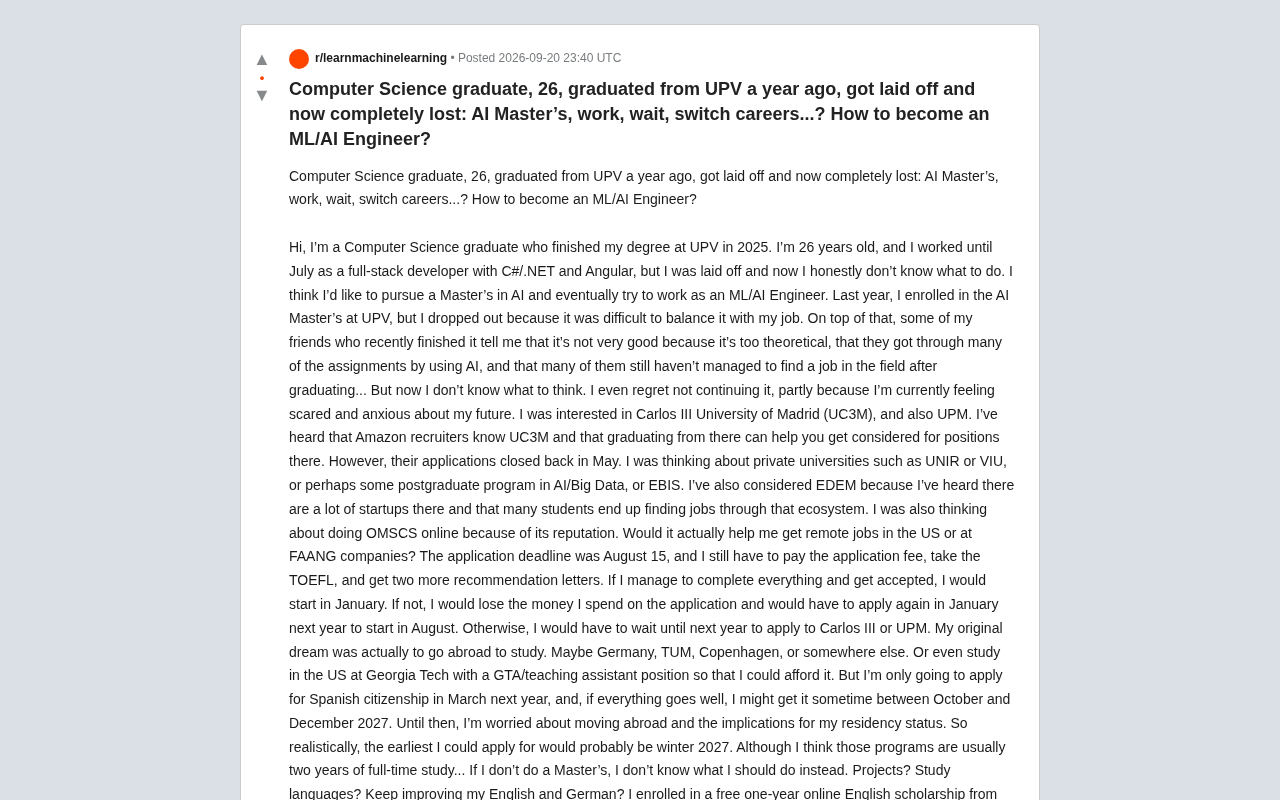
A 26-year-old computer science graduate from Universitat Politècnica de València (UPV) posted a candid, anxiety-ridden plea for help on Reddit. He'd worked as a full-stack developer in C#/.NET and Angular, got laid off in July, and found himself paralyzed: Should he pursue an AI master's degree? Keep job hunting? Pivot to something else entirely? His confusion is a near-perfect snapshot of what many young tech professionals are going through as the AI wave reshapes the industry.
This article isn't here to offer empty encouragement. Instead, it breaks down the realistic paths available given his specific situation — identifying which choices represent genuine investment and which are just anxiety-driven noise.
The Root of the Anxiety: Too Many Options, Not Too Few
His core problem isn't a lack of opportunity — it's grabbing at too many directions at once: UC3M, UPM, UNIR, VIU, EBIS, EDEM, OMSCS, TUM, Copenhagen, Georgia Tech… plus a scattershot job search spanning backend, frontend, full-stack, AI, and embedded roles, all layered on top of a future plan to move to Germany and apply for Spanish citizenship.
Information overload is its own form of paralysis. When someone is simultaneously weighing "go back to school," "find a job," "move abroad," and "change careers," the brain stalls because it can't prioritize. He admitted as much himself: "my head is completely overloaded and confused."
What's worth noting is that his actual goals are quite clear: an €80K–€100K salary, overseas or remote work, and career stability. These three benchmarks can serve as a filter for every decision that follows. Any option should answer one question: Does this get me to that destination faster and more reliably?
Is an AI Master's Degree Actually Worth It?
He enrolled in UPV's AI master's program last year but dropped out because it was hard to balance with work. More telling is the feedback from friends who actually completed the program: the coursework was too theoretical, assignments were largely gamed with AI tools, and many graduates still couldn't land jobs in the AI field.
This firsthand information is genuinely valuable — but it's easy to overlook when anxiety is driving the wheel. It reveals a harsh truth: a theory-heavy master's program with weak employment outcomes doesn't automatically convert into an ML/AI engineering role. A diploma is not a pass, especially as the supply of AI-credentialed candidates continues to balloon.
If he's going to pursue a master's, the selection criteria need to shift: Does the program have strong industry ties? Does it offer internship or exchange opportunities? Where do alumni actually end up working? By that measure, the programs he mentioned — EDEM (strong startup ecosystem, students often find jobs through that network) and UC3M (reportedly recognized by Amazon recruiters) — are better fits for his career-oriented goals than any purely academic option.
On OMSCS
Georgia Tech's online master's program, OMSCS, made his list for its reputation and low cost. It's genuinely one of the best value programs available — but two things need to be understood clearly. First, it primarily enhances your knowledge base and résumé signal; it does not automatically unlock U.S. remote jobs or FAANG opportunities. Second, the visa and residency barriers to getting hired remotely by U.S. companies as a non-resident are very real. OMSCS is a solid long-term investment you can pursue while working — not a short-term rescue plan.
What is OMSCS? Georgia Tech's Online Master of Science in Computer Science is one of the earliest and largest online CS master's programs offered by a top-tier university. Tuition runs roughly $7,000–$10,000 total — a fraction of traditional on-campus programs. The curriculum is identical to the on-campus version, and the degree certificate makes no mention of "online," which gives it some résumé weight. Specializations include Machine Learning, Computing Systems, and Interactive Intelligence, and most students complete it in 2–4 years part-time. That said, as admissions have expanded significantly in recent years, the program's signaling value in the industry has gradually diluted. For non-U.S. residents, holding this degree confers no visa advantages, and U.S. employers face real tax and compliance costs when hiring internationally — so real-world job outcomes vary considerably.
Moving Abroad: The Timeline Means It's Not an Urgent Priority
He dreams of attending TUM in Germany, studying in Copenhagen, or making it to Georgia Tech in the U.S. (funded by a TA position). But he's already done the math himself: Spanish citizenship won't come through until October–December 2027 at the earliest, and cross-border residency complications before then make him nervous. That means the realistic earliest application window is winter 2027.
This means moving abroad is a medium-term goal 2–3 years out, not something to stress about right now. Mixing a goal that can't even begin for years with an urgent task like "find a job before November" only amplifies pressure unnecessarily. The right move is to mentally "park" the relocation plan, do only the necessary groundwork in the meantime (keep improving English and German, build a transferable project portfolio), and stop letting it consume decision-making energy today.
The Immediate Priority: Stop the Bleeding, Then Plan
Once you cut through the noise, his near-term priorities are actually pretty clear:
First, land a job. He already has several interviews in progress and some positive responses. When you've just been laid off, restoring income and professional continuity matters far more than agonizing over which master's program to choose. A backend or full-stack role doesn't just solve cash flow — it also preserves the time and stability he needs to build AI experience on the side.
Second, fully use the free resources already in hand. He has a one-year free online English scholarship from Santander Bank, plus a data science and AI bootcamp designed for unemployed workers. These are zero-cost skill-building opportunities — no need to debate whether to invest. Just use them.
Third, demonstrate AI capability through projects, not diplomas. For anyone trying to transition into ML/AI engineering, a portfolio that shows end-to-end skills — data processing, model training, production deployment — is often more convincing to hiring managers than a theory-heavy master's degree. He loves building things and has solid frontend skills. There's every reason to combine that with AI capabilities and ship something worth showing.
Should He Switch Careers Entirely?
He's even entertained the idea of pivoting to civil engineering or dentistry. That reads more like an anxiety-fueled escape fantasy than a rational decision. He already has a CS degree, real development experience, and multiple free learning channels available. The opportunity cost of starting from scratch is enormous. Yes, AI is compressing demand for certain frontend roles — but the answer is to lean into AI and expand your skill set, not flee the entire tech industry.
On AI's impact on frontend development: The disruption plays out on two levels. First, AI coding tools like Copilot and Cursor have dramatically increased individual developer productivity, which means companies need fewer junior and mid-level frontend engineers on the margin. Second, low-complexity tasks — UI component generation, style tweaks — are increasingly handled directly by AI tools, squeezing the entry-level space further. But this doesn't mean frontend engineers are obsolete. Those who can combine AI tools with complex interaction design, performance optimization, and integrating AI capabilities into product interfaces are actually more in demand than ever. For developers with a frontend foundation, the lowest-cost path forward is evolving toward "AI product engineer" — someone who can call LLM APIs and build AI-powered user interfaces. That reuses existing skills more efficiently than any from-scratch career change.
Takeaways for Anyone Else Feeling Lost
This poster's situation has broad relevance for tech workers feeling unsettled by the AI shift:
- Separate urgent from important: Finding a job is urgent. Moving abroad is important but not urgent. Don't let the latter hijack the former.
- Degrees ≠ employment: A theory-heavy master's with weak industry connections and poor placement data offers limited returns.
- Max out free, low-risk resources first: Scholarships, bootcamps, and online courses are low-cost ways to experiment and build skills.
- Show your work: In AI, a demonstrable project portfolio often speaks louder than a certificate.
- Comparing yourself to friends' salaries only deepens anxiety: He admitted he doesn't even know whether his friends' choices actually worked out.
The real problem was never a shortage of paths. It's trying to walk ten of them at the same time. Get stable first. Then pick a direction.
Related articles

"Black October": Did AI Uncover 3% of All Critical Vulnerabilities Ever?
A Reddit post claims 3% of all critical software vulnerabilities ever were found in the past month, dubbed 'Black October.' We break down the statistical issues, how AI-assisted code auditing accelerates discovery, and how developers should respond.

Microsoft Project Gecko: Using AI to Bridge Language Gaps for African Farmers
Microsoft's Project Gecko launches PharmaChat, letting African farmers ask questions in their native language and get precise video clips and farming book chapters via AI. The project also releases three interactive manuals to advance inclusive AI.

Musk's Space Dominance: How Starlink Throttling Undermines Ukraine's Defense
SpaceX's Starshield throttling disabled Ukraine's high-speed interceptor drones, exposing how Musk's private control over low Earth orbit communications affects battlefield dynamics and national security, and highlighting the risks of commercial space militarization and space governance dilemmas.