Lakebase Postgres Branch-Based Restores: A New Approach to Fast Recovery for Large-Scale OLTP

Lakebase Postgres replaces full physical copies with metadata-level branching to make large-scale OLTP recovery nearly instant.
Managed OLTP database recovery has long relied on full backups plus log replay, with recovery time growing linearly or worse as data scales. Lakebase Postgres introduces branch-based restores, drawing on zero-copy cloning and time travel concepts from the Lakehouse world. By using a copy-on-write storage layer, creating a recovery branch is essentially a metadata operation — no physical data movement required — so recovery response time can remain low and constant regardless of dataset size. This approach could break the tight coupling between recovery cost and data scale, making fast rollbacks and production data validation cheap, and reducing the risk of schema changes and bulk migrations. Specific implementation details and benchmarks are still pending fuller technical disclosure.
The Long-Standing Problem with Managed OLTP Database Recovery
Data recovery has always been a headache in managed OLTP (Online Transaction Processing) database operations. The core pain point is straightforward: restores are slow, and they get slower as data grows.
There's a technical reason this happens. Traditional database recovery typically relies on full backups combined with incremental log replay. As datasets scale from gigabytes to terabytes or even petabytes, the amount of data that must be read, copied, and replayed grows linearly — or worse. For production systems that require high availability, lengthy recovery windows mean longer service disruptions and a direct impact on achieving Service Level Objectives (SLOs).
The Design Philosophy Behind Branch-Based Restores
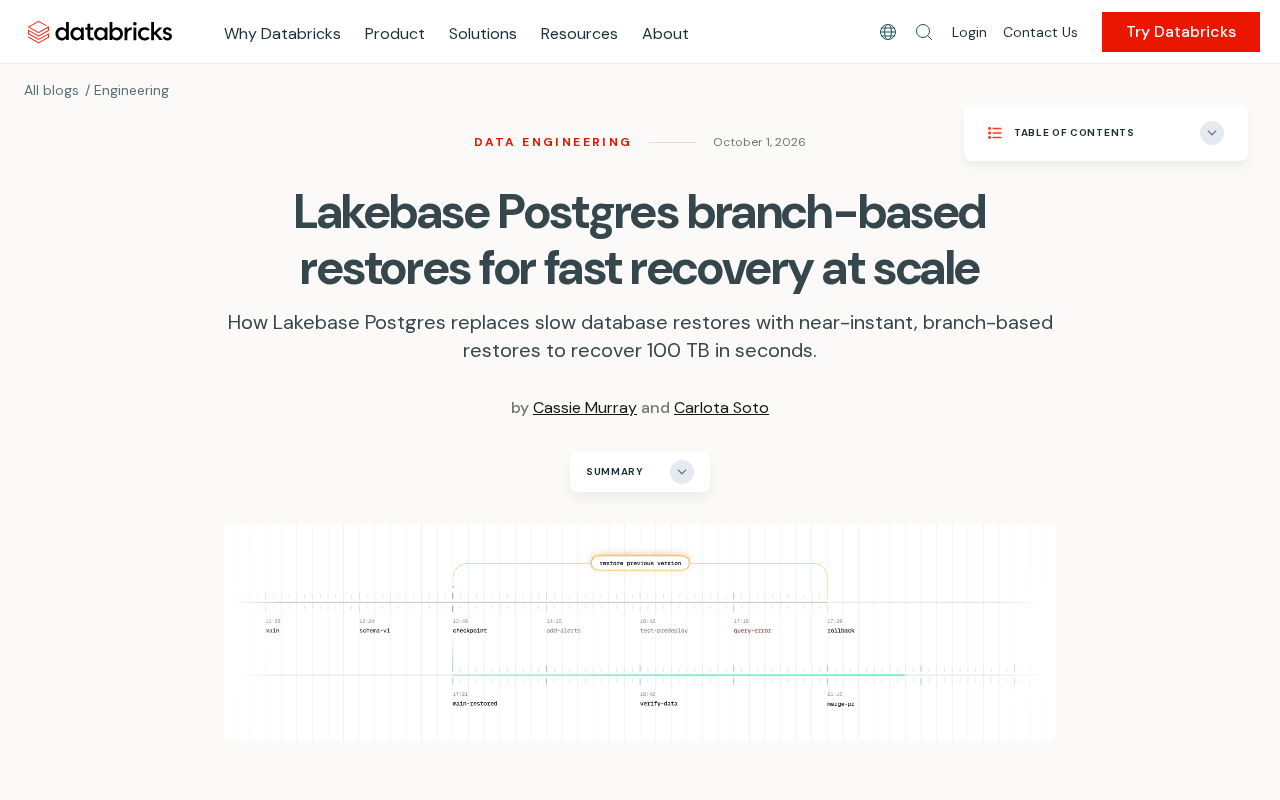
Lakebase Postgres introduces "branch-based restores" — a concept borrowed from version control systems. The key insight is this: instead of treating recovery as a heavyweight full-data rollback, the system achieves near-instant recovery by creating logical branches of the data.
Under this architecture, the storage layer typically employs copy-on-write (CoW) or similar mechanisms. When restoring to a historical state, the system doesn't need to physically copy all the data. Instead, it creates a new branch pointing to a snapshot at a specific point in time. Applications can immediately connect to this branch and resume operations, while the actual materialization of underlying data happens on-demand, in the background.
This aligns closely with concepts that have become popular in the Lakehouse world in recent years — "zero-copy cloning" and "time travel." Lakebase brings these cloud-native storage capabilities into Postgres, one of the most widely used relational databases, so that OLTP workloads can finally benefit from fast recovery.
Copy-on-Write (CoW) is the core mechanism behind branch-based restores. In a CoW model, the system doesn't immediately modify the original data block on a write. Instead, it copies the block first and writes new content to the copy, leaving the original intact. This means historical data blocks always exist in the storage layer and can be referenced without any additional backup. When creating a branch, the system only needs to record in the metadata layer "which set of data blocks at which point in time this branch starts from" — actual data blocks are shared on demand, and physical copying only happens when new writes occur. This mechanism is widely used in file systems (like ZFS snapshots), container images (Docker's layered filesystem), and cloud object storage. Lakebase's application of this to Postgres essentially replaces the storage engine with a cloud-native storage backend that supports CoW semantics.
Why "At Scale" Is the Key Phrase
The phrase "at scale" in the title deserves special attention. The fatal flaw of traditional recovery solutions is that their cost grows with data volume — recovery time is strongly correlated with dataset size. Branch-based restores aim to break this coupling.
Since creating a branch is fundamentally a metadata-level operation rather than a physical data movement, the time required to create a recovery branch can theoretically remain low and relatively constant, regardless of how large the underlying dataset is. This is hugely significant for large production systems running massive datasets: developers can quickly roll back to the state before an incident occurred, and testing teams can instantly spin up a copy of production data for validation — without waiting hours.
Traditional Postgres PITR (Point-in-Time Recovery) provides a useful point of comparison. It relies on a base backup plus WAL (Write-Ahead Log) archiving. During recovery, the system must first restore the full base backup, then serially replay all WAL logs from the backup point to the target time. On a terabyte-scale database, just restoring the base backup can take tens of minutes to hours, and the WAL replay phase is equally constrained by I/O and CPU throughput. This is precisely why traditional recovery time is strongly tied to both dataset size and the amount of accumulated WAL — branch-based restores sidestep both bottlenecks, reducing the complexity of recovery from O(data size) to something approaching O(1) metadata writes.
Potential Impact on Database Operations
If branch-based restores mature into a production-ready capability, they could fundamentally change how teams perceive the risk of database operations. When recovery becomes cheap and fast, the cost of experimentation drops significantly for operations that traditionally required extra caution — schema migrations, bulk data transformations, canary experiments.
That said, it's worth maintaining a realistic perspective. Public information about Lakebase remains limited at this stage. Key technical questions — such as the specifics of the implementation, performance benchmarks, consistency guarantees for branches, and compatibility with the existing Postgres ecosystem — have yet to be disclosed in detail. A comprehensive evaluation of its real-world value will require more complete technical documentation and feedback from actual production deployments.
The database community refers to this class of capabilities as "sandboxed operations" or "reversible changes." In traditional environments without fast recovery guarantees, DBAs typically must perform DDL changes (such as
ALTER TABLE) or large bulkUPDATEoperations within maintenance windows, with detailed rollback scripts prepared in advance. When branch creation is nearly zero-cost, teams can first validate a change on an instant branch of production data, confirm it works correctly, and then apply it to the main branch — much like a Pull Request in a code review workflow. This approach has already been practiced by products like Neon (another cloud-native Postgres provider). Lakebase is heading in the same direction, signaling that database operations are evolving toward a "GitOps"-style paradigm of auditability and reversibility.
Summary
Lakebase Postgres's branch-based restores represent a shift in database recovery thinking — from physical copying to logical branching — aimed at solving the long-standing pain point of slow recovery in large-scale managed OLTP scenarios. By bringing snapshot and cloning capabilities from the data lake world into relational databases, it offers a new technical path toward fast recovery and low-cost experimentation. For teams managing large production databases, this is a direction well worth watching closely.
Related articles

macOS Is No Longer UNIX: Apple Didn't Renew Certification, But the Technology Is Unchanged
Apple did not renew macOS's UNIX certification, and the Open Group has removed Apple's entry. This article analyzes the technical reality behind the expiration, Apple's possible intentions, and the practical impact on developers.

Building Stateful Multi-Agent Systems with Azure Cosmos DB
Based on the official Azure Cosmos DB tutorial, this article explains how to use the Agent Memory Toolkit to add shared persistent memory to a multi-agent travel planner, covering short-term, long-term, episodic, and semantic memory plus cross-session state continuity.

Production AI Agent Operations: A Three-Step Framework for Observing, Evaluating, and Optimizing
Azure Cosmos DB team proposes a three-step framework for production AI Agent operations: observe trace tracking, evaluate with LLM as a judge and regression testing, optimize cost across RU, retrieval, memory, and LLM layers.