Landing an Agent Dev Offer in Three Months: A Real-World Learning Roadmap
A 3-month Agent dev roadmap: from LLM fundamentals to RAG, LangChain, and real project deployment.
This article adapts a Bilibili creator's AI Agent learning roadmap built around one principle: reject shortcuts. Month one focuses on LLM reasoning, tokens, tool calling, and Chain-of-Thought. Month two covers engineering-grade Prompt management, the full RAG pipeline, and Agent architectures like ReAct. Month three ties it all together with 2–3 real-world projects deployed end-to-end. The key insight: what blocks most people isn't the knowledge — it's waiting for certainty instead of writing code.
A lot of people learning AI look like this: grinding through a couple of prompt engineering lessons today, messing around with context tomorrow — touching everything on the surface, mastering nothing underneath. Those "get started in 3 days, interview-ready in 5" headlines are clickbait. Don't actually follow them. For the average person who wants to break into the AI industry and land a real Agent development role at a decent company, there's no substitute for three solid months of focused work.
This article is based on a learning roadmap shared by a Bilibili content creator. The core philosophy is simple: reject the illusion of shortcuts, and walk the full path from foundational theory to production deployment using an engineering mindset.
First, Be Honest About the Time Commitment
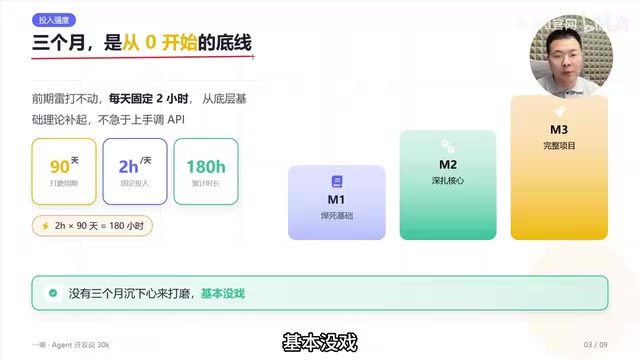
The early phase requires ironclad consistency — two hours every day, starting from the ground up with core theory, resisting the urge to jump straight into API calls. This commitment threshold is precisely why most people quit halfway. The roadmap's author keeps hammering the same point: whether you finish has nothing to do with how smart you are. It comes down to whether you're willing to actually write code.
There's one trap worth calling out: many people assume that learning a specific technology maps directly to a specific salary tier. They'd rather believe the "3-day speed run" myth than write a single line of code themselves. The thing that blocks 90% of people isn't the knowledge itself — it's the mindset of waiting for a guaranteed answer before taking action.
Month One: Build Real Understanding of the Fundamentals
The goal of the first phase is to fill in the prerequisite knowledge gaps. Many people still can't clearly explain the difference between an LLM and an Agent when they sit down for an interview. This phase is about genuinely internalizing the foundational concepts.
Core questions to work through: What is the reasoning logic behind large language models? How do you think about tokens and context windows? How does Tool Calling actually work under the hood? How are Chain-of-Thought and planning capabilities designed? At the same time, fill in any gaps in Python fundamentals and commonly used libraries.
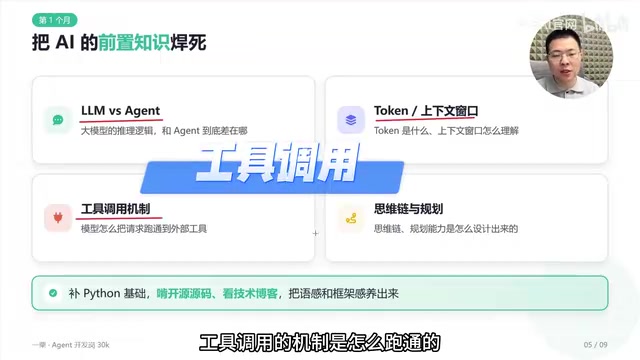
The key activity during this phase is reading source code from open-source Agent projects, technical blogs, and industry reports — building intuition for the concepts and a mental framework for the space. How solid your conceptual foundation is here directly determines how far you'll get in the following two months.
The core difference between LLMs and Agents deserves its own explanation. A large language model (LLM) is fundamentally a text-in, text-out prediction system — it completes a task in a single interaction with no persistent state. An Agent is a system built on top of an LLM that can perceive its environment, form plans, call external tools, execute multi-step actions, and iterate based on feedback. Simply put: the LLM is the "brain," the Agent is the "person who can actually act."
Understanding tokens and context windows is equally critical. A token is the basic unit a model uses to process text (roughly half a Chinese character to one English word), and the context window determines how much the model can "remember" within a single conversation. Mainstream models like GPT-4 have seen context windows expand from 8K to 128K tokens and beyond — this directly caps how well an Agent can handle long documents and multi-turn conversations. Understanding these two concepts is the cognitive prerequisite for later designing RAG retrieval strategies and multi-turn memory modules.
Month Two: Develop the Core Agent Engineering Skills
Month two opens two parallel tracks: the principles of Prompt engineering, and Agent architecture design.
There's an important dividing line here that's easy to overlook — an engineering role can't stop at "write a good prompt." You need to manage prompts in an engineering-grade way: templating, version control, and fallback handling for edge cases. This is the critical leap from "can use an LLM" to "can build a product."
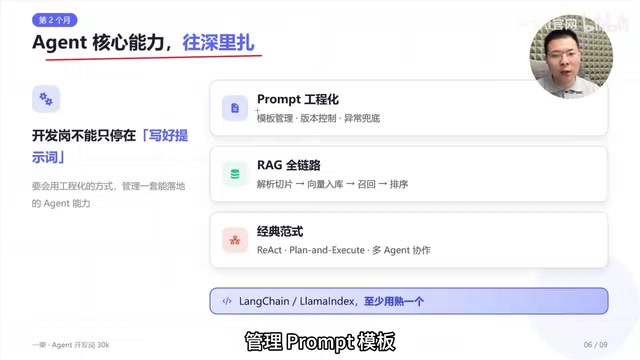
The second track is mastering the full RAG pipeline: how documents are parsed and chunked, how vectors are stored and retrieved, how retrieval strategies are tuned and results are reranked. On the tooling side, get comfortable with at least one framework like LangChain or LlamaIndex.
On architecture patterns, work through ReAct, Plan-and-Execute, and multi-Agent collaboration. The goal isn't to memorize definitions — it's to understand which architecture fits which scenario and where the failure modes are.
RAG (Retrieval-Augmented Generation) is the most common knowledge injection approach in Agent systems today and deserves a closer look. The core pipeline has three steps. First, indexing: split external documents into chunks, convert each chunk into a vector using an embedding model, and store them in a vector database (e.g., Chroma, Pinecone, Milvus). Second, retrieval: when a user asks a question, convert it to a vector and use similarity search to surface the most relevant document chunks. Third, generation: combine the retrieved content with the user's question into a prompt and let the LLM answer based on that context. The hard part of RAG isn't understanding the flow — it's the tuning details: chunk size, number of retrieved results, reranking strategies, and hybrid retrieval (vector + keyword) all significantly affect final answer quality.
The ReAct architecture is another core concept — it has the model alternate between outputting "Reasoning" and "Acting," feeding the tool's return value back into the model after each action, creating a think-act-observe loop. This enables Agents to handle complex tasks that require multiple sequential tool calls.
Month Three: Tie Everything Together With a Real Project
This is the most important step: build a complete Agent project that integrates everything from the previous two months.
The approach is to pick a real-world use case and build two to three working prototypes. Start with breaking down requirements, move through technology selection and core module development, then wrap it with an API and deploy it locally. Get an Agent running end-to-end from scratch.
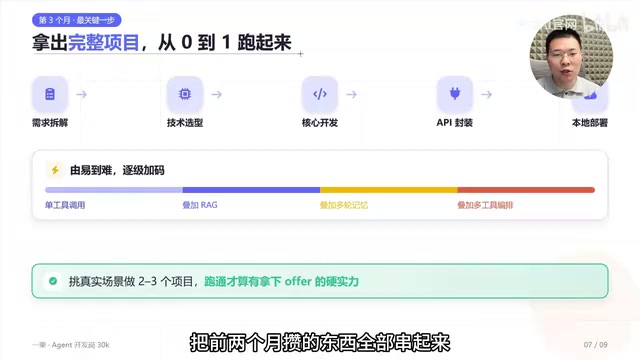
The progression within this phase matters too: start with a simple single-tool Agent, then incrementally add RAG, multi-turn memory, and multi-tool orchestration. This step-by-step approach keeps you out of the debugging swamp that comes from building a complex system all at once. When you've made it here, you've genuinely built the hard skills needed to land an Agent development offer.
What This Roadmap Gets Right — and Where It Falls Short
The greatest value of this roadmap is its anti-shortcut stance. It doesn't promise a fast track — instead, it breaks learning into three clear phases (theory, capability, projects), each with concrete output goals. For self-learners, that structure alone serves as an anchor against anxiety.
To be fair, as a high-level overview, this roadmap provides signposts rather than step-by-step tutorials. Actual execution still requires a huge amount of independent documentation reading, source code study, and iterative debugging. Whether three months is enough depends heavily on the learner's execution and prior background.
But the direction is right. In an increasingly competitive AI job market, building skills through an engineering mindset — rather than accumulating disconnected fragments — is what creates the real gap between candidates.
Related articles
Automattic Executives Signed Reciprocal Severance Agreements During Mullenweg's Brief Ouster
Automattic's CFO and General Counsel signed reciprocal severance agreements during Matt Mullenweg's brief ouster, covering one year's salary and accelerated equity vesting, raising corporate governance concerns.
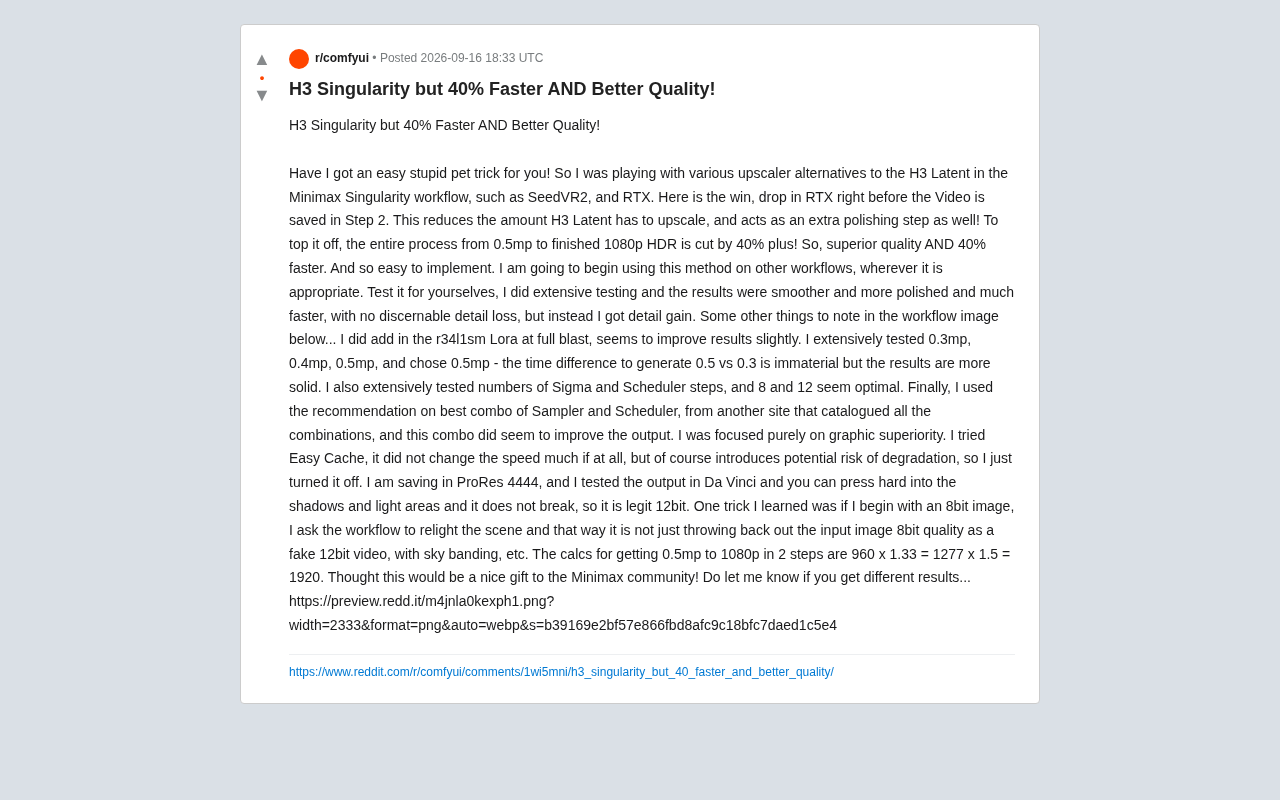
H3 Singularity Optimization: 40% Speed Boost With Better Image Quality
A Reddit user's Minimax Singularity workflow tip: insert an RTX upsampler before H3 Latent for 40%+ speed gains and better quality. Covers parameters, 12-bit output, and more.
Glyph: A Multi-Strategy Agent System for Automated Enterprise Data Catalog Annotation
Glyph is a multi-strategy LLM agent system for enterprise data catalogs that automates column description generation and sensitivity ontology tagging, grounding outputs in pipeline source code to improve accuracy.