LangChain 1.3 in Practice: A Complete Learning Path from LLMs to Agent Development
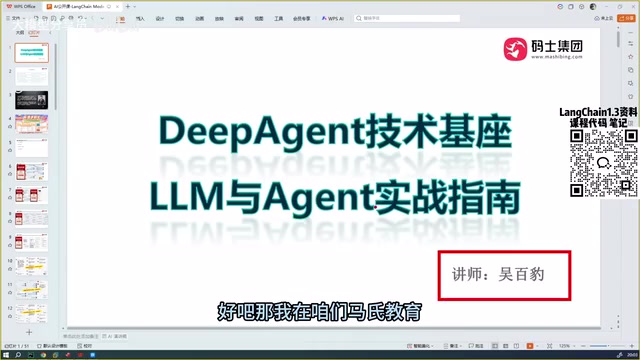
A structured LangChain 1.3 learning path covering 8 core modules from LLMs to production-ready Agent development.
This article provides a systematic walkthrough of LangChain 1.3, covering eight core modules from LLM integration to Agent construction, memory management, human-in-the-loop, and safety guardrails. It explains the Harness architecture philosophy, the LangGraph-based execution model, and why staying on v1.3 matters for production-grade development.
Why LangChain 1.3 Deserves Your Attention
If you're learning AI application development or preparing for related job interviews, you've probably noticed that the vast majority of LangChain tutorials online are stuck on version 0.x or even older. While freely available, these resources are outdated — the API has changed significantly, and what you learn from them may be completely disconnected from real production environments.
LangChain is an open-source framework released in 2022 by Harrison Chase, originally conceived as a "glue layer" connecting large language models (LLMs) with external data sources and tools. As powerful models like GPT-4 became mainstream, LangChain quickly rose to become one of the most popular frameworks in AI application development, at one point surpassing 90,000 GitHub stars. However, its rapid early iteration brought pain points like API instability and lagging documentation. The release of version 1.x marked the framework's official transition from an "experimental tool" to "production-grade infrastructure."
This article is based on the latest LangChain 1.3 and systematically maps out the core path from Models to Agent development, helping readers build a complete understanding of the modern Agent development framework.
One important note: versions prior to 1.0 (0.2, 0.6, 0.8, etc.) are no longer recommended for deep study. The framework underwent significant architectural and API redesigns in 1.x, and learning older versions not only yields diminishing returns — it can also instill incorrect mental models.
The Harness Architecture: The Foundational Thinking Behind Agent Development
Before diving into specific code, one concept is worth understanding first — Harness architecture. This term has been appearing frequently in job postings recently. It's not a specific library; it's an architectural philosophy.
The word "harness" comes from engineering, originally meaning a wiring harness or control system, and in software architecture it extends to mean "a unified governance framework for complex systems." In the AI Agent space, Harness architecture emerged in response to a core challenge: a standalone LLM call cannot handle complex multi-step tasks — you must introduce tool invocation, state tracking, memory management, and more. This thinking closely aligns with Microsoft's AutoGen, OpenAI's Assistants API, and similar designs, and represents the industry's mainstream answer to "how do you wrap an LLM into a reliable system."
What Dimensions Does Harness Architecture Cover?
Harness architecture is essentially a complete system for managing the runtime of a large language model, typically covering these dimensions:
- Context management: How to maintain and pass conversation and task context
- Tool management: How to register, schedule, and execute external tools
- State management: How to track various states throughout execution
- Context compression: How to trim context during long tasks to control cost and performance
- Prompt engineering: How to structure system prompts to guide model behavior
In short, the core problem Harness architecture solves is: how to wrap a large model into a system capable of autonomously executing complex tasks.
Deep Agent: One Implementation of the Harness Philosophy
Within the LangChain ecosystem, Deep Agent is a highly abstracted implementation of the Harness architecture. It doesn't come out of nowhere — it's built on two foundations: Models and Agent. And at the core of Agent lies LangGraph — the ability to orchestrate execution flows using a graph structure.
LangGraph is a standalone sub-library launched by the LangChain team in 2024. Its core idea draws from directed acyclic graphs (DAGs) and state machine theory in computer science. Traditional chain-based calls can only handle linear flows, but real-world Agent tasks often require conditional branching, retry loops, and parallel execution. LangGraph elegantly expresses complex multi-step workflows by abstracting execution flows into a graph structure of "Nodes" and "Edges." This design borrows from workflow orchestration systems like Apache Airflow, with targeted optimizations for LLM scenarios.
This gives us a clear technical dependency chain:
Models (LLMs)
   ↓
Agent (powered by Graph structure underneath)
   ↓
LangGraph (graph orchestration capability)
   ↓
Deep Agent (Harness architecture encapsulation)
Understanding this chain explains exactly why you need to have a solid grasp of Models and Agent before diving into Deep Agent.
Version Selection: Why You Should Stay Current
When learning a framework, version choice often determines how long your knowledge stays relevant. LangChain has already iterated to version 1.3.x, yet a large portion of online tutorials still cover the 0.x era.
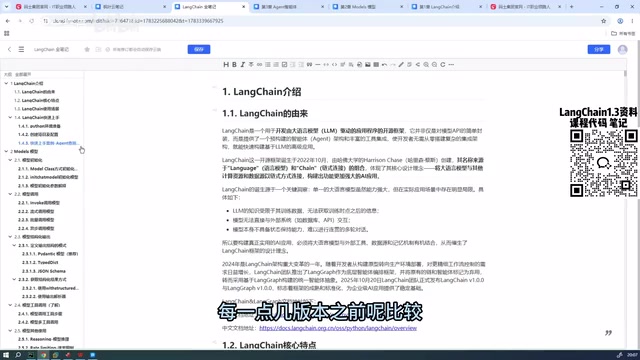
The problems caused by version gaps are very real: API naming conventions, module structures, and Agent construction patterns all went through significant refactoring in 1.x. Learning from old versions is essentially learning an interface set that's heading toward obsolescence. For developers hoping to work in production environments or pass technical interviews, sticking to version 1.3 is the safer bet.
Interestingly, LangChain maintains a fairly fast release cadence — the gap between 1.2 and 1.3 was quite short. This is a reminder to learners: rather than trying to exhaustively learn one fixed version, it's better to build a deep understanding of the framework's design philosophy, so you can adapt quickly when versions change.
The Complete Learning Path: Eight Core Modules
Systematic study of LangChain 1.3 is typically organized in a progression from foundational to advanced. The core content currently takes shape across eight main areas:
1. Framework Introduction
Understanding LangChain's applicable scenarios, core features, and how to configure your development environment. This is the first step for any newcomer.
2. Models (LLM Integration)
Learning how to integrate and invoke various large models within LangChain, and understanding the abstraction design of the model layer. LangChain provides a unified interface specification at this layer, allowing developers to call models from different providers — OpenAI, Anthropic, Google, and others — using the same code structure, significantly reducing migration costs when switching between models.
3. Agent Construction
A deep dive into the construction, scheduling, and execution mechanisms of Agents — the core module of the entire system. Modern Agent implementations are typically based on the ReAct (Reasoning + Acting) framework, enabling models to complete complex tasks through a "Think → Act → Observe" loop.
4. Short-Term Memory
Handling contextual memory within a single session or task cycle, keeping the Agent coherent throughout a single task. The technical challenge of short-term memory lies in efficiently organizing information within a limited context window, avoiding performance degradation and cost spikes caused by excessively long content.
5. Long-Term Memory
Implementing persistent memory across sessions, giving the Agent the ability to "remember" historical interactions. Long-term memory typically relies on vector databases (such as Pinecone, Chroma, or Weaviate) to encode historical information as vector embeddings, which can be retrieved via semantic similarity when needed — a concrete application of RAG technology in Agent scenarios.
6. Human-in-the-Loop (HITL)
This is a high-frequency topic in technical interviews. It involves introducing human review and intervention mechanisms into the Agent's execution flow, including different types of collaboration and specific implementation approaches.
Human-in-the-loop is not a new concept in AI — it was first widely adopted in machine learning annotation pipelines and reinforcement learning from human feedback (RLHF). In Agent development, the meaning of HITL has expanded: it's no longer just a data annotation mechanism during training, but a real-time intervention capability at runtime. When an Agent pauses before executing a high-risk operation (such as sending an email, calling a payment API, or deleting data) to request human confirmation, HITL becomes a critical safety line. Both OpenAI's official best practices documentation and Anthropic's Agent safety guidelines list HITL as a must-have capability for production-grade Agents.
7. Safety Guardrails
How to set safety boundaries for an Agent to prevent out-of-bounds outputs or risky behaviors. Guardrails typically include three layers: input filtering (blocking malicious prompt injection), output auditing (detecting harmful content), and behavioral constraints (restricting the scope of executable operations). These are standard capabilities for enterprise-level Agent deployments.
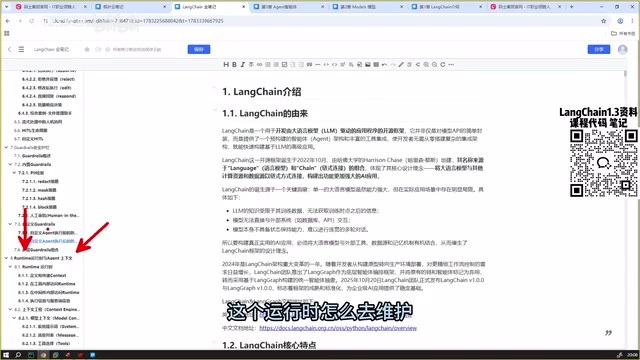
8. Context Runtime Management
How to maintain and manage the Agent's context at runtime — a critical engineering capability for ensuring stable Agent operation.
Advanced Directions and Extended Learning
Beyond the eight core modules above, a complete knowledge base extends into several more cutting-edge areas:
- MCP (Model Context Protocol): An open protocol standard launched by Anthropic in late 2024, designed to unify interface specifications between AI models and external tools and data sources — often described as the "USB standard" for AI, and a major milestone in standardizing tool integration
- RAG / Retrieval: Retrieval-Augmented Generation was proposed by Meta AI in 2020. By retrieving relevant documents from an external knowledge base before generating an answer, it overcomes the limitations of LLMs' knowledge cutoff dates and significantly reduces hallucinations — the core technical foundation for knowledge-augmented Agents today
- LangGraph system content: A deep dive into the workflow mechanisms of graph orchestration
LangGraph is particularly important here. While the workflow portion of LangGraph may see relatively less use in day-to-day Deep Agent usage, it is the foundational bedrock of Agent and Deep Agent alike. Anyone who wants to truly master Agent development cannot skip a systematic study of LangGraph.
A Few Recommendations for Learners
First, build the overall framework understanding before diving into details. Understand the dependency chain of Models → Agent → LangGraph → Deep Agent first, and you won't get lost in scattered API specifics.
Second, take engineering capabilities seriously. Memory management, human-in-the-loop, safety guardrails, context runtime — these seemingly "supplementary" modules are precisely what separates a demo from a production system, and they're the real differentiators in interviews.
Third, follow the framework's evolution rather than memorizing specifics. The framework will keep updating. Understanding the design philosophy has far more long-term value than memorizing specific interfaces.
Conclusion
What LangChain 1.3 represents is more than just a version upgrade — it's a microcosm of the evolution of Agent development paradigms, from "simple chain-based calls" to "a complete Harness architecture system." From LLM integration to Agent orchestration to the high-level abstraction of Deep Agent, the entire tech stack reflects the industry's ongoing exploration of a core question: how to build intelligent agents that are reliable, controllable, and scalable.
For developers, the right path to avoiding detours is to stay current with the latest versions and truly understand the underlying philosophy.
Key Takeaways
Related articles

Network Doctor: An Open-Source Terminal Tool for Network Fault Diagnosis
Network Doctor is an open-source terminal network diagnostic tool that integrates ping, dig, curl, and traceroute, automatically detecting connectivity in stages and outputting fault conclusions in natural language.

LangChain Guardrails Explained: Building Safe and Controllable AI Agents
A detailed guide to LangChain Guardrails covering layered ecosystem architecture, middleware implementation, deterministic and model-driven protection for building production-grade secure AI Agents.

Deep Dive into Microsoft's AI Security Tools: Does Performance Really Surpass the Competition?
Microsoft launches enterprise AI security tools claiming superior performance. This deep analysis examines core capabilities, ecosystem advantages, and risks to guide enterprise security decisions.